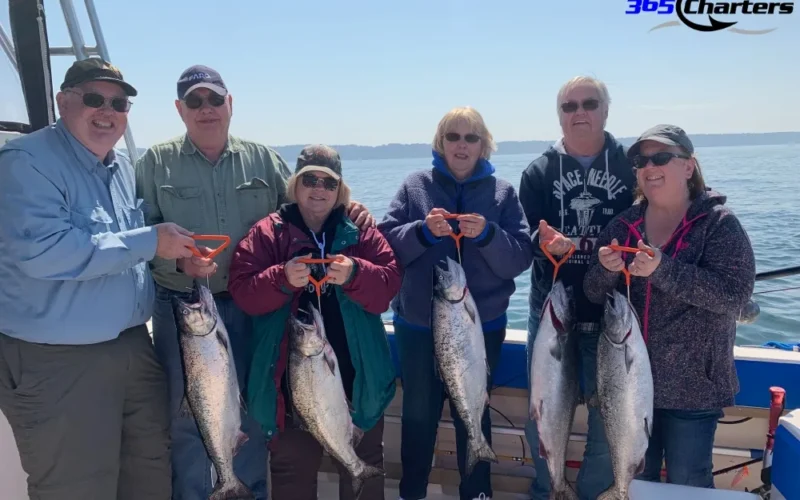
Andy was born and raised in Seattle and has spent most of his life exploring Washington's waters. He's happiest mooching for salmon in the salt or throwing flies for trout on the rivers.
Trolling is fishing from a boat that keeps moving. A downrigger, a diver or a sinker takes a lure or bait to the depth where salmon are holding, and the boat's speed gives it action. Because you cover a lot of water, trolling finds salmon when they're spread out, and it's the most common way to fish for salmon in Washington's salt water. Anyone can watch a rod. Catching fish consistently comes down to depth, speed and leader length, and knowing when to change them.
What It Is and When It Beats Other Methods
There are three ways to get trolled gear down:
Downriggers. A heavy lead ball on a wire cable sets the depth. Your fishing line is clipped to the ball with a release clip that lets go when a fish bites, so you fight the fish on a light rod with no weight. This is the standard on Puget Sound and the coast.
Divers. A plastic diving plane on the main line pulls the gear down and "trips" when a fish hits, so it stops diving and stops pulling. Divers are simpler and cheaper and still common at Buoy 10.
Sinkers. A 1 to 8 ounce banana sinker on the line, also called flat-lining or motor mooching. It's the simplest way to troll and works well for coho near the surface.
Most trollers add a flasher or dodger, a flashy plastic or metal blade that attracts fish from a distance and gives action to the lure behind it.
Trolling beats mooching and jigging when fish are scattered, when the tide is too weak or too strong for a good drift, and when you want to fish several depths at once. It's weaker when fish are stacked in a small spot, where a drifting boat can sit on them, and for anyone who wants to feel a light-tackle bite from the start.
Target Species and Where in Washington
Chinook, including winter blackmouth, coho and pink salmon are the main targets. Trollers also catch chum and sockeye where those fisheries open. See Salmon.
Where Washington anglers troll:
Puget Sound and the San Juans: points, bars and tide rips from the San Juans and Admiralty Inlet to the South Sound. See Puget Sound Salmon.
The Strait of Juan de Fuca: Port Angeles to Sekiu and Neah Bay, often in deep water with strong currents.
The coast: Westport and Ilwaco, where boats run offshore for coho and Chinook. See Westport Salmon Charters.
Buoy 10: the mouth of the Columbia in late summer, a big diver-and-bait fishery. See Buoy 10 Salmon.
Trolling is a boat method. Most charters fish two or more downriggers.
Seasons and Conditions
Best Times, Not Regulations. Summer and early fall are the peak for migrating Chinook, coho and pinks in Puget Sound, the Strait and the coast. Pinks return in odd-numbered years, mainly August and September. Buoy 10 peaks around August into early September. Blackmouth are trolled from late fall into spring.
Tide and current. Moderate tides are easiest. Big tides push the downrigger balls back (blowback), drag weeds into the gear and make speed hard to control. Bait and salmon often gather on the edges of points and bars during the tide change.
Light and depth. Chinook often come shallow and close to shore at dawn and dusk, then go deeper as the sun climbs. Coho stay higher in the water, often in the top 50 feet, unless bright sun pushes them down.
Wind and swell. Wind against tide in narrow passages and the Strait builds steep chop quickly. On the coast, the bar crossing can decide the day.
Where to check. NOAA tide and current predictions, the marine weather forecast and, on the coast, bar conditions from the Coast Guard.
Rods, Reels, Line and Leader
Gear
Typical setup
Range
Why
Downrigger rod
9'–10' medium, limber
8'–10'6", rated about 12–30 lb
A soft rod bends deep in the holder, keeps tension on the clip and absorbs the fight.
Diver rod
8'6"–9' heavy
Rated about 30–50 lb
Divers put a lot of strain on a rod.
Reel
Level-wind with a line counter
Level-wind; a heavy spinning reel will do in a pinch
A line counter repeats exact setbacks and diver depths.
Main line
25–30 lb mono
20–30 lb on downriggers; 30–40 lb (or braid) with divers
Mono stretches enough to protect light hook holds.
Downrigger ball
12 lb
10–20 lb; heavier in strong current and deeper water
More weight means less blowback.
Flasher
11" plastic flasher
8" to 11"; or a dodger
Attracts fish and gives action to hoochies.
Leader
40 lb fluorocarbon or mono
25–60 lb; heavier behind flashers
A stiff, heavy leader passes the flasher's action to the lure.
Lures and bait
Hoochie, spoon or cut-plug herring
Also bucktails, plugs and whole herring in a bait holder
Set up the downrigger. Clip a 10 to 20 pound ball to the cable. Attach a release clip to the ball or to a short lead above it. Zero the depth counter with the ball at the surface.
Tie the main line to the flasher. Tie a quality ball-bearing swivel to the main line and clip it to the front of the flasher. Most flashers have rings at both ends.
Tie the leader to the back of the flasher. Use 40 to 60 pound leader behind a flasher with a hoochie or bucktail, and 25 to 40 pound for bait or spoons. Leader length decides how much the lure moves (see the table below).
Rig the lure or bait:
Hoochie: thread it onto the leader over two tied hooks, and add a bead or two so the hooks sit in the skirt.
Spoon: tie it with a loop knot or clip it to a swivel so it can wobble.
Cut-plug herring: rig it on two hooks as for mooching, or use a whole herring in a plastic bait holder.
Let out the setback. With the boat moving at trolling speed, check that the lure is working beside the boat. Then let the flasher out behind the ball: about 8 to 20 feet for an 11-inch flasher and 10 to 20 feet for an 8-inch one.
Clip the line and lower the ball. Put the line in the release clip and lower the ball to the target depth while letting line off the reel.
Load the rod. Put the rod in the holder and reel down until it bends deeply. The bent rod shows a bite; when the clip releases, the rod springs up.
Starting Leader Lengths, Flasher to Lure
These are starting points from WDFW guidance. Many guides adjust them.
Species
11" flasher + hoochie
11" flasher + spoon or bait
8" flasher + hoochie
8" flasher + spoon or bait
Chinook
36–50 in
42–72 in
26–36 in
26–48 in
Blackmouth
20–34 in
20–56 in
20–24 in
20–36 in
Coho
26–40 in
24–42 in
22–30 in
22–48 in
Pink
about 27 in
about 42 in
18–24 in
18–36 in
A shorter leader gives a hoochie a sharper, more erratic dart. Spoons and bait have their own action and fish better on longer leaders.
Find bait and fish. Use the sonar to find bait and salmon marks along a point, bar or rip. Note their depth.
Set the gear at the fish. Put the deepest ball a few feet above the marks. On Chinook and blackmouth near the bottom, keep the ball just off the bottom. Set a second downrigger at a different depth, at least 5 feet apart, to search and to avoid tangles on turns.
Get the speed right for the lure. Speed is measured through the water, not over the ground. As a rough guide, about 2 to 2.5 mph for Chinook with flashers, slower (under 2 mph) for Chinook on bait near the bottom, about 2.5 to 3.5 mph for coho, and around 1.5 to 2 mph for pinks. These numbers vary by guide and gear. The real test is the action: a flasher should rotate smoothly all the way around, a herring should spin tightly and a spoon should wobble without spinning.
Adjust for the tide. Trolling with the current, your GPS reads faster than the gear is moving through the water. Against the current, it reads slower. Watch the angle of the downrigger cable. Pick the angle that works and hold that angle in both directions by changing the throttle.
Don't mix gear. Run all bait or all hardware. Herring wants a slower speed than a spoon or a hoochie and flasher, so mixing means one set is always wrong. Use flashers or dodgers, not both, for the same reason.
Troll a pattern. Follow a depth contour along the edge of a bar or point, and use gentle S-turns. On the outside of a turn, the gear speeds up and rises. On the inside, it slows and sinks. Note where bites happen.
Clear the gear. Many guides check lines every 15 to 30 minutes for weeds, jellyfish and twisted leaders. A flasher fouled with weed won't turn.
Repeat what works. When you get a bite, put the gear back at the same depth, setback and speed, and troll the same line again.
Reading Tide and Structure
Points and bars: Salmon hold on the up-current side, where bait is pushed against the structure.
Tide rips: Seams of foam and debris gather plankton, bait and coho.
Birds: Diving birds over bait balls often have salmon below.
Kelp edges: Chinook cruise them at first and last light.
Depth contours: Follow the contour where the sonar shows bait.
Other boats: A group of boats circling one area is a clue, but keep your distance and follow their direction.
The Bite, Hook Set, Fight and Landing
On a downrigger, the bite usually shows as the bent rod springing upright when the clip releases. Sometimes the rod bounces or the tip pumps while the line stays in the clip. That's often a small fish or a fish that's still holding the lure.
Grab the rod and reel fast. When the line pops, take the rod from the holder and reel quickly until you feel the fish. A release clip and a moving boat usually set the hook. Avoid a big, sweeping set, which can pull out a lightly hooked fish.
A bouncing rod. If the rod is bouncing in the clip, pull the line free and reel up tight.
Divers. The rod tip jumps and then the rod relaxes as the diver trips. Reel steadily.
The fight. Keep the rod up and the line tight. Let the drag work on runs. The skipper usually slows the boat, turns away from the fish and raises the other downrigger balls so the fish doesn't tangle in the cables.
Landing. With a flasher, reel until the flasher is near the rod tip. Then lift and step back so the net handler can get the fish in front of the flasher. Net head first. With a long leader, a second person may need to hand-line the leader.
Handling and Release
Many salmon fisheries in Washington are mark-selective, meaning only hatchery fish (with a clipped adipose fin) may be kept. Others limit the species.
Leave a fish you'll release in the water and use a knotless rubber net.
Use pliers or a dehooker. Barbless hooks come out quickly. Cut the leader if the hook is deep.
Don't lift the fish by the gills or the jaw or squeeze its belly.
Hold it upright in the water until it swims off.
Check the WDFW pamphlet for marine-area handling rules, including whether released fish may be brought aboard.
Common Mistakes and Fixes
Mistake
What you'll notice
Fix
Wrong speed for the gear
The flasher wobbles or spins too fast; the herring is limp or tears off
Check the action beside the boat and adjust the throttle.
Trusting only GPS speed
You get bites only in one direction
Watch the cable angle. Hold the same angle with and against the tide.
Mixed gear
One rod catches, the others don't
Run all bait or all hardware.
Fouled gear
Long stretches with no bites
Check the lines regularly; many guides do it every 15 to 30 minutes.
Gear too close together
Tangles after turns
Keep balls at least 5 feet apart in depth, and turn gently.
Balls on rocky bottom
Snagged or lost ball
Watch the sonar and keep the ball above the bottom in rocky areas.
Setting the hook hard
Fish come off early
Reel down fast instead of jerking.
Pro Tips From Guides
Start with a hoochie or spoon. They're easier than bait to keep fishing well, and you can troll faster to cover water.
Fish near the bottom for blackmouth. Winter Chinook usually sit within about 10 feet of the bottom, so the ball needs to be just above it.
Slow down near the rivers. Salmon close to their home river tend to feed less and may not chase fast gear.
Add scent to hoochies and spoons. Many guides add a herring strip or scent to a hoochie, especially at slow speeds.
Use a stacker. A second clip on the same downrigger cable lets you fish two lines at different depths.
Keep the release clips clean. A clip with scent or gunk in it may release too easily or not at all.
Rinse everything. Salt water eats reels and downriggers. Rinse with freshwater after every trip.
When It's Slow
Depth. Move the gear 10 to 20 feet up or down, or put it where the sonar shows bait.
Speed. Speed up or slow down in small steps.
Leader length. Shorten it for more action, or lengthen it for a softer swim.
Lure. Change color or size, or switch between bait and hardware.
Water. Move to the next point, rip or contour.
Method. Drift and mooch if fish are concentrated, or jig a spot that holds fish.
Safety
Wear a life jacket on the water. Cold water is the main risk on Puget Sound and the coast.
Keep hands and clothes clear of downrigger cables, which are under strain and can cut. Don't grab a moving cable.
Watch for traffic, ferries, shipping lanes and other boats. Keep a lookout during long trolls.
Coast trips cross a bar. Check bar conditions and follow the skipper's instructions.
Watch the weather. Fog, wind and tide changes can turn calm water rough quickly.
Keep clear of hooks when landing fish with flashers.
WDFW Rules to Check
Saltwater salmon rules in Washington vary by Marine Area and can change mid-season. Before every trip, check the current WDFW sport fishing rules and emergency rules for the area you'll fish. For trolling, check these in particular:
Whether the Marine Area is open for salmon, and which species may be kept
Mark-selective (hatchery-only) rules and minimum sizes
Hook rules, including barbless and the number of hooks per lure
Rules on how many lines may be fished per angler or per boat, and whether a second rod is allowed
Handling rules for released fish, catch-record cards and closed areas
A Guided Day and What to Ask
A trolling charter usually starts at first light. The guide sets the downriggers, picks depths and speed and decides where to fish. Your job is to watch the rods, grab the rod when the clip releases and reel in the fish. Some boats give each angler a rod. Others rotate who takes the next fish. Trolling is easy for beginners and families. On the coast, plan on an early start, a bar crossing and a longer run.
Questions worth asking before you book:
Do you troll, mooch or both, and what will we likely do?
How many people are on the boat, and how are rods shared?
What's included: gear, bait and fish cleaning?
What's your weather and bar-crossing policy?
What can we keep in the area right now?
How long is the run to the fishing grounds?
What should I bring for cold, wet weather?
Can I help set the downriggers if I want to learn?
Ask your guide for their WDFW guide license number before you book.
Glossary
Downrigger
A reel and boom with wire cable that lowers a heavy ball to a set depth.
Release clip
A clip that holds the fishing line to the downrigger and lets go when a fish bites.
Setback
The distance between the downrigger ball and the flasher or lure.
Blowback
The angle at which the cable trails back from the boat as speed and current increase.
Flasher
A plastic blade that rotates fully to attract fish and give action to a lure.
Dodger
A metal blade that sways side to side instead of rotating.
Hoochie
A soft plastic squid lure, usually fished behind a flasher.
Diver
A plane that pulls gear down and trips when a fish strikes.
Stacker
A second release clip on the same cable for an extra line at another depth.
Speed through the water
The speed of the gear relative to the water, not the ground.