

Spoons and Spinners
How to fish spoons, spinners and casting jigs for salmon, steelhead and trout: sizing by flow and clarity, casting angle and swinging near the bottom.
How to fish spoons, spinners and casting jigs for salmon, steelhead and trout: sizing by flow and clarity, casting angle and swinging near the bottom.
Spoons and spinners let you fish rivers, lakes and saltwater beaches and piers with a small selection of metal lures. A spinner makes flash and vibration with a turning blade. A spoon flashes as it wobbles through the water. A casting jig is a heavy metal lure that you lift and let flutter down. Beach anglers use these for coho and pink salmon.
The tackle is simple. The skill comes from keeping the lure working at the right depth. In rivers, aim for near the bottom, an occasional tick, never dragging. From a beach or lake shore, search different depths instead of assuming every fish is far out or deep down.
What It Is and When It Beats Other Methods
"Hardware" means metal lures such as weighted spinners and spoons. You cast them, let them sink and retrieve them through the water. Current, retrieve speed and rod position all affect how deep they run.
A spinner has a blade, the moving metal part, that turns around a wire shaft. A spoon is a curved metal lure that wobbles from side to side. Neither needs a hard, fast retrieve to look alive. You need enough movement to keep its action working.
Why It Works
Hardware moves, flashes and vibrates. All spinners make underwater vibration, while spoon shape controls the wobble. You can cover water, change depth and test another finish without rebuilding a complicated rig.
Watch the rod tip and learn the lure's feel. A vibrating tip tells you the lure is working. Test unfamiliar tackle in clear, quiet water before relying on that signal farther out.
This method suits a search. You can cast along a lake shore, swing through a river run or work a public beach. It also gives you a clear action check: a spoon should wobble without turning over, and a spinner blade should keep turning.
Compare it with Drift Fishing or Float Fishing when you want another way to fish holding water. Hardware needs room to swim. Snags, tangled wood and constant bottom contact make that harder.
Don't assume a lure fits the rules for your water. Check WDFW's regulations for hook, bait, scent and selective gear rules before you rig. Selective gear is WDFW's term for gear limits on some waters; read its definition in the rules.
Spoons and Spinners: Which One When
Choose by depth and current first. Then consider the action you want.
- Long, narrow spoon: A tighter wobble tolerates more speed or current. The shape also has less resistance and tends to fish deeper.
- Wide spoon: A wider wobble works at slower speeds. More water resistance tends to hold it shallower.
- Long, narrow spinner blade: It turns closer to the shaft, creates less drag and runs faster and deeper.
- Short, wide spinner blade: It turns farther from the shaft. It makes more flash and vibration while keeping action at slower speeds.
Weight and shape do different jobs. Weight helps a lure sink; shape controls its resistance and action. A heavy, wide spoon can still reach deep water.
For example, the Blue Fox Pixee Spoon comes in 1/4, 1/2 and 7/8 oz. The maker says it's heavy enough for long casts and deep retrieves in fast water. Weight gets it down; its wide shape sets the wobble.
For river coho, 1/4, 3/8 and 1/2 oz spinners are the most popular. Pick by depth and by what the fish want. A blade number isn't a depth rating.
Spoon vs Spinner Action

- 1. Spoon wobbles side to side
- 2. Too fast: it spins and rises
- 3. Spinner blade turns around the shaft
- 4. Too slow: the blade stops
- 5. Narrow: faster, deeper
- 6. Wide: slower, more wobble
Brushing Up: Test action before testing color. A new finish can't fix a spoon that spins or a blade that has stopped.
Target Species and Where in Washington
Coho and pink salmon are the main targets. WDFW says spoons work very well for both. Trout take spinners and spoons. Washington steelhead anglers swing spoons for winter fish too.
See Coho, Pinks, Steelhead, Trout and Cutthroat for species background.
Where It Works in Washington
- Rivers: On the Snohomish, start at WDFW's Oscar Hoover access site at Thomas' Eddy. For the Skykomish and Bogachiel, this page gives gauges and WDFW's access list.
- Saltwater beaches and piers: WDFW describes coho within casting range of many public shores. Pinks also travel within beach-casting range in large schools.
- Lakes: Spinners and spoons can be cast from shore or a drifting boat. WDFW recommends light or ultralight spinning tackle for high lakes.
For broader Puget Sound river planning, see Skagit and Snohomish Salmon and Steelhead and Puget Sound Salmon.
Keep the methods separate. Thin-bladed spoons fished behind an anchored boat belong on the Plunking page. For spinners pulled behind a moving boat, see Trolling. For fishing a lure straight down, see Jigging.
River by River
Start with access, then look at the water. A named place is a starting point. It doesn't tell you today's access, footing or whether fishing is open.
A gauge helps you see the trend. Discharge means water flow. Gage height means water level. A hydrograph is a chart of river measurements over time.
Snohomish
WDFW's Oscar Hoover water access site is at Thomas' Eddy, reached from the town of Snohomish. Its WDFW page lists a parking lot and no boat ramp. Check the site's WDFW page before you go.
In Washington, pink salmon return in odd years. That's a timing clue, not a fishing date.
Read USGS 12150800, Snohomish River near Monroe. Look at the recent rise, peak and drop before you leave. Then compare the chart with the river you find.
A rising line means the river is changing. Check footing, color and current at the bank. At the peak, don't assume the river has settled. As it drops, look again at color and the current your lure must cross. This page gives no flow number for hardware on the Snohomish.
Note the reading, the water color and how the lure fished. Over time, you'll learn what the gauge means at the places you fish.
Snohomish Bank Access
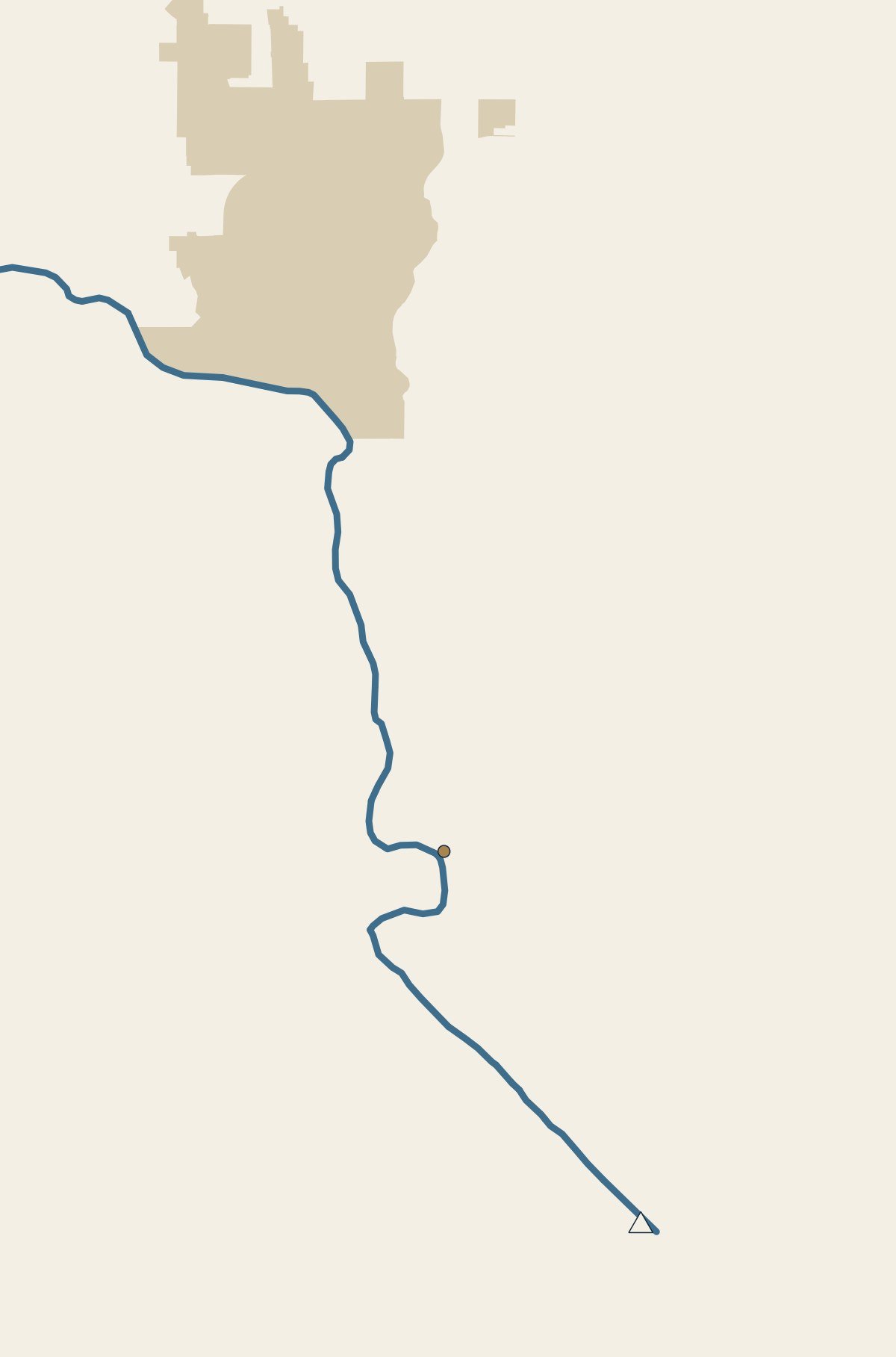
- 1. WDFW Oscar Hoover access site at Thomas' Eddy (parking lot; no boat ramp)
- 2. USGS gauge 12150800, Snohomish River near Monroe
- 3. Town of Snohomish
Rivers and gauges: USGS · Access sites: Washington Department of Fish and Wildlife (WDFW)
Simplified drawing. River data from USGS; access sites from WDFW. Not the legal boundary; WDFW rules govern. Not endorsed by WDFW.
Rules change by river and in season. Check the current WDFW sport fishing regulations and emergency rules before every trip.
Olympic Peninsula and Skykomish
For winter steelhead planning on the Bogachiel, read USGS 12042800, Bogachiel River near Forks. For the Skykomish, use USGS 12134500 near Gold Bar.
Find bank access on WDFW's water access sites list. This page doesn't name a bank spot on either river. Read each gauge as a trend. Then check footing, color and current at the river. This page gives no flow number for either river.
Rules change by river and in season. Check the current WDFW sport fishing regulations and emergency rules before every trip.
Beach by Beach
Points, nearby drop-offs, baitfish and jumping fish help narrow your search. Coho also use current rips. A tide rip is a visible boundary between moving water that can concentrate plankton and baitfish. Pinks are not necessarily tied to those rips.
Use tide timing as a starting point. WDFW describes fishing around the tide change, especially the incoming tide. For Alki, it gives a window on either side of the change. Its coho article points to the two hours before high tide.
Washington Marine Areas Explained
WDFW divides Washington's salt water into numbered Marine Areas. Match the area you plan to fish with its current rules. The table lists the areas this page uses.
| Marine Area | Where It Is |
|---|---|
| 8-1 | Deception Pass/Skagit Bay. |
| 9 | Admiralty Inlet. |
| 10 | Seattle/Bremerton. |
| 11 | Tacoma/Vashon. |
| 13 | South Puget Sound. |
Find your area on WDFW's Marine Areas page and map. Check its current rules before each trip.
Puget Sound Beach Spots by Marine Area
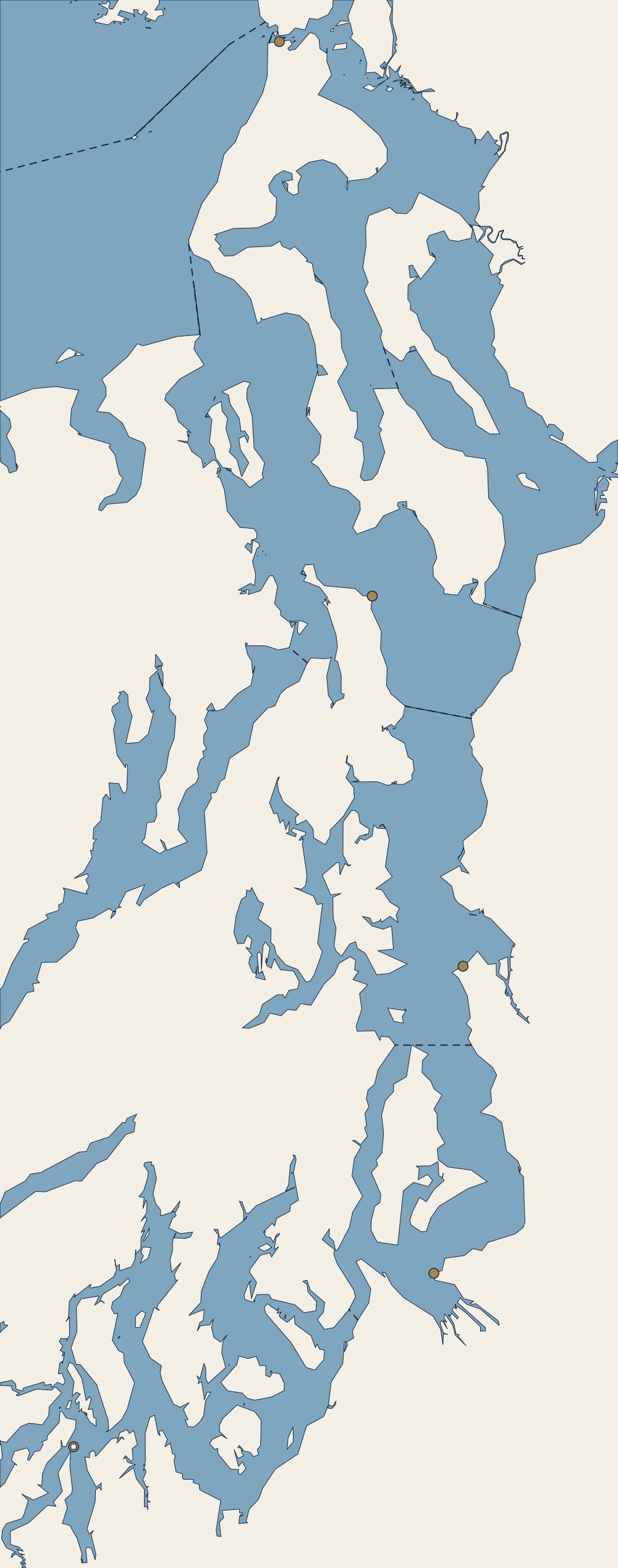
- 1. North Beach at Deception Pass, Marine Area 8-1 (Deception Pass/Skagit Bay)
- 2. Point No Point, Marine Area 9 (Admiralty Inlet)
- 3. Alki Point, Marine Area 10 (Seattle/Bremerton)
- 4. Browns Point, Marine Area 11 (Tacoma/Vashon)
- 5. Fish Trap, Marine Area 13 (South Puget Sound): boat access only
- Hollow ring: boat access only
Marine Area boundaries: Washington Department of Fish and Wildlife (WDFW).
Simplified from WDFW data. Not the legal boundary; WAC 220-311-010 and WDFW rules govern. Not endorsed by WDFW.
North Beach at Deception Pass
In Marine Area 8-1 (Deception Pass/Skagit Bay), WDFW names North Beach at Deception Pass State Park. Its shore guidance points east of West Point along North Beach.
WDFW describes migratory coho and pink activity during August and September. Odd-year pinks can travel close to shore. Spinners and casting jigs are among its named presentations. These are best-time clues, not an opening calendar.
Inspect the current before choosing a retrieve. Cast where you can keep the lure working, not into current that sweeps it away at once.
Check WDFW's Marine Area 8-1 rules page.
Rules change by Marine Area and in season. Check the current WDFW sport fishing regulations and emergency rules before every trip.
Point No Point
In Marine Area 9 (Admiralty Inlet), Point No Point at Hansville has a wide sandy beach and public access. WDFW describes a steep drop-off within an easy cast.
That drop-off is the draw. You can fish its edge without a long cast. Watch for baitfish and surface signs, then adjust the lure's sinking time.
Check WDFW's Marine Area 9 rules page.
Rules change by Marine Area and in season. Check the current WDFW sport fishing regulations and emergency rules before every trip.
Alki Point
In Marine Area 10 (Seattle/Bremerton), WDFW describes access through Alki Beach Park. Its directions are to use street parking and walk northwest along the beach.
Coho and pinks are the migratory targets. WDFW's Alki guidance points to the hours around the tide change. Its coho article favors the incoming tide. The area page also names spinners for sea-run cutthroat.
Watch the water as the tide turns. Check where your lure travels and how fast it sinks as the current shifts.
Check WDFW's Marine Area 10 rules page.
Rules change by Marine Area and in season. Check the current WDFW sport fishing regulations and emergency rules before every trip.
Browns Point
In Marine Area 11 (Tacoma/Vashon), WDFW names shore fishing at Browns Point for migratory coho and pinks. Casting jigs are among the listed methods.
Its area guidance also describes sea-run cutthroat and resident coho in fall and winter on small spinning tackle or fly gear. Those call for lighter tackle than a casting-jig outfit.
Watch where bait and fish show before you pick a distance or depth. Fish the water in front of you, not a fixed retrieve.
Check WDFW's Marine Area 11 rules page.
Rules change by Marine Area and in season. Check the current WDFW sport fishing regulations and emergency rules before every trip.
Fish Trap
In Marine Area 13 (South Puget Sound), Fish Trap is reached by boat. WDFW lists it as "Accessible by Boat." It is not a walk-in beach recommendation.
WDFW names spinners among the presentations for returning net-pen coho in October. That's when the fish return, not a season date. You need a boat to reach it.
Check WDFW's Marine Area 13 rules page.
Rules change by Marine Area and in season. Check the current WDFW sport fishing regulations and emergency rules before every trip.
Other WDFW-Named Beaches and Piers
WDFW also names Point Wilson at Fort Worden State Park, Fort Flagler/Marrowstone Point, Fort Casey, Lagoon and Bush Points, Mukilteo, Richmond Beach, Meadow Point at Golden Gardens, Carkeek Park, Lincoln Park, Dash Point State Park and Point Robinson. Its pier list includes Des Moines, Point Defiance Boathouse and Redondo. This page doesn't give their Marine Areas. Find each one on WDFW's Marine Areas map and rules pages.
Rules change by Marine Area and in season. Check the current WDFW sport fishing regulations and emergency rules before every trip.
Seasons and Conditions
Best Times, Not Regulations. In Washington, pink salmon return in odd years. Washington anglers swing spoons for winter steelhead, but this page gives no month range for them.
Lake depth changes with conditions. Fish may be near the surface in cool water, early in the day, under cloud or in the evening. Bright midday sun and summer heat can move them deeper.
Use USGS Water Data for Washington for observations and NOAA's Northwest River Forecast Center for river forecasts. Check the trend before traveling, then inspect the actual water.
Reading the Water: Light, Clarity and Temperature
Light affects both fish position and lure appearance. WDFW notes that bright sun can push saltwater coho deeper. A maker's trolling report also describes baitfish and salmon nearer the surface when bright sun is absent. Use light as a depth clue, not a schedule.
Advice on finish differs:
- A maker's technique report favors brass or copper in low light, dark weather, murky water or deep water. It suggests nickel in bright conditions or clear water.
- A steelhead spoon column favors silver plate through moderate visibility, then copper or plain brass in very clear water.
- A coho column suggests black, part-black, brass or copper in clear water. It adds paint in colored water and returns to metal flash with fluorescent accents in high, colored water.
Carry a few contrasting finishes and test them. Include toned-down finishes for clear water. No finish wins every time.
Finish by Light and Clarity
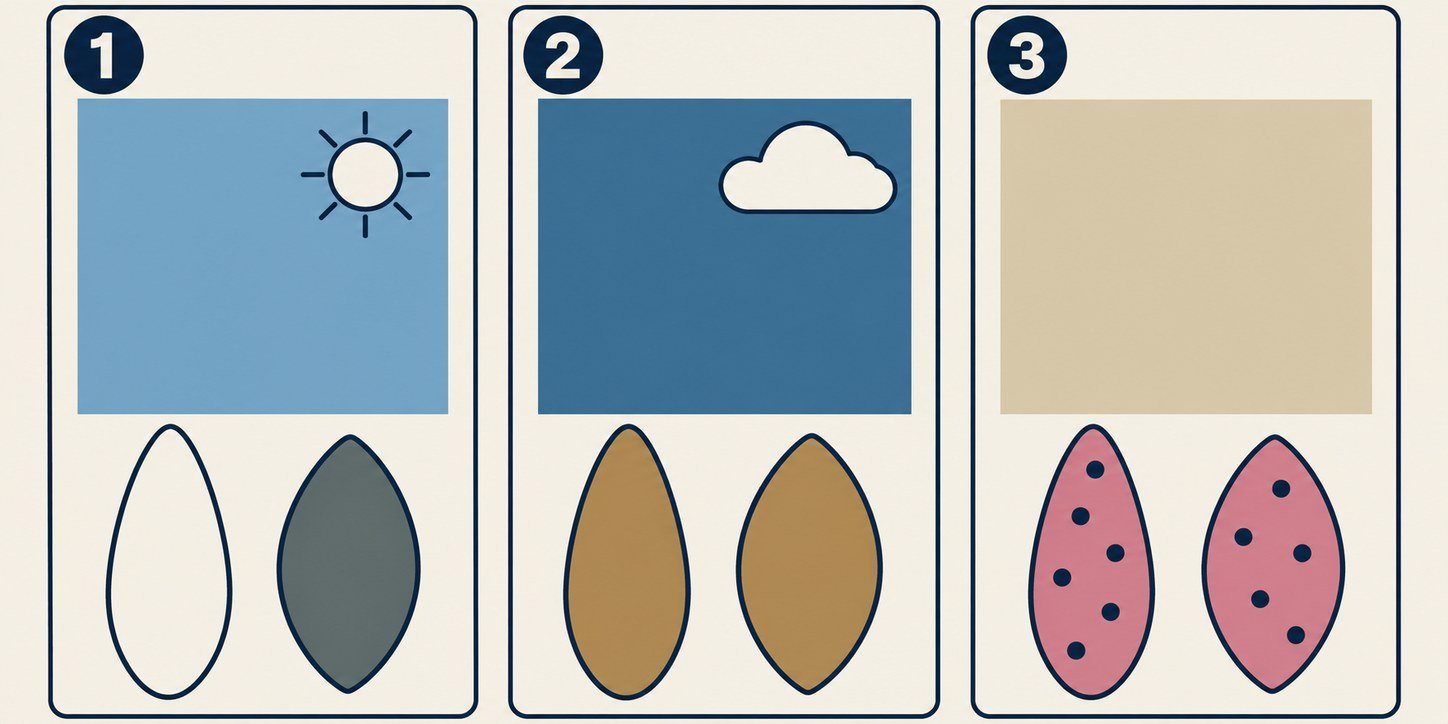
- 1. Bright day or clear water: nickel or toned-down finishes
- 2. Dark day or low light: brass or copper
- 3. Colored water: painted and fluorescent
Advice differs: test.
Very cold water can make fish less active. A steelhead column says a spoon's flash can still wake them up, so cold water doesn't rule out hardware. Slow down, but keep the lure working.
In rivers, fish are usually near the bottom unless feeding activity draws them higher. Keep the lure deep, but don't drag it. Unlike drift gear, hardware shouldn't bounce along the bottom. In lakes, use changing light and temperature as reasons to search another depth.
Rods, Reels, Line and Leader
A spinning reel holds line on a fixed spool and releases it under a wire arm called the bail. A level-wind reel has a guide that moves across the spool to lay line evenly. Spinning reels make light spinners easier to cast.
Monofilament, or mono, is single-strand line. Braid is line woven from fibers. Match your line and lure weight to the rod's ratings.
| Gear | Starting Point | Why It Helps |
|---|---|---|
| River Coho Rod | 8 1/2–9 ft, medium to medium-heavy. | Casts and controls the lure. |
| River Reel | Medium spinning reel holding about 140 yards of 10–14 lb mono. | Makes light spinners easier to cast. |
| River Main Line | 10–14 lb mono for the coho spinner setup. | A simple first setup. |
| Spoon Setup Alternative | Fast-action spinning rod, 8 ft 6 in–9 ft 6 in, rated 8–17 lb; 2500 or 3000 reel. | Another column's setup. |
| Beach Rod | 8 1/2–10 1/2 ft medium-weight, soft-action salmon rod. | WDFW's beach-casting example. |
| Beach Reel | Spinning reel or suitable level-wind. | WDFW notes the casting-distance advantage of spinning reels. |
| Trout Line | 4–6 lb for trout and fish to about 5 lb. | Light lures cast better and sink deeper on thin line. |
| River Spinner | 1/4, 3/8 or 1/2 oz for coho. | Choose by depth and response. |
| Steelhead Spoon | 1/4 oz for shallow or slow water; 2/5 oz as a middle choice; 2/3 oz for distance and depth. | Covers different current and depth needs. |
| Beach Casting Jig | Carry 2–4 oz choices. | Select by casting distance and shore slope. |
| Separate Leader | Not needed for the direct river setup | If used, choose the same test as your main line or lighter. |
| Beach Jig Leader | 4–5 ft of 20–50 lb mono, with a main line at least as heavy as the leader. | Applies only to the WDFW casting-jig arrangement below. |
Line setups differ. One column ties 30 lb braid straight to the spoon. Another adds about 7 ft of mono as a top shot, a length of mono added to braided main line for stretch. Pick one setup; don't mix their parts.
In winter, that column ties 15 lb mono to 30 lb braid with a uni knot. The top shot is lighter than the braid, so it breaks first.
A leader is the line between the swivel and the lure. Keep it the same test as the main line or lighter, so it breaks first. A nicked line or a weak knot can still break sooner.
If you add a leader, Seaguar STS Trout & Steelhead is a fluorocarbon leader line made in 4–17 lb. Pick a test no heavier than your main line. Fluorocarbon is leader material that is harder for fish to see. WDFW's 20–50 lb beach-jig leader below is heavier mono, not this line.
Starter Kit vs Upgrade Path
Starter Kit
- River: A generic 8 1/2–9 ft medium spinning rod and a medium spinning reel. For line, Izorline XXX Super Co-Polymer Hi-Vis Yellow is a hi-vis mono made in 8–20 lb; 10–14 lb fits this setup.
- River lure: A Blue Fox Classic Vibrax in a coho weight, 1/4 to 1/2 oz, with a small swivel above it. The Vibrax runs 7/64 to 5/8 oz, and sizes 3–6 come with a siwash.
- Spoon option: An Acme Little Cleo is a casting spoon to compare with the spinner. It comes with a split ring and hook attached. Sizes include 1/8 to 3/4 oz; pick by depth and current.
- Lake: Light spinning tackle with 4–6 lb line. A Mepps Aglia with a single hook in #1, #2 or #3 weighs 1/8, 1/6 or 1/4 oz.
- Beach: WDFW's 8 1/2–10 1/2 ft beach rod and a Buzz Bomb. The maker recommends its 3 in extra-heavy from shore.
Upgrade Path
- Add a Worden's Vibric Rooster Tail in 3/8 or 1/2 oz to compare spinner action. The maker says its offset body reduces line twist.
- Add a Blue Fox Pixee Spoon when you need more weight. Each comes with a matched siwash.
- If you swap hooks, Gamakatsu Siwash Open Eye singles come in sizes that include 1/0 and 2/0. Check WDFW's regulations for hook rules on your water first.
- For beaches, carry jigs from 2 to 4 oz, as WDFW suggests. The Point Wilson Dart Candlefish is another casting jig to try once the Buzz Bomb feels familiar.
Buy only what you'll fish differently. A bigger box adds little if every lure gets the same depth and retrieve.
Terminal Tackle and Rigging, Step by Step
A split ring is a small overlapping metal ring. A snap is a wire clip for changing lures. A barrel swivel is a small rotating connector that reduces line twist. A snap swivel is a swivel with a clip.
A siwash is a single-point lure hook. A treble is a hook with three points. Most spoons and spinners come with trebles, so check the hooks on each lure.
How It Works, Step by Step
- Choose the lure and connection. A spoon needs a rounded attachment, such as a split ring or round-nosed snap. Sharp or V-shaped attachments can spoil its action.
- Keep the river rig simple. Tie the main line to the lure's ring or snap. You don't need a separate leader. One column ties 30 lb braid straight to the spoon.
- Stop spinner twist. One maker ties a small swivel 12–18 in above the spinner. The line below the swivel is the same test as the main line or lighter.
- Check the hooks. A single hook can make release easier than a treble. Check WDFW's regulations for hook rules on your water.
- Test the action. Watch the spoon wobble or spinner blade turn in visible water. A clevis, the small fitting holding the blade on the shaft, must move freely.
- Pull-test every connection. Check that snaps close fully and rings, wire and hook eyes have no damage.
Spinner and Spoon Rigs
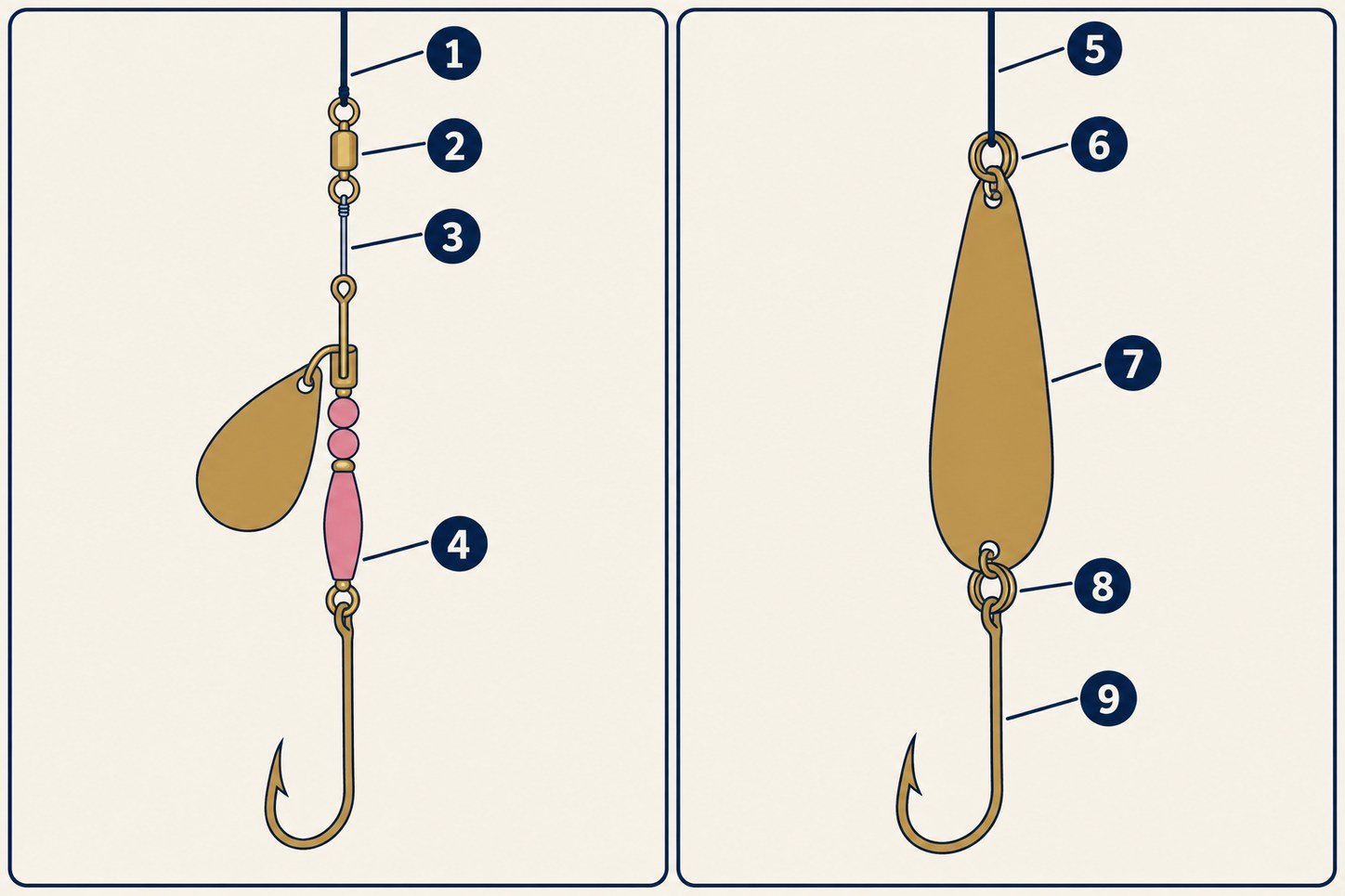
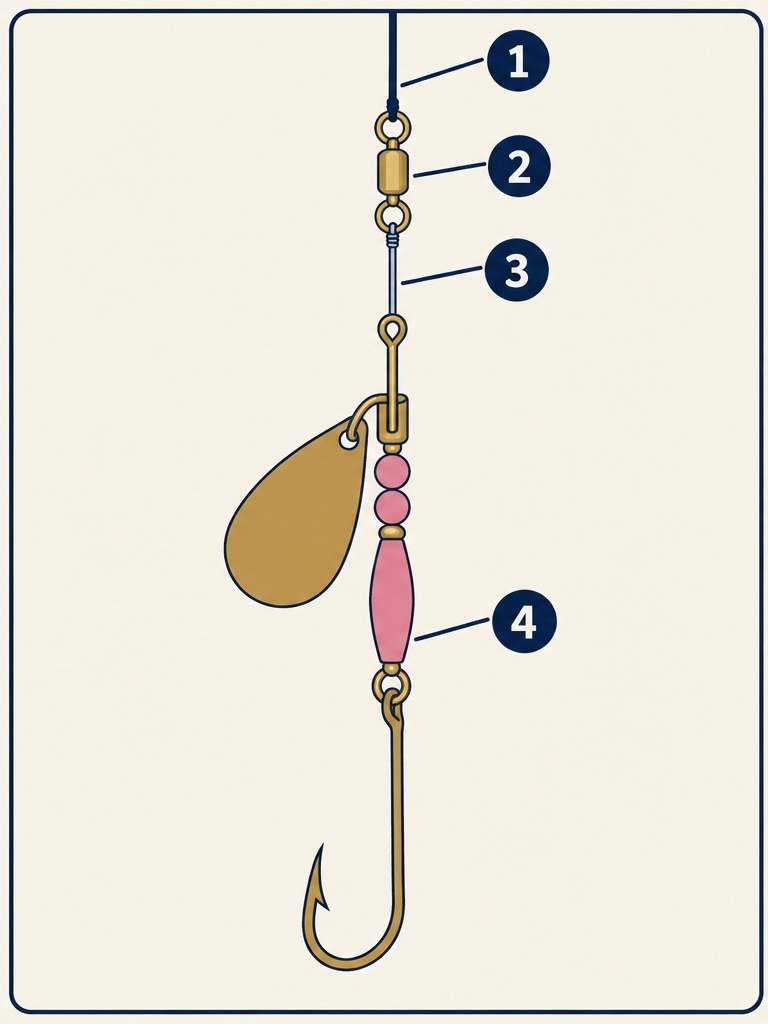
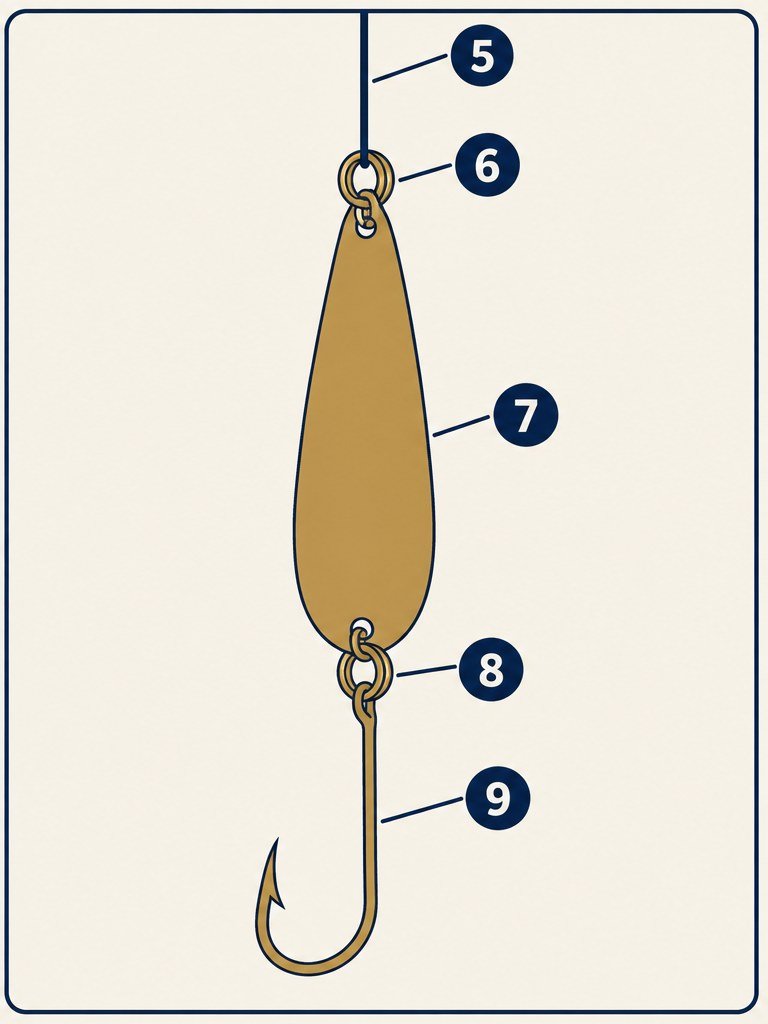
- 1. Main line
- 2. Small swivel
- 3. 12–18 in of line, the same test as the main line or lighter
- 4. Spinner with a single hook
- 5. Main line
- 6. Round split ring or round-nosed snap (no V-shaped snap, no snap swivel)
- 7. Spoon
- 8. Split ring
- 9. Open-eye single
Knots and Action Checks
For mono, use the improved clinch knot shown step by step on Drift Fishing. Pass the loose end through the eye, wrap the standing line and bring the end through the small loop. Return it through the larger loop, moisten and tighten slowly.
For braid, use the knot the braid maker recommends.
Makers differ on twist. Some favor a snap swivel on the spinner. Others favor untwisting the line or moving a swivel ahead of it. Start with the small-swivel option above and watch the result. Keep a snap swivel off the spoon's attachment point.
Line-Twist Fixes
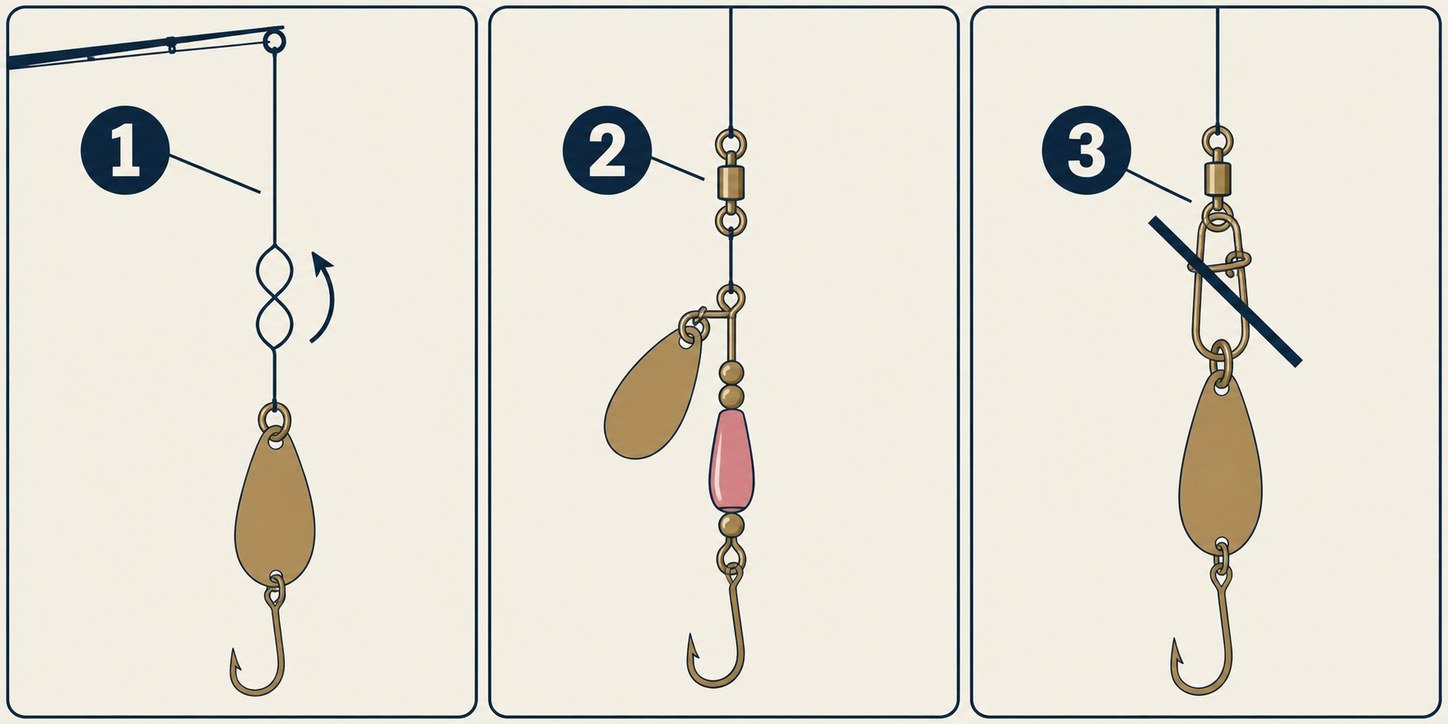
- 1. Let the line hang and untwist now and then
- 2. Small swivel ahead of the spinner
- 3. No snap swivel on a spoon
Very light spoons, such as the Dick Nite style, and unweighted spinners can't be cast alone. One column ties the main line to a three-way swivel. A 1/4 to 1/2 oz weight hangs on a 12 in dropper, and a 4 ft leader runs to the spoon. Fish it very slowly in slow water.
Casting Jigs for Beaches
WDFW's pink-salmon rig uses a jig that slides along the leader. Its directions describe adjusting the eyelets so line passes freely, then adding a bead and rubber stops.
The leader is 4–5 ft of 20–50 lb mono, with a main line at least as heavy as the leader. WDFW's arrangement uses tandem single hooks, meaning hooks tied in line, about an inch apart or less. Its pink-salmon advice gives 1/0 or 2/0 as smaller hooks. Check WDFW's regulations for hook rules before you tie it.
The Buzz Bomb maker recommends its 3 in extra-heavy version for shore casting. Start there. The Point Wilson Dart Candlefish is another casting jig. Check WDFW's regulations for hook rules before you fish any jig.
Don't throw a heavy jig on a rod rated only for light lures. Check the rod's lure rating against the whole rig.
By Species
Coho
In rivers, look at slow, deep holes and sloughs near wood. Start with spinners of 1/4–1/2 oz. Keep clear of the snagging wood itself. Use the open water beside it.
Metal finishes and fluorescent colors give you contrast to test. Starts, stops and changes in speed can tease coho, but keep control of the lure.
From beaches, watch baitfish, points and current rips. Coho may come close to shore and into shallow water when baitfish are present. A lift-and-flutter jig retrieve is another option.
Pinks
Choose smaller lures and include pink in the selection. Pink salmon return in odd years. They can travel in large schools within casting range, without being tied to a rip.
Keep the beach-jig setup separate from a light river spinner. If using WDFW's jig leader, pair it with a main line at least as heavy as the leader. Use a controlled response to a bite because pinks have softer jaws.
Steelhead
Swing a spoon slowly near the bottom. A spoon-fishing column uses 2/5 oz most days, lighter or heavier as the water needs.
Choose a spoon that keeps wobbling at the current speed. Near the bottom, an occasional tick, never dragging, is the aim. Slow doesn't mean bouncing off the rocks.
Trout and Sea-Run Cutthroat
Small spinners and spoons work in rivers, lakes and on WDFW-named beaches. Light line helps them cast and sink; thicker line holds them shallow.
For lake trout, start with a light outfit. Try another depth before you move. For beach cutthroat, use the location-specific WDFW guidance and check the rules for the exact water.
Technique, Step by Step
How It Works, Step by Step
Cast, let the lure reach depth and feel its action. Adjust speed before adding more force. The river and beach sequences use different retrieves, so learn each separately.
In a River
- Stand at or just above the best water. Begin with a cast across or slightly upstream. This gives the lure room to sink before the current carries it through the target water.
- Let it settle while recovering slack. A count-down means counting as the lure sinks so you can repeat a depth.
- Start the action. A slight pull of the rod tip starts the spinner blade. Retrieve slowly enough to keep it working.
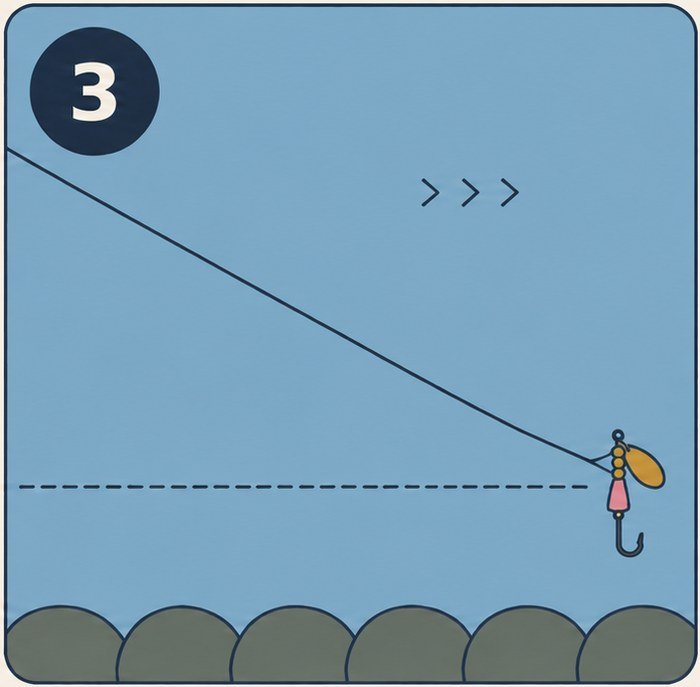
- Let it swing. The swing is the lure's path as current carries it across the river. Slow the retrieve as current takes over.
- Control depth. Lowering the rod helps keep the lure down. Too much speed lifts a spinner; slack can stop its blade.
- Read bottom contact. Near the bottom, an occasional tick, never dragging. Taps in a row mean speed up. No taps, slow down.
- Finish the cast. The hang-down is the end of the swing, with the lure directly downstream. If it remains in holding water, leave it briefly before retrieving clear of shallow rocks.
- Cover fresh water. Take a small step downstream when footing and space allow, then repeat.
Three River Casts
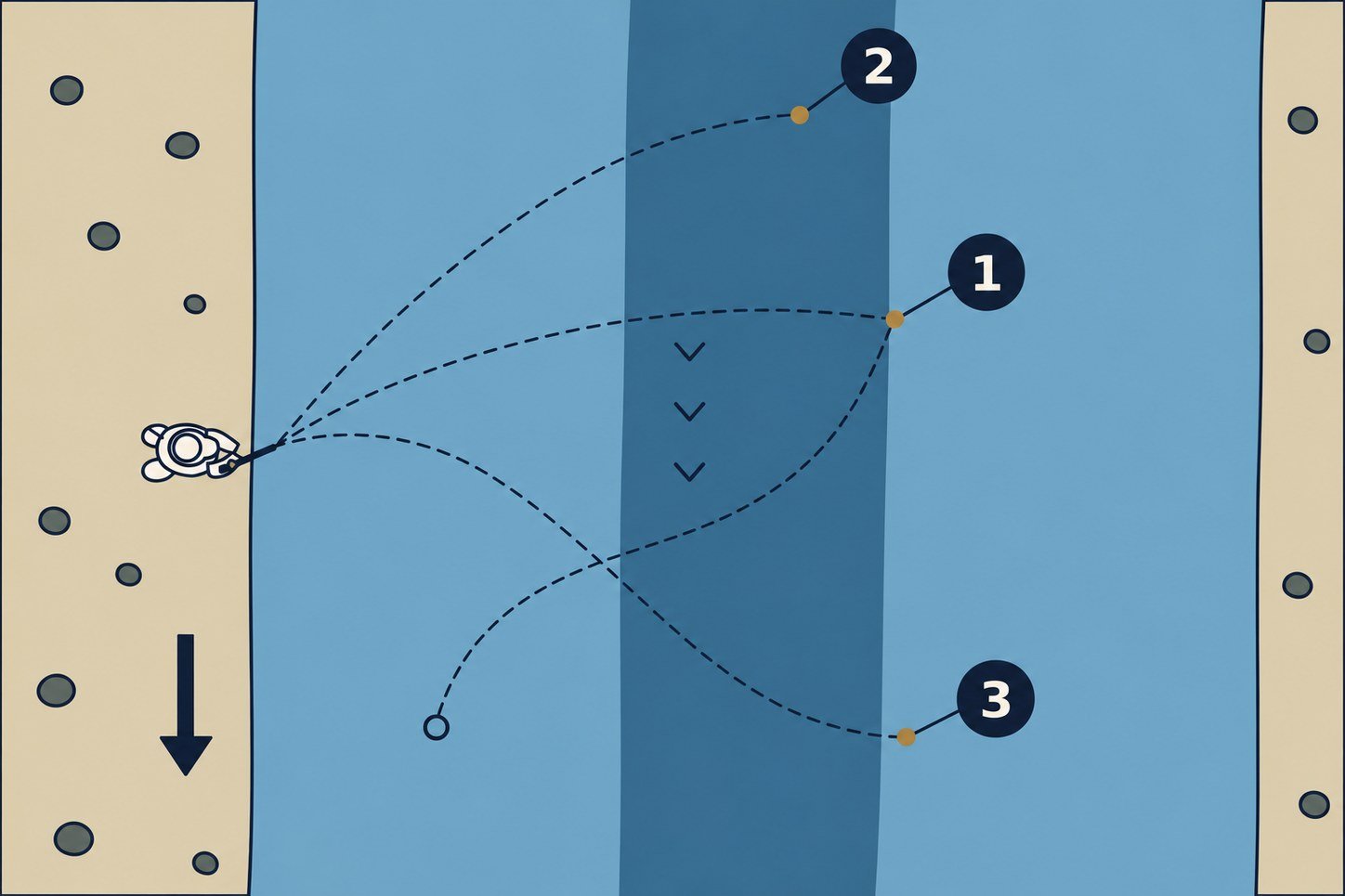
- 1. Across or slightly upstream, then swing
- 2. Upstream for deep or fast water
- 3. Across and down for the tailout
Upstreaming means casting upstream and recovering loose line as the lure sinks. It is another option for deep or fast water. Once the lure comes across from you, slow down as current takes over.
A downstream cast serves tailouts and wide holes. Stand above the water, cast across and down, then let the current work the lure with little retrieve. Learn the across-and-upstream cast first.
Learning the Count-Down
A maker's technique report says a 1/4 oz spoon or spinner sinks about 1 ft per second on a tight line. It sinks faster on slack line. It's a rough guide, not a depth reading.
Count until bottom contact, then shorten the next count by 2 seconds. Search each level, then go back to the depth that worked. Current, line and lure shape change the result, so compare casts in the same spot.
Count-Down Depth

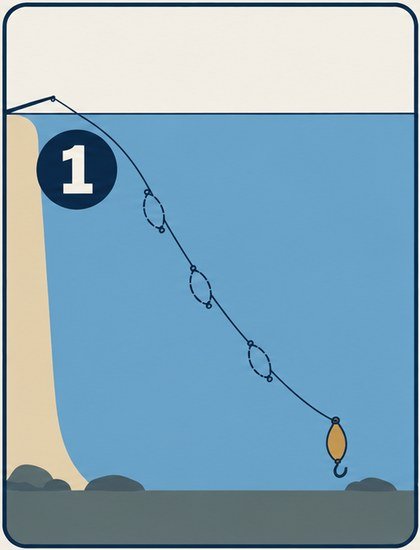 A 1/4 oz lure on a tight line sinks about 1 ft per second
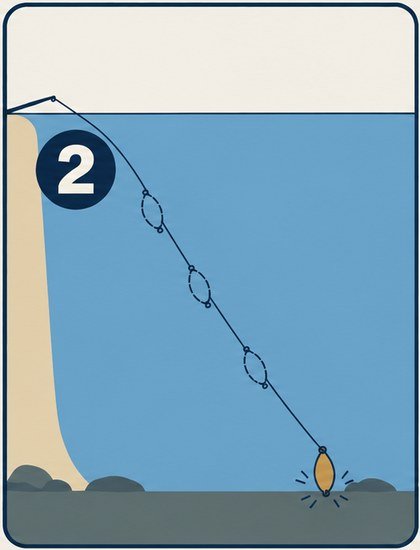 Count to the bottom
 Next cast, take 2 seconds off
 Go back to the count that worked
- 1. A 1/4 oz lure on a tight line sinks about 1 ft per second
- 2. Count to the bottom
- 3. Next cast, take 2 seconds off
- 4. Go back to the count that worked
Reading the Taps
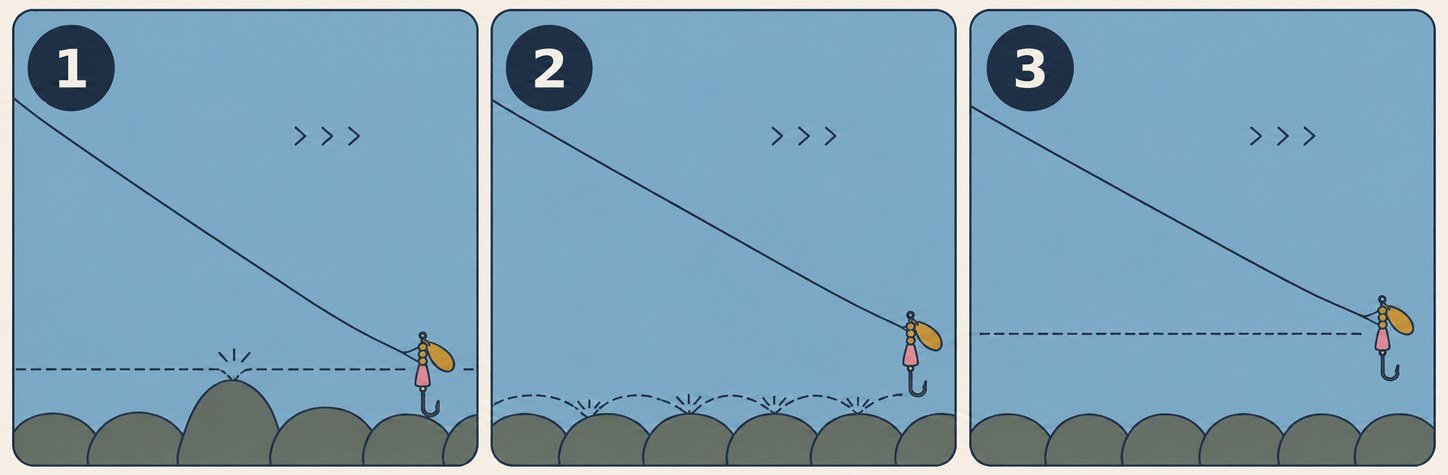
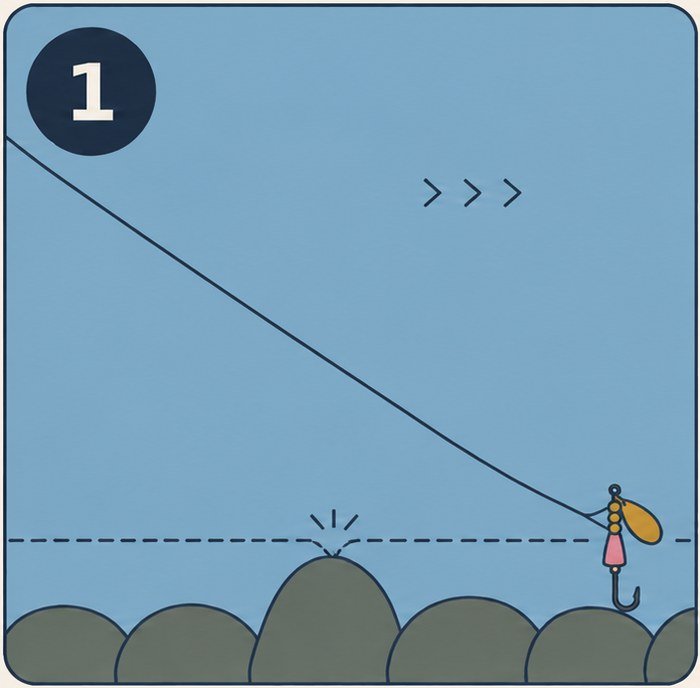 An occasional tick = right depth
 Taps in a row = speed up
 No taps = slow down
- 1. An occasional tick = right depth
- 2. Taps in a row = speed up
- 3. No taps = slow down
Unlike drift gear, hardware shouldn't bounce along the bottom.
On a Beach
- Watch the tide and surface. Plan around the tide change, especially the incoming tide. Look for baitfish, rips and jumping fish.
- Cast well out. WDFW advises casting well out or toward jumping fish. Recover slack before working the jig.
- Lift and flutter. Lift the rod, let the jig flutter down, then reel and lift again. Continue the sequence back toward your feet.
- Watch the drop. Most bites come during the flutter. Sudden slack calls for a quick response.
- Stay above the weeds. Don't let the jig fall into bottom weed or kelp.
WDFW's pink guide says a beach jig sinks about 1 ft per second. Use the count as a rough guide, not an exact depth.
Reading the Water
A tailout is the shallowing end of a pool above the next riffle. A riffle is shallow, moving water with a broken surface. Tailouts can hold resting or feeding fish and suit downstream casts.
A seam is the boundary between currents moving at different speeds. Watch how the lure changes speed as it crosses that boundary. Keep it working instead of forcing the same reel speed through every patch.
For spoons, a long run with depth across the river and shallower water toward your gravel bar gives room to control a swing. For coho spinners, look at slow holes, sloughs and water near downed trees, logjams or stumps.
On beaches, look for points, close drop-offs, baitfish and jumping fish. From lake shore, work along the shoreline and vary depth.
Worked Examples
These are plans, not catch reports. Each one walks through choices; none promises a fish.
Spinners on the Snohomish From the Bank
Rules change by river and in season. Check the current WDFW sport fishing regulations and emergency rules before every trip.
Start at WDFW's Oscar Hoover access site at Thomas' Eddy. Check USGS 12150800 for a drop after rain. Then compare the chart with the color and current you find.
Use an 8 1/2–9 ft spinning rod with 10–14 lb mono. For coho, start with a 3/8 oz spinner, the middle of the popular coho weights. Pick a fluorescent body or metal finish to suit the water clarity, then test its action.
Stand at or just above the best water. Cast across and slightly upstream, recover slack as it sinks and pull gently to start the blade. Let the current swing the spinner while you reel as slowly as the blade allows.
Keep it near the bottom with an occasional tick, never dragging. A pause or change of speed changes how the lure moves without a lure change. If the blade suddenly stops, respond as though it may be a strike.
Coho at Alki Point on an Incoming Tide
Rules change by Marine Area and in season. Check the current WDFW sport fishing regulations and emergency rules before every trip.
At Alki Point in Marine Area 10 (Seattle/Bremerton), plan around the tide change, especially the incoming tide. Enter through Alki Beach Park and inspect the water before setting up.
Use WDFW's 8 1/2–10 1/2 ft beach-rod example with a suitable spinning reel. Select a 2–4 oz jig that fits the rod's casting rating. With WDFW's sliding-jig leader, use a main line at least as heavy as the leader.
Cast, reel away slack and lift. Let the jig flutter, then repeat while keeping it above weeds. Watch the falling line. A sudden change to slack can signal a fish, so recover contact and respond promptly.
You can also cast a spoon or spinner from shore. If coho won't bite, WDFW's coho article suggests changing spinner colors. Change one thing at a time so you can compare.
A Spoon for Winter Steelhead in Clear Green Water
Rules change by river and in season. Check the current WDFW sport fishing regulations and emergency rules before every trip.
Look for a long run with deeper water across from the bank and a gradual taper toward you. Start with a 2/5 oz spoon, the column's middle choice.
The same column favors silver plate up to about 6 ft of visibility, then copper or plain brass beyond that. Other advice differs, so test finishes.
Stand at or just above the best water and cast across or slightly upstream. Let the spoon settle, then keep enough tension for it to wobble with its head facing into the flow.
Follow it with the rod tip instead of pulling it fast across the current. If it remains in holding water at the end, pause before retrieving clear of the shallows. A hard tap or abrupt change in action calls for a controlled response.
Trout From a Lake Shore
Rules change by river and in season. Check the current WDFW sport fishing regulations and emergency rules before every trip.
Use light spinning tackle with 4–6 lb line. A Mepps Aglia #1 is a 1/8 oz spinner. The #3 is 1/4 oz.
Cast along reachable shoreline water and begin a repeatable count-down. Keep the blade turning on the retrieve. If it stops, increase speed just enough to restart it.
Try another depth before you change everything. Counting down lets you compare depths. WDFW's lake advice is to vary depth until you find fish. A single hook can make release easier. Check WDFW's regulations for hook rules before you swap.
If the lure loads under a fish's pull, recover slack and keep steady tension. Let the reel's drag give line rather than pulling against a locked spool.
The Bite, Hook Set, Fight and Landing
A strike can feel like a hard tap, sudden weight or a blade that stops turning. The makers' how-tos say to set the hook when in doubt. Learn the normal pulse so you can recognize the difference.
Recover slack and lift firmly with control. Avoid a wild sweep that puts you off balance. For pink salmon on a beach jig, WDFW advises reeling until the rod pulls down rather than making a hard hook set.
A beach jig may signal a bite with slack during the fall. Be ready to recover contact promptly. Watching the line matters as much as feeling the rod.
During the fight, maintain tension and let the drag release line. Move only where footing allows. Don't follow a fish into fast water or across slick rocks.
Choose a landing place before casting. Use a net that supports the fish. Keep a fish you'll release in the water. Don't slide it onto gravel or strand it with a wave.
Check hook points during the session. The technique report recommends light, one-way file strokes on dull points and replacing damaged hooks.
Handling and Release
Prepare pliers or a dehooker before the fish arrives. Wet your hands, support the body and avoid touching the gills. Keep release fish in the water while removing the hook.
A single hook can make release easier than a treble. WDFW's high lakes guidance says trebles can be swapped for singles and still work. Check WDFW's regulations for hook rules on your water. The hook that comes on a lure may not fit them.
If removal would cause more injury, cut the connection instead of digging for the hook. Hold the fish upright in gentle current and let it swim away under its own power.
Check WDFW's current retention and handling requirements for your species and water. This includes its directions for released fish. The rules can differ by species and water.
Common Mistakes and Fixes
| Mistake | What You Notice | Fix |
|---|---|---|
| Retrieving a spoon too fast | It spins instead of wobbling | Slow down and retest its action. |
| Retrieving a spinner too slowly | The blade stops | Add enough speed or a twitch to restart it. |
| Dragging bottom | Repeated taps and snags | Speed up, lift slightly or adjust weight; aim for an occasional tick. |
| Fishing too high | Little depth control | Slow down, lower the rod or choose a heavier lure. |
| Poor spoon attachment | Restricted wobble | Use a rounded connection rather than a V-shaped snap. |
| Ignoring twist | Kinks and loose coils | Check the blade and try the twist fixes above. |
| Dropping a beach jig too far | Weed or kelp on the hook | Shorten the fall and keep it above the bottom. |
| Assuming a lure's hooks fit the rules | An unchecked rig | Read current WDFW requirements before fishing. |
| Leader heavier than the main line | The main line breaks instead | Keep the leader the same test as the main line or lighter. |
| Changing everything together | No clear comparison | Change depth, speed, weight or finish separately. |
Tips That Make the Difference
- Learn the pulse. Test each lure where you can see it. Match the rod-tip vibration to proper action.
- Slow down without stalling. Keep the spinner blade turning and the spoon wobbling. Slow only helps while the lure still works.
- Carry a range of weights. Change weight for depth or current, not just color.
- Keep contrasting finishes. Metal, toned-down and fluorescent options let you test different visibility conditions.
- Include pink for pinks. Use smaller lures in pink.
- Prepare hooks at home. Check fit, action and current WDFW requirements before reaching the water.
- Treat scent separately. WDFW's pink advice mentions shrimp, anise and herring scent. Check WDFW's regulations for scent and bait rules before adding any.
- Inspect after contact. A leaf, bent fitting or damaged point can change the next cast.
Brushing Up: Follow the lure with the rod instead of holding it rigidly against every change in current. That helps control a spoon's depth and tension.
When It's Slow
Start with action. Is the blade turning? Is the spoon wobbling? A lure that has stopped working needs attention before a new color does.
Then check depth. In rivers, aim for near the bottom, an occasional tick, never dragging. A heavier lure, a slower retrieve or an upstream cast can change where it runs.
From lake shore, vary the count-down and work another depth. On a beach, look at baitfish, nearby drop-offs and the current before you cast farther.
Try another finish after those checks. WDFW describes color changes as an option for shore-cast coho spinners. Keep notes simple: what changed, how the lure worked and where you fished it.
If hardware can't stay clear of snags or work slowly enough, consider Float Fishing or Drift Fishing. Sometimes a different method works where another lure won't.
Safety
- Current and footing: Fish from a stable position. Leave fast, deep or rising water alone. Don't wade deeper for casting room.
- Cold water: Dress for immersion risk and wear a suitable flotation device where needed. Cold water can turn a simple slip into an emergency.
- Wood: Stay clear of sweepers, trees or branches hanging into the water, and strainers, wood that lets water through but traps boats and people.
- Heavy casts: Check behind and beside you before casting. Keep other anglers outside the lure's path.
- Snags: Don't yank a loaded rod toward your face. Point it safely away and keep people clear of a lure that may spring free.
- Eyes: Wear glasses for hook protection. Polarized lenses also help you see into the water.
- Beach footing: Watch the tide, slippery rocks and your return route.
- Hooks: Carry loose lures in secure boxes. Cover exposed points before moving through a crowded shore.
A fishy-looking spot isn't always a safe place to stand. Choose where you can stand, fight a fish and leave without rushing.
WDFW Rules to Check
Check the exact river section, lake or Marine Area and the species you intend to target. Review:
- Whether fishing is open when you plan to go
- Species ID, keeping fish and catch record cards
- Hooks, barbs and trebles
- Bait and scent
- Selective gear rules
- Anti-snagging rules
- Casting-jig and tackle arrangements
- Saltwater salmon rules by Marine Area
- Night restrictions and closed areas
- Handling rules for released fish
- Access rules and any permit an access site needs
A diagram shows how to tie a rig, not whether you may fish it.
Rules change by river and in season. Check the current WDFW sport fishing regulations and emergency rules before every trip.
A Guided Day and What to Ask
Before booking, confirm whether the trip teaches bank casting, casting from a boat or another method. Ask how much of the day will focus on spoons and spinners.
Your guide can walk you through lure selection, casting space, depth control and the feel of a working lure. Ask to practice those checks yourself. The goal is knowing what to change when you fish on your own.
Questions worth asking:
- Will we fish from shore or a boat?
- Which species will we target?
- Will we use hardware throughout the trip or mix methods?
- What tackle do you bring, and what should I bring?
- Do I need waders?
- How much walking is involved, and what is the footing like?
- What happens if the river or beach isn't fishable that day?
- Will you show me where to find the WDFW rules for this water?
- How will we handle and release fish?
- Can we practice spotting good lure action before long casts?
Ask your guide for their WDFW guide license number before you book.
Learn More
- WDFW Freshwater Salmon Fishing — spoon choices and the anchored-boat method.
- WDFW Salmon Fishing in Marine Areas — salmon location, depth and saltwater context.
- WDFW Marine Areas — find your area and its rules page.
- WDFW High Lakes — light tackle, lure choices and release considerations.
- USGS Water Data for Washington — river observations and gauge trends.
- NOAA Northwest River Forecast Center — river forecasts.
- WDFW Sport Fishing Regulations and Emergency Rules — check before every trip.
Glossary
- Hardware
- Metal fishing lures, including weighted spoons and spinners.
- Spinner
- Lure with a blade turning around a wire shaft.
- Spoon
- Curved metal lure that wobbles side to side.
- Blade
- Moving metal part of a spinner.
- Clevis
- Small fitting holding a spinner blade on its shaft.
- Casting Jig
- Heavy metal lure cast and worked with lifts and falling flutters.
- Swing
- Lure's path as current carries it across the river.
- Hang-Down
- End of the swing, with the lure directly downstream.
- Riffle
- Shallow, moving water with a broken surface.
- Tailout
- The shallowing end of a pool above the next riffle.
- Seam
- The boundary between currents moving at different speeds.
- Upstreaming
- Casting upstream and recovering slack as the lure sinks.
- Count-Down
- Counting during a lure's descent to repeat or change depth.
- Split Ring
- Small overlapping metal ring joining tackle parts.
- Snap Swivel
- Swivel with a wire clip.
- Barrel Swivel
- Small rotating connector that reduces line twist.
- Siwash
- A single-point lure hook.
- Treble
- A hook with three points.
- Mono
- Monofilament, a single strand of fishing line.
- Braid
- Line woven from fibers.
- Fluorocarbon
- Leader material that is harder for fish to see.
- Leader
- Line between the swivel and the lure.
- Top Shot
- A length of mono added to braided main line for stretch.
- Spinning Reel
- Reel with a fixed spool that releases line under a bail.
- Bail
- Wire arm opened to cast and closed to retrieve.
- Level-Wind
- Reel guide that moves across the spool to lay line evenly.
- Drag
- The reel mechanism that releases line under pressure.
- Selective Gear
- WDFW term for gear limits on some waters; read its definition in the rules.
- Tide Rip
- Current boundary that can concentrate plankton and baitfish.
- Hydrograph
- A chart of river measurements over time.
- Sweeper
- Tree or branch hanging into the water.
- Strainer
- Wood that lets water through but traps boats and people.
Guides Who Specialize in This
More River Methods
Explore Drift Fishing and Float Fishing for other ways to fish moving water. See Plunking for thin-bladed spoons behind an anchored boat. For lures pulled behind a moving boat or fished straight down, see Trolling and Jigging.
At a Glance
| Field | Summary |
|---|---|
| Main Species | Coho, pinks, steelhead, trout and sea-run cutthroat. |
| Water | Rivers, beaches and lakes. |
| In Short | Cast metal lures and control their action, speed and depth. |
| Skill Level | Beginner-friendly; depth control and recognizing action take practice. |
| River Starting Gear | 8 1/2–9 ft medium to medium-heavy rod, medium spinning reel and 10–14 lb mono for coho spinners. |
| Beach Starting Gear | 8 1/2–10 1/2 ft medium-weight, soft-action salmon rod and suitable reel; 2–4 oz jig choices matched to the rod. |
| Lake Starting Gear | Light spinning outfit and 4–6 lb line for trout-sized targets. |
| Leader | River: none needed; any leader is the same test as the main line or lighter. Beach jig: WDFW's leader, with a main line at least as heavy as the leader. |
| Bottom Contact | Near the bottom, an occasional tick, never dragging. |
| Best Times | Pinks in odd years. North Beach coho and pinks peak August–September. Fish Trap coho return in October. Patterns, not season dates. |
On This Page
- What It Is and When It Beats Other Methods
- Target Species and Where in Washington
- River by River
- Beach by Beach
- Seasons and Conditions
- Rods, Reels, Line and Leader
- Terminal Tackle and Rigging, Step by Step
- By Species
- Technique, Step by Step
- Worked Examples
- The Bite, Hook Set, Fight and Landing
- Handling and Release
- Common Mistakes and Fixes
- Tips That Make the Difference
- When It's Slow
- Safety
- WDFW Rules to Check
- A Guided Day and What to Ask
- Learn More
- Glossary
- Guides Who Specialize in This
- More River Methods