

Float Fishing
How to float fish a jig, bead or bait for steelhead and salmon: setting depth, sizing the float, mending the drift and reading the float.
How to float fish a jig, bead or bait for steelhead and salmon: setting depth, sizing the float, mending the drift and reading the float.
Float fishing is a good way to start fishing for salmon or steelhead in rivers. Bites are usually easy to see, and snags are fairly few. A float carries a bait or lure at a set depth and signals when something changes below. A jig is a weighted hook dressed with feathers or other material. A bead imitates a loose salmon egg. To mend is to lift and flip the line so it doesn't pull the float off course.
Start with the bank skills: balance the float, set the depth and guide a natural drift. Then learn which float movements come from the river and which need a quick hook set.
What It Is and When It Beats Other Methods
A float rig hangs your bait or lure at a set depth. Move the depth setting to change how far down it fishes. The aim is a natural drift: the jig should move as though it were drifting freely. In moving water, the float should travel at the speed of the current. It shouldn't race ahead, lag behind or get pulled across.
Why It Works
A float holds the jig above the rocks, so it snags less. That lets you fish boulder water where drift gear hangs up. A seam is the boundary between currents moving at different speeds. Small depth changes let you work above a snag, beside a seam or below a boulder.
The float also gives you something clear to watch. A bite can pull it under or make a much smaller change in how it sits. Learning those changes is easier when the rig is balanced and the line is under control.
It is useful when:
- The bottom catches gear. A jig under a float rides above the rocks.
- The current is at walking pace or slower. Steelhead float water includes seams, the ends of riffles and tailouts. A riffle is shallow, moving water with a broken surface. A tailout is the shallow downstream end of a pool.
- The water is nearly still. WDFW says float fishing is often used in very slow or still water, such as a big eddy or tidewater at slack tide. An eddy is a spot where the current swirls back or slows. Tidewater is the lower river where the tide rises and falls. Slack tide is the pause as the tide turns.
- You need a careful presentation. Light line, small floats and small jigs suit still water where fish may hold well off the bottom.
- You are learning. Easy-to-see bites and fewer snags make it a good first method.
Water with a very uneven bottom is hard to float fish. A setting that clears one rock may drag across the next shallow patch. You have to keep resetting the depth, and that's harder still from a moving boat.
For other ways to fish moving water, see Drift Fishing and Side Drifting.
Target Species and Where in Washington
Winter and summer steelhead take jigs and beads under floats. A sliding float rig can catch Chinook (kings), pinks, coho and chum, depending on the lure. Marabou, a soft, fluffy feather dressing, gives a jig movement in gentle current. WDFW says marabou jigs under a float can be especially good for pinks. They can also work for other salmon in very low, clear water.
Where It Works in Washington
- Southwest Washington: On the Cowlitz, bobber anglers fish bait, yarnies (small trimmed balls of yarn used as bait), jigs and beads. The Kalama and Lewis blocks below list WDFW access sites.
- Puget Sound rivers: The Snohomish is a pink-salmon river and the Skykomish is part of that system. The Skykomish also has a WDFW wild summer steelhead program.
- Olympic Peninsula: The Bogachiel, Sol Duc and Hoh blocks list access sites and gauges. Rules on fishing from a boat can differ by stretch on these rivers. Check WDFW's regulations for yours.
The Skagit is also a Puget Sound pink salmon river. A river on this list isn't necessarily open; check WDFW. See Steelhead, Skagit, Snohomish and Skykomish Salmon and Steelhead Fishing and Olympic Peninsula Winter Steelhead for related reading.
River by River
Use WDFW's access pages to plan where you can reach the river. Check the bank when you arrive and pick secure footing. A boat launch isn't always a good place to fish from the bank.
Read each gauge as a trend. Compare the rise, peak and drop with the color at the bank. Studies on the Snake and Columbia rivers found that fish slow down in muddy water and on fast rises, then move again as the river drops. Keep notes, and you'll learn what the readings mean on your river.
Per-River Access Map
- WDFW water access site
- Walk-in bank access
- USGS gauge
Forks rivers

- 1. Wilson (Bogachiel)
- 2. USGS 12042800 Bogachiel gauge
- 3. Salmon Hatchery (Sol Duc)Sol Duc: no gauge
- 4. USGS 12041200 Hoh gauge at US 101
Dashed line: Olympic National Park boundary; the park sets its own rules upstream. Check WDFW rules on fishing from a boat.
Skykomish and Snohomish rivers

- 5. USGS 12150800 Snohomish near Monroe gaugeNo WDFW site checked: see WDFW water access sites
- 6. Lewis Street (Monroe)
- 7. Simmons (Clay Banks Hole): bank access by trail, about 1/3 mile; no onsite parking; not a boat launch
- 8. Big Eddy: hand launch, Washington State Parks
- 9. USGS 12134500 Skykomish near Gold Bar gauge
Cowlitz, Kalama and Lewis rivers

- 10. Barrier Dam
- 11. Blue Creek: shore access and an ADA platform near the hatchery
- 12. Massey Bar
- 13. Toledo
- 14. I-5 Bridge
- 15. Wallace Bar: public fishing easement on private land
- 16. USGS 14243000 Cowlitz at Castle Rock gauge: regulated
- 17. Beginners' Hole
- 18. Modrow BridgeKalama: no gauge
- 19. Cedar Creek
- 20. Island
- 21. Pekin Ferry
- 22. USGS 14220500 Lewis at Ariel gauge: regulated
Check WDFW's regulations and emergency rules before you go.
Rivers and gauges: USGS · Access sites: Washington Department of Fish and Wildlife (WDFW) · Park boundary: NPS
Simplified drawing. River data from USGS; access sites from WDFW. Not the legal boundary; WDFW rules govern. Not endorsed by WDFW.
Cowlitz
Begin with Blue Creek, which has shore access and an ADA platform near the hatchery. Other WDFW sites include Barrier Dam, Massey Bar, Toledo and I-5 Bridge. Wallace Bar is a public fishing easement on private land.
Blue Creek's confluence, where the creek meets the Cowlitz, is near-still water that suits a float and jig. Check USGS 14243000 at Castle Rock. USGS marks it "Regulated", meaning dams upstream affect the flow.
A fast, muddy rise can pause movement. At the peak, check color again. Fish can move again on the drop. Look at the drift you plan to fish before you cast.
Best Times, Not Regulations: Cowlitz reports include steelhead in late February and late September to early October.
Rules change by river and in season. Check the current WDFW sport fishing regulations and emergency rules before every trip.
Kalama
Start with Beginners' Hole, a bank site with a restroom, or Modrow Bridge. Read each site's WDFW page before you carry tackle down.
There is no live USGS gauge for the Kalama. After a major storm, wait for the river to settle and judge its color at the bank.
Watch the river itself. A fast, muddy rise can stop fish moving. When it seems to peak, check the color and your way back out. A clearing drop is the time to look again, because fish can move again then.
Rules change by river and in season. Check the current WDFW sport fishing regulations and emergency rules before every trip.
Lewis
Shore access near Woodland includes public land, but more of it is private. WDFW access sites include Cedar Creek, Island and Pekin Ferry. Check property lines when you arrive.
Read USGS 14220500 at Ariel, also marked "Regulated" because dams affect the flow. Follow the rise through its peak, then compare the drop with the river's color. A fast, muddy rise can slow fish; falling water can get them moving again. Check the bank again before you settle in.
Rules change by river and in season. Check the current WDFW sport fishing regulations and emergency rules before every trip.
Skykomish
WDFW lists three kinds of access here. Lewis Street in Monroe has a boat ramp. Big Eddy, by the US 2 bridge east of Gold Bar, is a hand launch (for boats you carry to the water) managed by Washington State Parks. Simmons, also called Clay Banks Hole, is reached by a trail of about 1/3 mile near Gold Bar. It has no onsite parking. It's walk-in bank access, not a boat launch.
Check USGS 12134500 near Gold Bar. Watch a rise through its peak, then compare the falling line with the water's color. Fast rises can stop fish moving, and the drop can get them going again.
WDFW runs a wild summer steelhead program here. The river is also part of the Snohomish pink system.
Rules change by river and in season. Check the current WDFW sport fishing regulations and emergency rules before every trip.
Snohomish
Find bank access on WDFW's water access sites map. Make sure you stay on public land.
Use USGS 12150800 near Monroe. During a muddy rise, fish can slow down. Watch for the peak. Then check that the color is improving on the drop before you pick a drift.
The Snohomish is a Puget Sound pink salmon river. Pink timing is late summer into fall of odd years; check WDFW for openings.
Rules change by river and in season. Check the current WDFW sport fishing regulations and emergency rules before every trip.
Bogachiel
Begin with WDFW's Wilson access site. Check the bank and your way back before you pick a spot.
Read USGS 12042800 for the river trend. A fast, muddy rise can stop fish moving. Check the color at the peak and keep watching the drop, when fish can move again.
Rules on fishing from a boat or floating device can differ by stretch on coastal rivers. Check WDFW's regulations for your exact stretch.
Rules change by river and in season. Check the current WDFW sport fishing regulations and emergency rules before every trip.
Sol Duc
Start with WDFW's Salmon Hatchery access site. Read its WDFW page before you plan your day.
There is no active USGS gauge for the Sol Duc. Judge the river by eye. Check river forecasts before and during the trip. Fast rises can stop fish moving, and falling water can get them going again.
Rules on fishing from a boat or floating device can differ by stretch on coastal rivers. Check WDFW's regulations for your planned stretch.
Rules change by river and in season. Check the current WDFW sport fishing regulations and emergency rules before every trip.
Hoh
Find public access on WDFW's water access sites map. Check which agency manages the water where you plan to fish.
Read USGS 12041200 at US 101. Watch the rise, peak and drop along with the color. A fast, muddy rise can stop fish moving; they move again as the flow drops.
Rules on fishing from a boat or floating device can differ by stretch on coastal rivers. Check WDFW's regulations for the Hoh stretch you plan to fish. Upstream of the Olympic National Park boundary, the park sets its own fishing rules. Check both WDFW and the park.
Rules change by river and in season. Check the current WDFW sport fishing regulations and emergency rules before every trip.
Seasons and Conditions
Best Times, Not Regulations. WDFW's creel surveys interview anglers about their fishing. In its north coast creel tables, anglers keep hatchery steelhead mostly in December and January. They release wild steelhead mostly from February through April. These are patterns, not season dates.
Cowlitz reports include steelhead in late February and late September to early October. They also include coho below I-5 in early October. These reports don't say which method caught the fish. Pink salmon return in late summer into fall of odd-numbered years; check WDFW for openings.
Flow and Color
Flow and color work together. Fish move more slowly in cloudy water. Studies on the Snake and Columbia rivers found that a fast rise can stop fish moving upstream, and they move again as the river drops. Very muddy water can nearly stop migration, the fish's trip upriver. A falling gauge helps, but it can't tell you whether your bank has safe footing or fishable current.
A hydrograph is a chart of river level or flow over time. Read the rise, peak and drop, then compare the trend with the water in front of you. Check USGS gauges and Northwest River Forecast Center forecasts before and during wet-weather trips.
Flow-Gauge Reading Chart
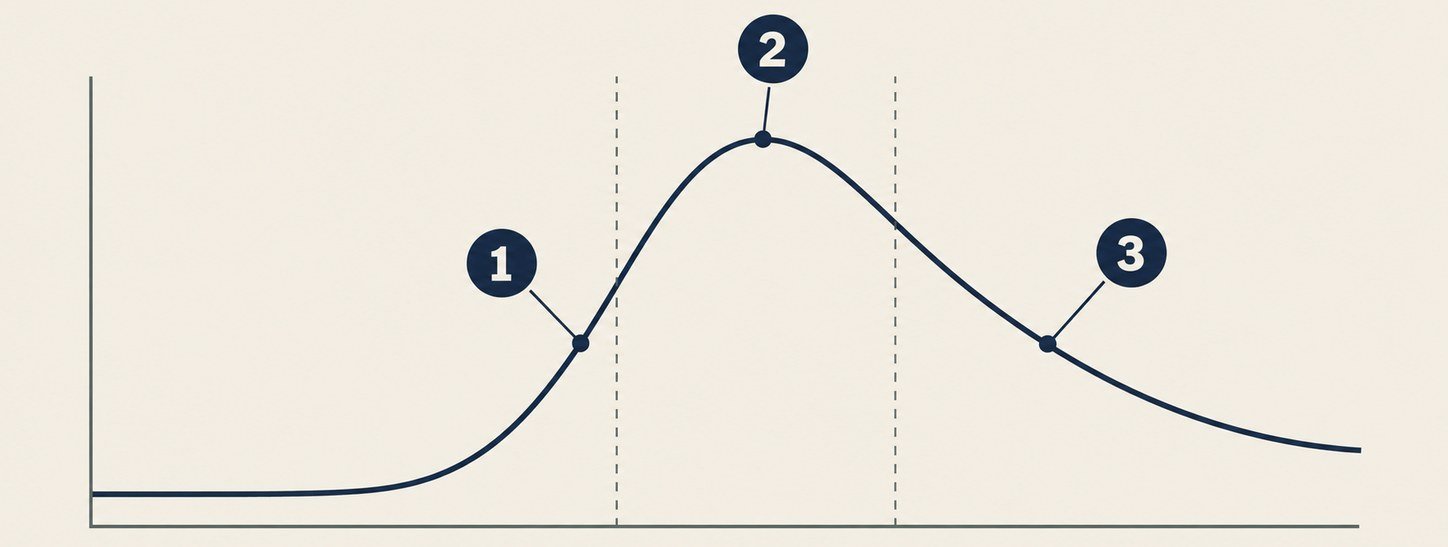
- 1. RisingA fast rise can pause movement
- 2. Peak
- 3. DroppingMovement can pick up as flows drop
Match the jig to the water color. Start with a 1/8 oz jig. Try 1/4 oz in colored water or 1/16 oz in clear water. Check the float's balance whenever you change jig weight.
Cold, off-color water calls for a change. One bead angler's approach uses more weight and a shorter gap between the float and the weight. Pick a bead color and size that has worked for you before. Then check the balance and depth again.
Water-Color Scale
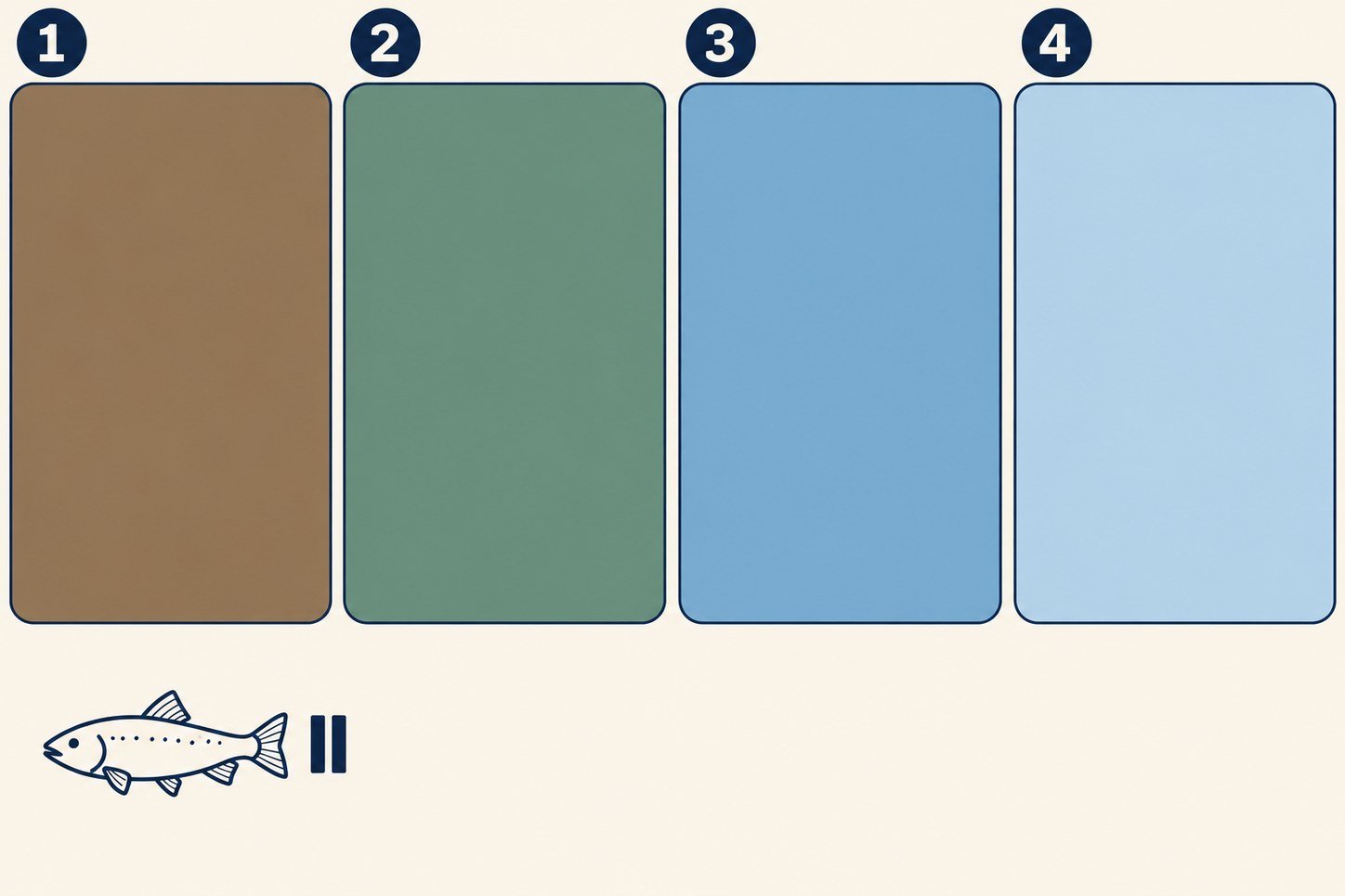
- 1. Muddy: very muddy water nearly stops migration
- 2. Dirty green
- 3. Clearing
- 4. Clear
Light changes the salmon setting. Very early in the morning, salmon may hold well off the bottom. Once the sun hits the water, they tend to move to the bottom. WDFW says to set the bait within a foot of the bottom then. This tip is for salmon, not steelhead.
Rods, Reels, Line and Leader
A long rod helps keep spare line off the water and makes mending easier. A moderate-action rod bends through more of its length, not just near the tip. A spinning reel is the kind that hangs under the rod and holds line on a fixed spool. Its bail is the wire arm you open to cast and close to reel in. Drag is the reel's adjustable resistance when a fish pulls line out.
Choose a reel that releases line smoothly and retrieves quickly enough to keep up with the float. Jerky line release can pull the float away from its natural path.
Braid is line woven from fibers. It floats and has almost no stretch. That makes it easier to mend and carries your hook set to the jig. A leader is the length of line between the swivel and the hook or jig. Fluorocarbon is a leader material that is harder for fish to see.
Use a leader the same test as your main line or lighter. Then the leader breaks first and you keep the rest of the rig. With about 30 lb braid, a 10–12 lb leader is well under it.
A slip float slides along the line until it reaches a bobber stop, a small knot or stop that sets depth. An inline weight sits on the line below the float. A center-pin reel has a freely turning spool that feeds line smoothly.
| Gear | Starting Setup | Range or Alternative | Why It Helps |
|---|---|---|---|
| Rod | A moderate-action spinning rod. | Bead rods: 9'8"–10'6". WDFW also describes float rods of 10–12 ft. | Extra reach helps manage line. |
| Reel | Lets line off smoothly, reels in fast and has a good drag. | A center-pin reel is an option. | Smooth line release keeps the drift natural. |
| Main Line | About 30 lb floating braid. | The leader should be the same test or lighter. | Floating line is easier to mend. |
| Float | A 3/8 oz slip float for a 1/8 oz jig. | A 1/2 oz float for a 1/4 oz jig with the same weight. | Carries the rig and shows the bite. |
| Weight | A 1/4 oz inline weight with a 1/8 oz jig. | Change the added weight when the jig changes. | Helps pull line through the sliding float. |
| Leader | 10–12 lb fluorocarbon, 2–3 ft to start. | WDFW's rig uses a 12–24 in leader. Same test as the main line or lighter. | The leader breaks first, so you keep the rest of the rig. |
| Jig | 1/8 oz as a starting choice. | 1/4 oz in colored water or 1/16 oz in clear water. | Matches the jig to the water. |
| Bead | An egg imitation, with hook size matched to bead size. | Position it 1–3 in above the hook. | Shows fish something other than a jig. |
Fixed floats clip to the line at one spot and don't slide. They suit water under about 6 ft. Sliding floats are better deeper. A bobber stop reels through the rod guides, so casting and landing fish are easier.
Starter Kit vs Upgrade Path
Starter Kit
- A moderate-action spinning rod, 9'8"–10'6" or 10–12 ft long, with a smooth reel.
- About 30 lb floating braid.
- A 3/8 oz Aero-Float AF-3 Series slip float. It's built for braid and comes with a bobber stop and beads.
- A 1/4 oz inline weight and a 1/8 oz Aerojig Marabou Steelhead Jig #113, a cerise (hot pink) marabou jig. Together they balance the 3/8 oz float.
- Seaguar STS Trout & Steelhead in 10 or 12 lb for the leader. It's made in 4–17 lb. Pick a test no heavier than your main line.
Upgrade Path
- Add BnR Tackle Soft Beads in 8–20 mm, with the pegs that come in each pack. A peg is a small insert that holds the bead in place on the leader.
- Add Gamakatsu Octopus Hooks, sized to match the bead.
- Carry jigs from 1/16 to 1/4 oz for different water colors. The Aerojig #113 is sold only in 1/8 and 1/4 oz, so pick another jig for the lightest size.
- A center-pin reel feeds line the most smoothly. Learn balance, depth and mending on your spinning reel first.
Terminal Tackle and Rigging, Step by Step
Float Rig, Side View


- 1. Bobber stop: sets the depth
- 2. Bead
- 3. Slip float
- 4. Inline weight, with a bead under the float
- 5. Swivel
- 6. Leader: 10–12 lb fluorocarbon, 2–3 ft to start, the same test as the main line or lighter
- 7. Jig: about 1 ft off the bottom
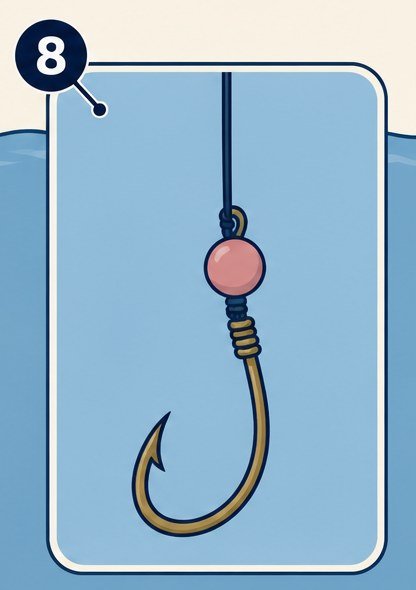
- 8. Bead option: pegged 1–3 in above the hook
A swivel is a small connector that turns freely so the line doesn't twist. Lay out the parts before you thread anything. Start with a jig rig so you can learn how the float sits before changing to a bead or bait.
How It Works, Step by Step
- Fit the stop. Thread on a pre-tied bobber stop. For a tube-style stop, slide the knot off the tube toward the rod. Trim the tags, the loose knot ends, to about 1/2 in so you can still snug the knot.
- Add a bead and the float. The small bead sits between the stop and the float. Thread the line through the float.
- Add the weight and lower bead. Put the inline weight below the float. Add a second bead so the swivel can't jam into the float. Pick the weight together with the jig, not by itself.
- Connect the swivel and leader. Tie the swivel to the braid with the knot the braid maker recommends. Tie the leader to the other end with an improved clinch knot, a common all-round knot. Drift Fishing shows it step by step. For steelhead, use 10–12 lb fluorocarbon, 2–3 ft to start. Keep the leader the same test as your main line or lighter. WDFW's rig uses a shorter 12–24 in leader. Drift and side-drift rigs use other leader lengths, so follow the rig for the method you're fishing.
- Tie on the jig. Tie the leader straight to the jig. The improved clinch knot works here too. The Aerojig #113 has a size 1 hook at 1/8 oz. At 1/4 oz it has a size 1/0 hook.
- Check the whole rig. Pull-test each knot and remove twists. Test how the float sits in water you can reach before you fish.
Tie Your Own Stop Knot
WDFW says you can tie your own stop with a uni knot in 15–30 lb Dacron, a braided polyester cord. Lay the stop cord alongside the main line. Make a loop in the cord, then pass its loose end through that loop while wrapping around both the main line and the straight section of cord. Wet the wraps and snug them into a small coil. The knot should hold its place but slide when you push it.
Uni Bobber-Stop Knot

- Lay 15–30 lb Dacron beside the main line
- Form a loop in the Dacron
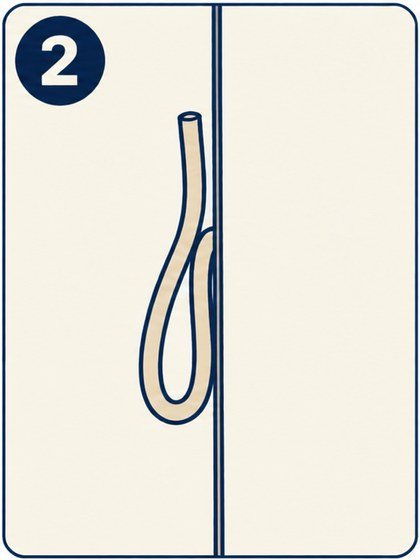
- Wrap the tag through the loop around both lines
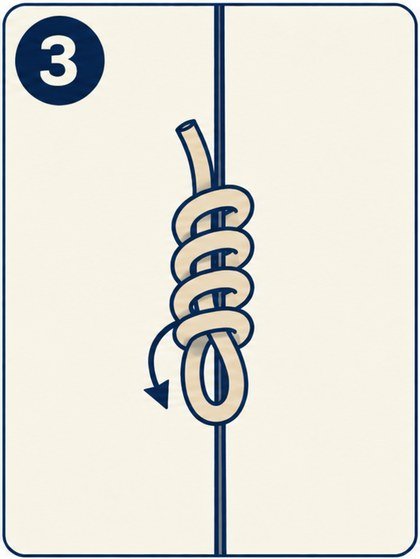
- Wet and snug; the stop holds but slides when pushed
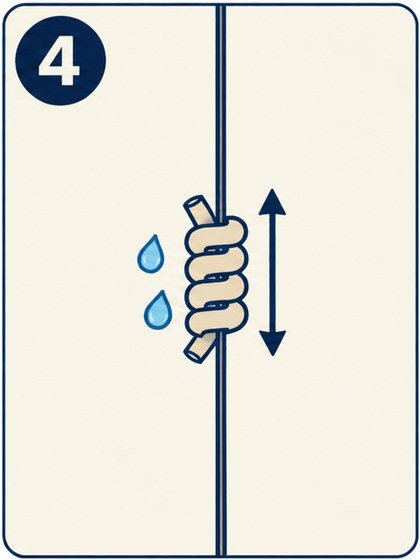
- 1. Lay 15–30 lb Dacron beside the main line
- 2. Form a loop in the Dacron
- 3. Wrap the tag through the loop around both lines
- 4. Wet and snug; the stop holds but slides when pushed
Trim tags to about 1/2 in.
Balance Before You Set Depth
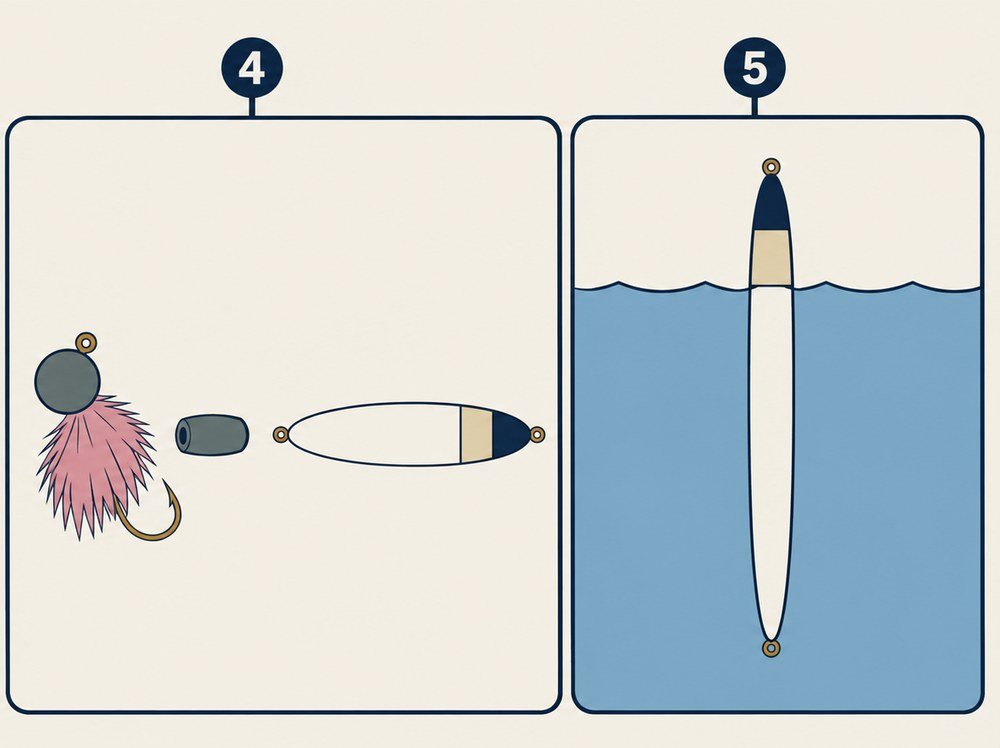
Jigs are sold by head weight, and the hook size is often on the package. The float's rating should equal the jig and the inline weight together. A 1/8 oz jig and a 1/4 oz weight need a 3/8 oz float. With a 1/4 oz jig and the same weight, step up to a 1/2 oz float. Count the jig, not just the weight.
Check how the assembled rig sits. In rough water, the bottom of the lower color band should meet the waterline. In calmer water, leave less of the float showing. Keep enough showing to read it.
Balancing the Float
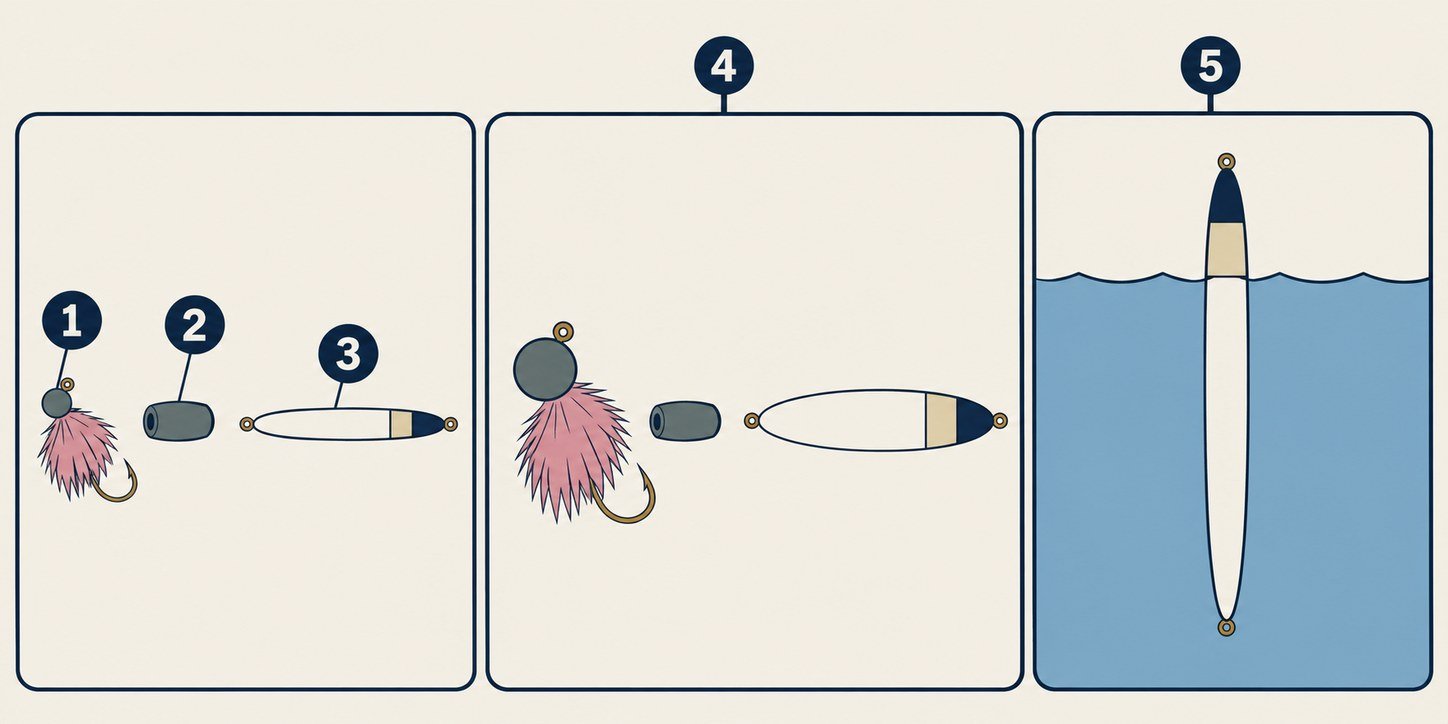
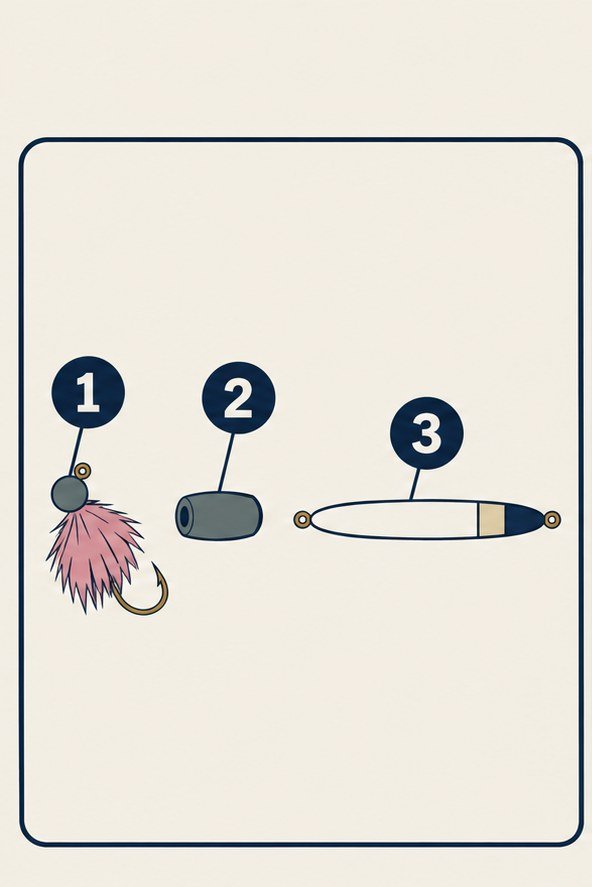
- 1. 1/8 oz jig
- 2. 1/4 oz inline weight
- 3. 3/8 oz float: its rating equals the jig and the weight together
- 4. Colored water: a 1/4 oz jig with the same 1/4 oz weight takes a 1/2 oz float
- 5. Rough water: weight the float so the bottom of the lower color band sits at the waterline
Test the float's carrying weight before you fish.
The Aero-Float AF-3 is a foam slip float built for braid and river fishing, with brass grommets at both ends. It's made from 1/8 to 2 1/2 oz. Still test the load in the water.
Set Depth and Read the Float
Start by letting the jig touch bottom. Then reel up and move the stop until the jig rides about 1 ft off the bottom. Make small changes and drift the same lane again. A new lane may need a new setting.
Fish look up or to the side, not down, so a jig fished a little high still gets seen. One writer starts about 3 ft above the bottom for less active fish. Then he moves the stop to fish deeper until the jig is near the bottom.
The float should stand straight up. If it tips downstream and jerks along, the jig is dragging bottom. Reel in and shorten the depth. Too much line downstream can also tip the float downriver. A top leaning upriver means you're holding it back. Check your line before you change the depth.
Reading the Float
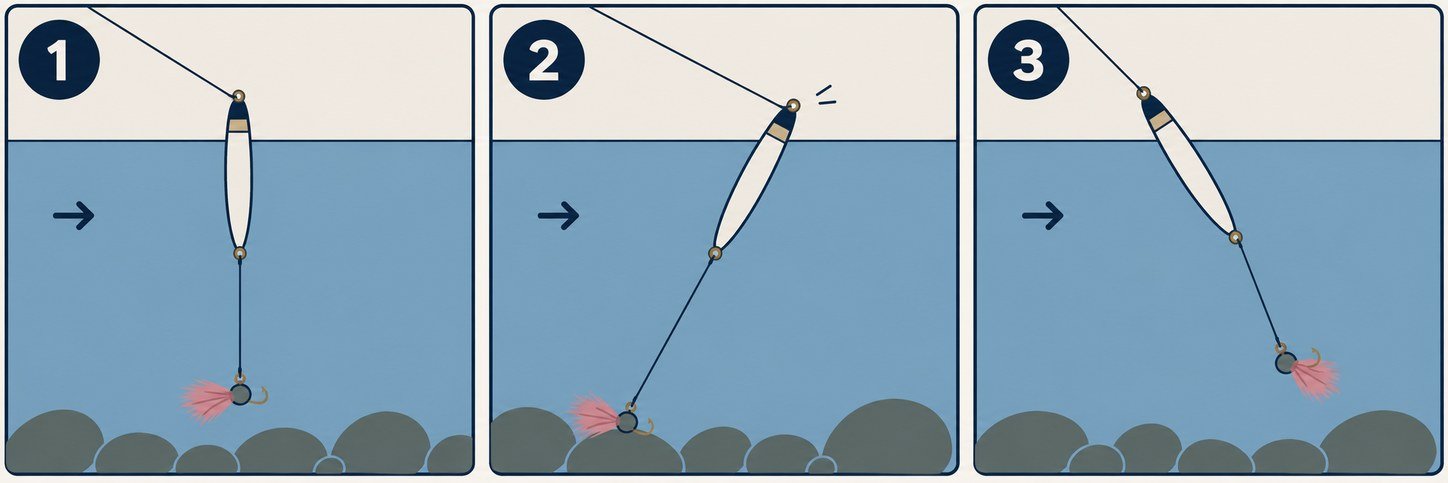
 Upright: right depth
 Top tipped downstream and jerking: dragging bottom or too much line downstream; check the line, then shorten
 Top tipped upstream: held back
- 1. Upright: right depth
- 2. Top tipped downstream and jerking: dragging bottom or too much line downstream; check the line, then shorten
- 3. Top tipped upstream: held back
Change to a Bead or Bait
For a bead rig, slide the bead onto the leader and tie on a hook sized to the bead. Peg the bead 1–3 in above the hook. BnR Tackle Soft Beads come in many sizes, including 8–20 mm, and each pack has pegs. An attractor is a bright lure or bead that helps fish find the bait. Check WDFW's current hook, bead and attractor rules before you rig.
Gamakatsu Octopus Hooks work for beads and bait. Match the hook size to the bead. For salmon, WDFW says eggs are the top float bait and sand shrimp are popular. Some anglers fish both together. Check bait rules for your water first.
By Species
Winter Steelhead
Start with a balanced float and a 1/8 oz pink or cerise jig on 10–12 lb fluorocarbon. Cerise is a bright hot pink. A bead pegged 1–3 in above the hook is another choice. Go to 1/4 oz in colored water and 1/16 oz in clear water. Rebalance the float after you change.
Summer Steelhead
A few western Washington rivers have summer runs, including the Skykomish program noted above. Summer fish in warmer water may come well up for a jig. Try a few depths while keeping the drift under control.
Chinook
WDFW says eggs are the top float bait and sand shrimp are very popular for Chinook. Early in the morning, salmon may hold off the bottom. Once the sun hits the water, set the bait within a foot of the bottom. Check bait rules before you set up.
Coho and Chum
A sliding float rig can take coho and chum, depending on the lure. No Washington source ties them to float fishing on a named river. Use the same balance and line checks as above.
Pink Salmon
Use a 1/8–1/4 oz pink marabou jig under a float. Pinks run in Washington only in odd-numbered years. Check WDFW for the river, species and planned date before going.
Jig and Bead Choice Card
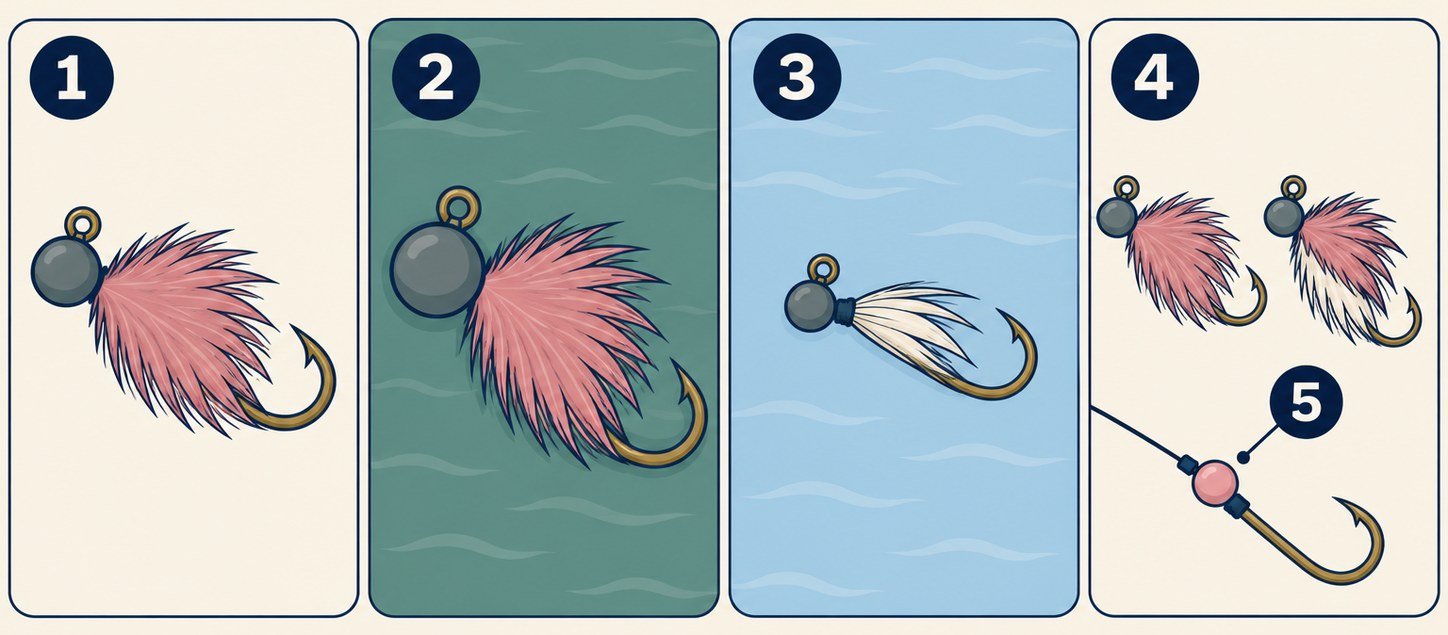
- 1. 1/8 oz: the default
- 2. 1/4 oz: colored water
- 3. 1/16 oz: clear water
- 4. Colors: pink, pink and white or cerise
- 5. Soft bead, 8–20 mm, pegged 1–3 in above the hook
Aerojig Marabou #113 (cerise) is sold in 1/8 and 1/4 oz.
Technique, Step by Step
A belly is a loose curve of line on the water. That curve can catch current and cause drag, an unwanted pull on the float. Here drag means a pull on the drift, not the reel setting.
Mending a Float Drift, Overhead View
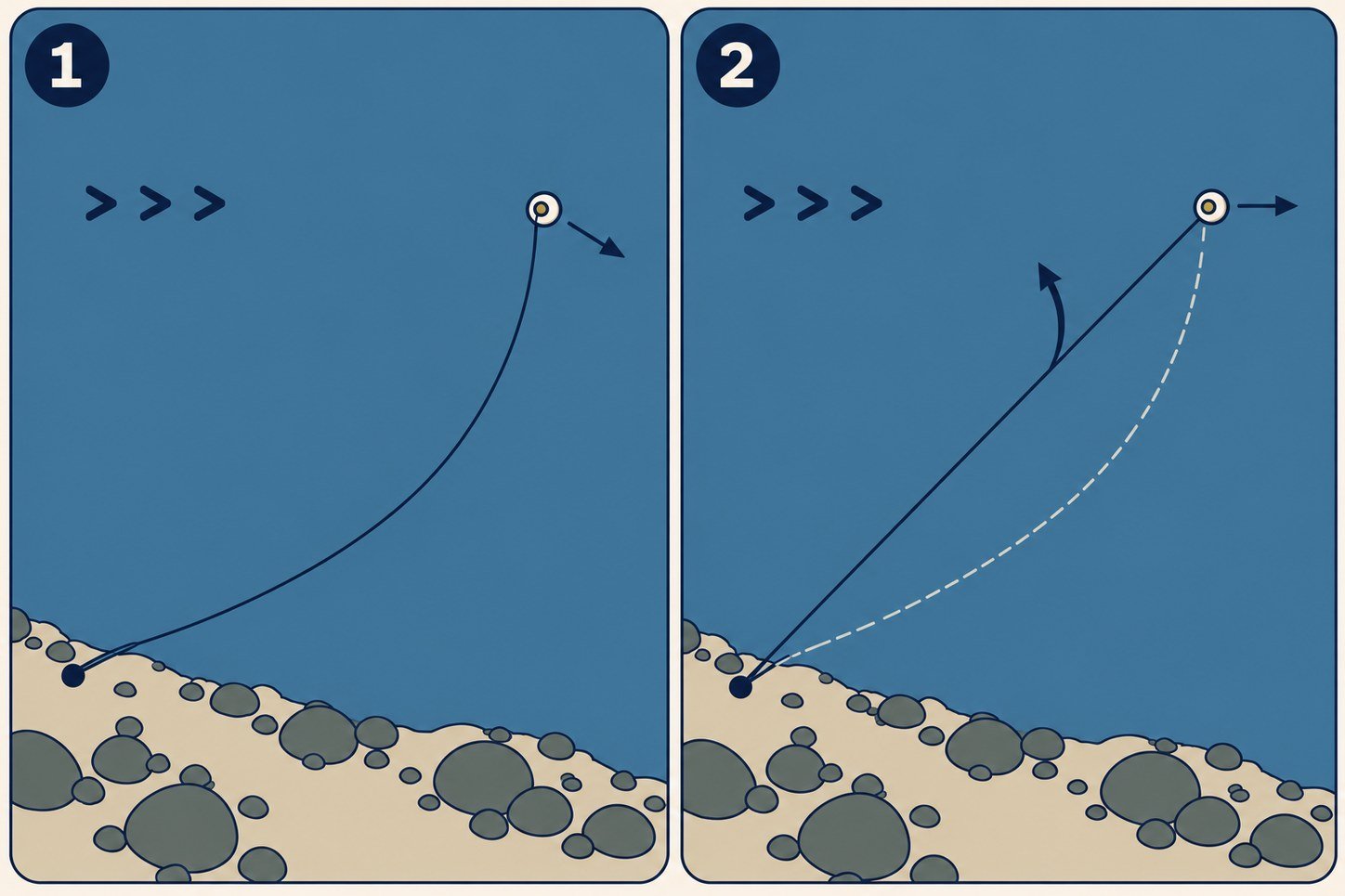
- 1. Downstream belly: the float drags and lifts the jig
- 2. After an upstream mend: the line runs straight to the float, which drifts at current speed
How It Works, Step by Step
- Start at the tailout and fish close first. Tailouts often hold more fish, and more active fish, than the rest of a run. That's different from Drift Fishing, which works a run from the head down. Fish the nearest lane before you lengthen your cast. Land the float at least 10 ft upstream of where a fish should be, so the jig can sink. Allow more room in low, clear water.
- Cast smoothly. Lob the rig rather than snapping it. Guide the line as the rig lands so it doesn't tangle. On the first pass, watch how the float acts in that lane.
- Mend early. Lift or flip spare line upstream to remove a downstream belly. You want a straight line from rod to float without pulling the float across the current. Use the rod's reach to keep excess line off the surface.
- Follow the float. Reel in spare line while the float moves toward you. As it passes downstream, feed line smoothly. With a spinning reel, open the bail and control the line with your finger. Don't stop it suddenly.
- Keep the drift natural. Watch the current beside the float and keep the float moving with it. Mend when the line starts pulling, but don't drag the jig out of its lane.
- Hold back now and then. Slow the float slightly so the jig matches the slower current near the bottom. Then let line out smoothly again. Do this briefly, not for the whole drift.
- Finish the swing. Let the float swing until it is straight downstream. A fish may follow and take a rising bead at the end. Stay ready until the jig is out of the water.
- Cover the next lane. Lengthen the cast after you've fished nearby water. Give a good spot several passes and try another color before you move.
Cast-to-Drift Sequence
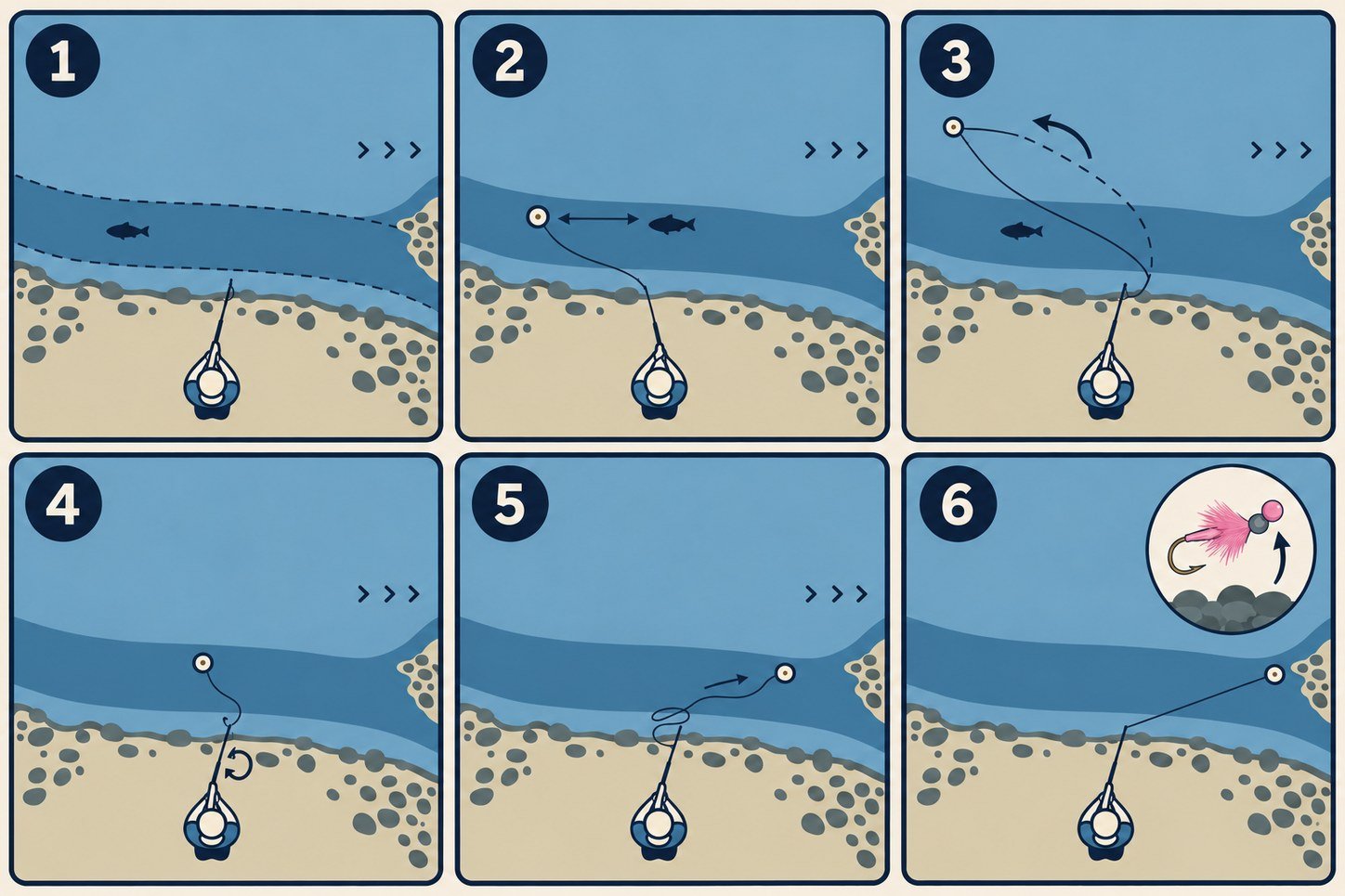

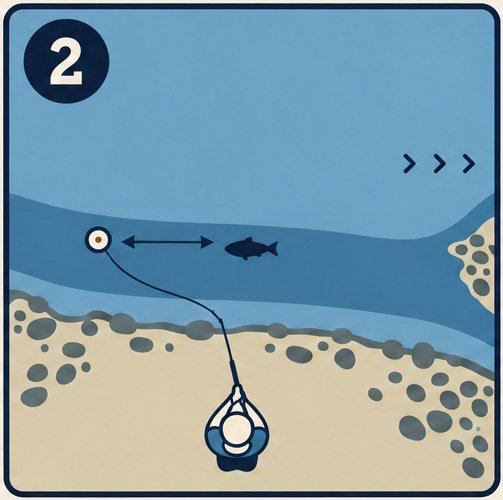
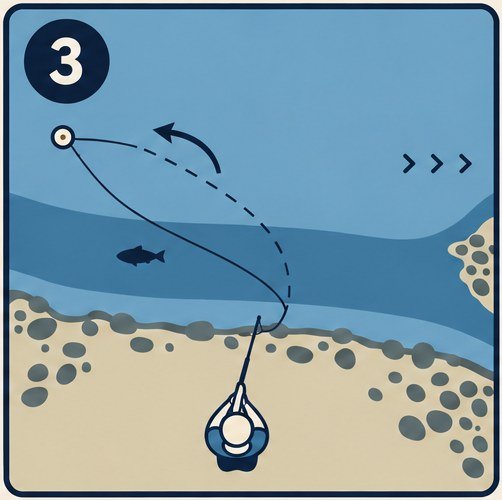
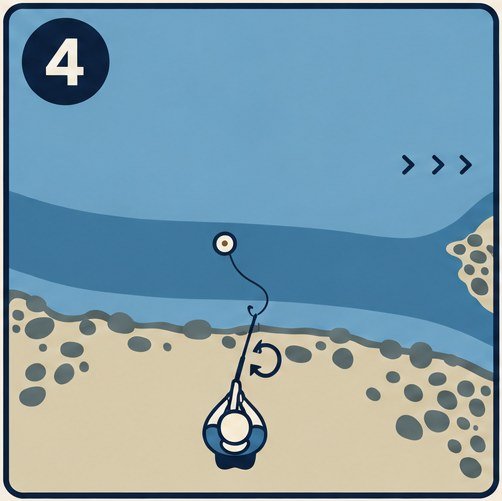


- 1. Start at the tailout and fish the nearest lane first
- 2. Cast at least 10 ft above where a fish should be
- 3. Mend: flip the line upstream
- 4. Reel in spare line as the float comes toward you
- 5. Feed line as it passes
- 6. Let it swing straight downstream and watch the bead rise
End of the Drift
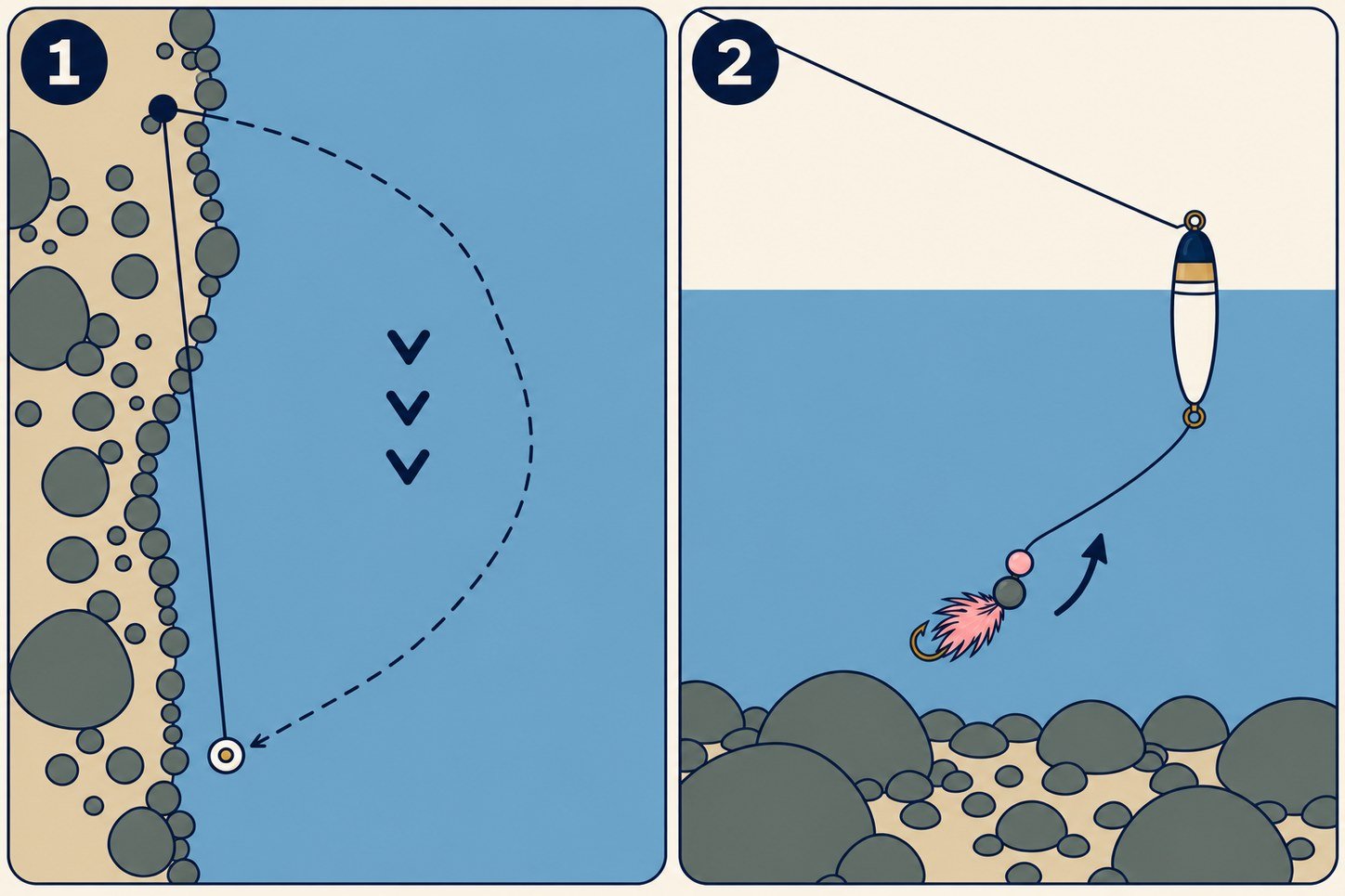
- 1. Let the float swing until it is straight downstream
- 2. The bead or jig rises: fish often follow and take it here
Bobberdogging
Bobberdogging is a float rig fished from a moving boat. It uses a longer leader, very little weight near the bead and a sliding weighted float fished upstream of the boat. See Side Drifting for the boat side.
Reading the Water
A pool has a head where current enters, a deeper middle called the gut and a tailout where it shallows. Tailouts often hold more fish and more active fish than other parts of a run. Start there, and fish the closest lane first.
- Seams and riffle ends: A riffle is shallow, moving water with a broken surface. Look for water moving at a fast walking pace or slower, 4–10 ft deep.
- Pocket water: These are the small pools between rocks. Jigs sink fast, so they suit short slots behind boulders.
- Pool heads: Fish may sit in the fast, shallow head. Lift the rod tip or shorten the depth to keep the jig off the bottom.
- Eddies and slack tidewater: Use the still-water approach with light line, small floats and small jigs. Fish may hold well off the bottom.
Approach quietly. From a boat, avoid running over water you intend to fish. Note where the float dips on every pass; that's the current, not a fish.
Where to Float a Jig
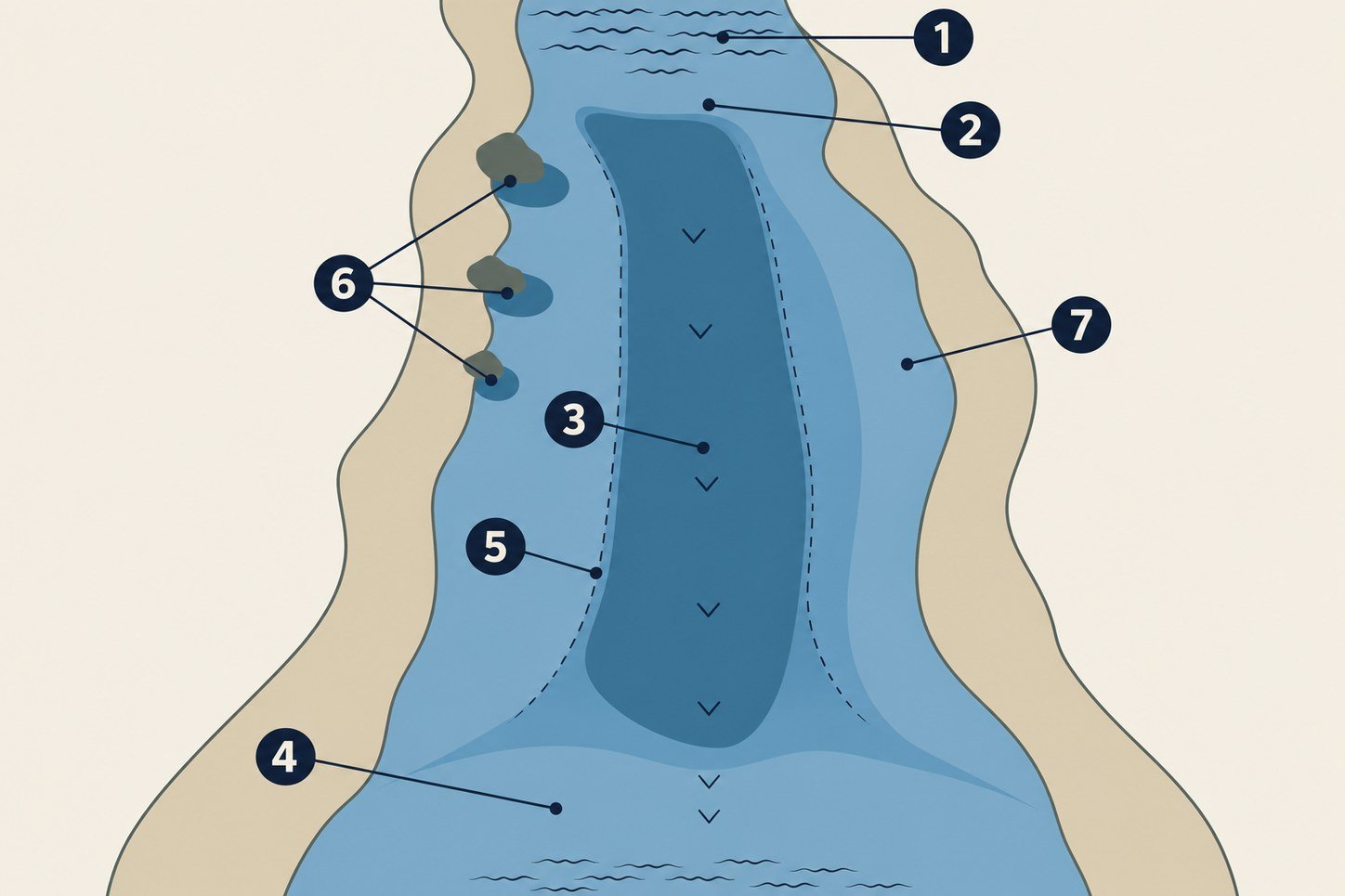
- 1. End of a riffle
- 2. Pool head: fish may sit in the fast, shallow head
- 3. Gut: the deeper middle
- 4. Tailout: fish first
- 5. Seams
- 6. Pocket water behind boulders
- 7. Walking-pace water 4–10 ft deep
Worked Examples
These are plans, not catch reports. Check access, conditions and the current rules first.
A Winter Morning at Blue Creek on the Cowlitz
Blue Creek has shore access and an ADA platform near the hatchery. Check the Castle Rock gauge trend and the water's color before you pick a spot. The confluence is near-still water with no tailout to start at, so fish the nearest water first. Where gentle current carries the float, cast above the target so the jig sinks before it gets there. If the float barely moves, use light line, a small float and a small jig.
Use the 3/8 oz float. Balance it with a 1/8 oz jig and a 1/4 oz inline weight. Find bottom, then set the jig about 1 ft off it. Mend without pulling the float away from the lane. In nearly still water, watch for a small lift or jiggle as well as a clear dive.
If the float goes under, take up loose line and set fast. Keep steady pressure and let the reel's drag give line when the fish runs.
Rules change by river and in season. Check the current WDFW sport fishing regulations and emergency rules before every trip.
A Tailout on the Skykomish
Plan access at Big Eddy or Lewis Street, and check the trend on the Gold Bar gauge. Start at the tailout, because it can hold more active fish. Fish its closest lane first and cast above the target. Check the bank and current before you pick where to stand.
Give the jig time to sink before it reaches the holding water. Mend spare line, reel as the float approaches and feed line as it moves downstream. If the float tips downriver and jerks, check for too much line downstream or a jig on the bottom.
If you change to a bead, keep watching as the float swings straight downstream. A fish may take the bead as it rises. If the float goes under, tighten the line and set fast. Lengthen the next cast only after you've fished the nearer lane.
Rules change by river and in season. Check the current WDFW sport fishing regulations and emergency rules before every trip.
Odd-Year Pinks on the Snohomish System
Pinks run only in odd years. The Snohomish system includes the Skykomish. Use WDFW's access map to plan a bank spot and the Monroe gauge to check the trend. A run doesn't mean the river is open, so check WDFW. Start at a tailout if there is one, and fish the closest lane first. Land the float above the target so the jig can sink.
Choose a 1/8–1/4 oz pink marabou jig and balance the float to it. In low, clear water, a marabou jig under a float can be especially good. Keep the line from pulling the float sideways. Set the depth for the lane you're fishing.
If the float goes under, take up slack and set fast. Keep working nearby lanes before you cast farther.
Rules change by river and in season. Check the current WDFW sport fishing regulations and emergency rules before every trip.
The Bite, Hook Set, Fight and Landing
A hard dive is easy to notice, but many takes are smaller. Set the hook when the float stops, jiggles, leans or rides higher. Set on anything unusual. In still water, a slight lift or jiggle may be the whole signal.
Strike Signs
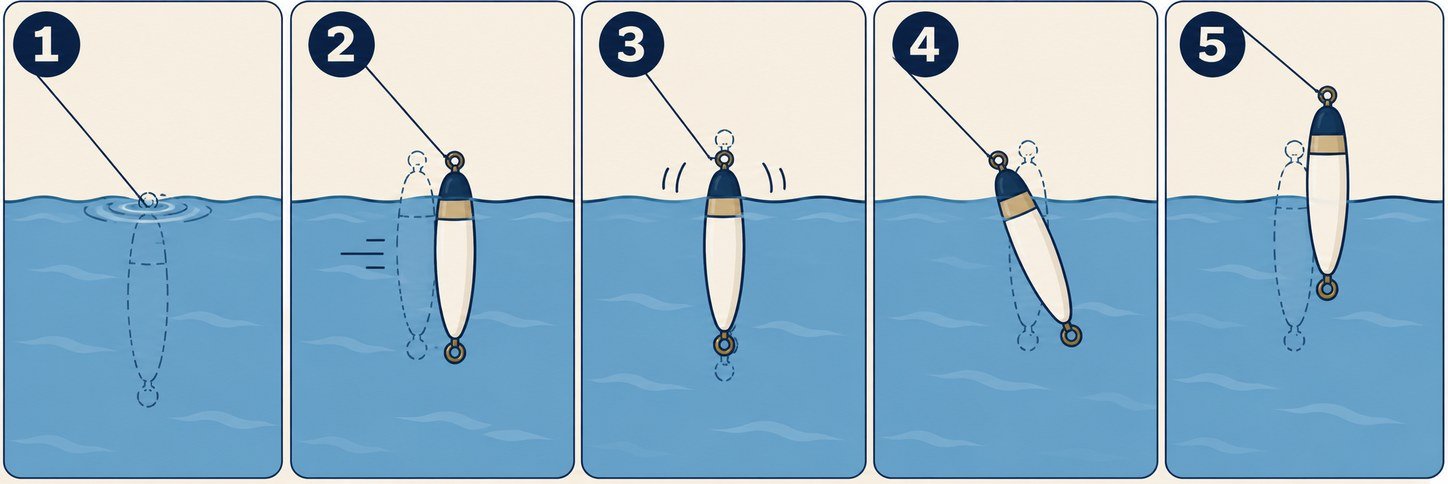
 Goes under
 Stops
 Jiggles
 Leans
 Rides higher
- 1. Goes under
- 2. Stops
- 3. Jiggles
- 4. Leans
- 5. Rides higher
Watch the first drift closely. A dip in a heavy seam that bounces right back is the current, not a bite. Learn that pattern, but still set on anything new.
Take up slack and set hard and fast. Steelhead seldom hold an unscented jig long. Braid's low stretch carries the hook set to the jig. Good mending keeps that line straight.
If the float stops in the same place every pass, check your line and depth. A downstream lean with repeated jerking can mean the jig is dragging. If it's on the bottom, reel in and shorten the depth.
During the fight, keep the rod up and the pressure steady. Let the drag give line when the fish runs. Move along the bank only where the footing is safe. Have the net ready and lead the fish into gentle water you can reach. Don't follow it into deeper current.
Handling and Release
Plan the landing and release before you cast. Keep a fish you intend to release in the water. Wet your hands, support its body and avoid squeezing or touching its gills. A soft, knotless net helps you control the fish without beaching it.
Keep pliers or a dehooker within reach. Remove a hook you can reach. If it's deep, cut the leader instead. Hold the fish upright into gentle current and let it swim away under its own power.
WDFW's handling requirements for released steelhead vary by area. Read the current handling rules, including whether a fish may be removed from the water. Check whether you may keep a fish, too; it isn't the same everywhere.
Common Mistakes and Fixes
| Mistake | What You Notice | Fix |
|---|---|---|
| Guessing depth | You have no bottom reference | Find bottom, then set the jig about 1 ft above it. |
| Setting too deep | Float tips downstream and jerks along | Check the line, then shorten the depth if the jig is dragging. |
| Leaving a line belly | Float pulls off its natural path | Mend and keep excess line off the water. |
| Overloading the float | It sits too low before a bite | Match the combined jig and added weight to its rating. |
| Leaving too much float exposed | Small movements are harder to read | Test the load and set the color band at the waterline in rough water. |
| Snapping the cast | Leader tangles around the main rig | Lob smoothly and inspect the rig after a poor landing. |
| Ignoring a weight change | The float no longer balances | Recheck the load whenever you switch jigs. |
| Casting past nearby water | The closest lane stays unfished | Work close first, then extend the cast. |
Tips That Make the Difference
- Change jig weight for a reason. Use 1/16 oz in clear water and 1/4 oz in colored water. Rebalance the float after you switch.
- Start with proven colors. Pink, pink and white or cerise are the usual first picks. Try pale colors or black in still water.
- Give a good pocket some time. Make several passes and try another color before you leave it.
- Try bait. Eggs and sand shrimp fish well under a float. Check bait rules first.
- Keep nearby water undisturbed. Approach quietly and fish close before extending the cast.
- Tie spares at home. Carry ready-made leaders so a break-off costs minutes, not the morning.
Brushing Up: Change one thing at a time: depth, line or jig. If you change everything at once, you can't tell what helped.
When It's Slow
Start with what you can see and control:
- Depth: Find bottom again. A float standing upright doesn't tell you how far the jig is off the bottom.
- Drift: Compare the float with nearby current. Remove any belly that is pulling it ahead or across the lane.
- Balance: Check the combined weight after every tackle change.
- Jig or bait: Try another jig color, or switch to a bead or bait after checking the rules.
- Water: Go back to the seams, tailouts and small slots behind boulders.
- Method: If the bottom changes too much for a float, try Drift Fishing or Side Drifting instead.
A slow day doesn't always mean you did something wrong. Check your setup, then move when the water no longer suits a float.
Safety
- Wading: Use a wading staff and stay out of swift water or water above your waist. Shallower water isn't always safe. Wear a wading belt and boots with good grip, and keep a clear way back.
- Cold water: Many Washington waterways stay below 60°F most of the year. Cold water shock makes you gasp and can lead to drowning. Washington State Parks uses the 1-10-1 memory aid: about 1 minute to control breathing, about 10 minutes of useful movement and about an hour before hypothermia can take consciousness. Wear waterproof layers and keep dry clothes handy.
- Rain and rising rivers: Check USGS gauges and Northwest River Forecast Center forecasts before and during the trip. Move before rising water cuts off your exit.
- Boats: In a boat, wear a life jacket that fits. Washington State Parks says to carry a U.S. Coast Guard-approved life jacket for each person; check its life-jacket guidance for children's and throwable-device rules. Check its boater education rules to see whether you need a Washington State Boater Education Card.
- Sweepers and strainers: Woody debris can form these hazards. Sweepers are trees hanging low over the water. Strainers let water through but trap boats and people. Know what lies downstream and keep clear.
- Lead weights: Wash your hands with soap and water after handling lead. Hand sanitizer does not remove lead.
- Other anglers: A long rod and a lobbed cast can reach a neighbor. Give others room and wear glasses.
Cold Water 1-10-1 and Wading

 About 1 minute: control your breathing
 About 10 minutes of useful movement
 About an hour before hypothermia takes consciousness
- 1. About 1 minute: control your breathing
- 2. About 10 minutes of useful movement
- 3. About an hour before hypothermia takes consciousness
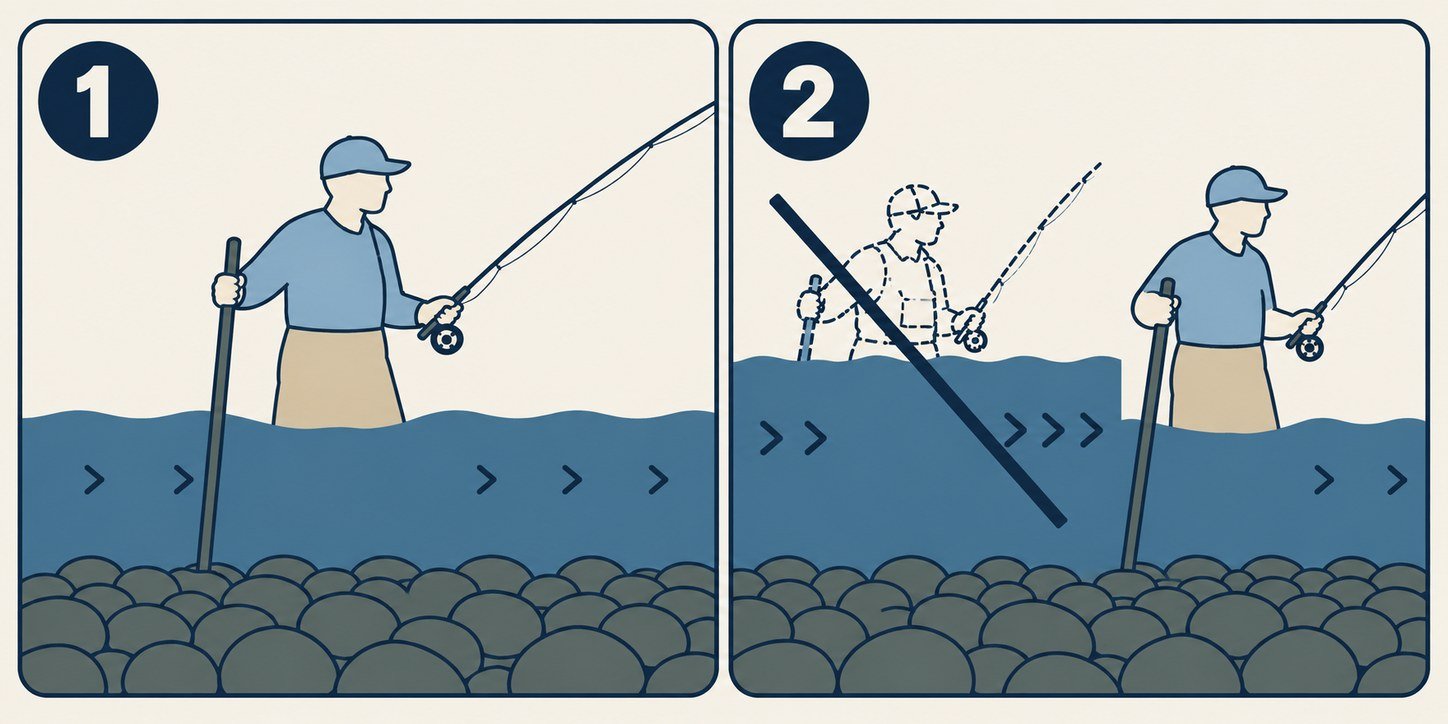
- 1. Use a wading staff
- 2. Stay out of swift water or water over your waist
Source: Washington State Parks
WDFW Rules to Check
Check the exact river section and species. Answer these questions from WDFW's current rules. This list isn't permission to use the rig shown here.
- What season and open dates apply to the river, section and species?
- Which fish may you keep, hatchery or wild?
- What release and handling rules apply?
- What hook, barb and hook-size rules apply?
- What bait or selective-gear rules apply to your jig, bead or bait? Selective gear is WDFW's term for gear limits on some waters, so read its definition in the rules.
- How may beads and other attractors be arranged?
- Are there weight or anti-snagging provisions affecting the rig?
- What rules apply to fishing from a boat or floating device?
- Are there night closures?
- Have emergency rules changed anything?
For boating rules, check Washington State Parks through the links in Safety. Check again if you change rivers or stretches during the trip.
Rules change by river and in season. Check the current WDFW sport fishing regulations and emergency rules before every trip.
A Guided Day and What to Ask
Ask whether the trip is on the bank, in a boat or both. Ask how much of the day is float fishing. A guided day is a good time to practice setting depth, casting and mending. Agree on that goal before you go.
Ask before booking:
- How much walking or wading is involved, and what is the footing like?
- Will we fish from the bank or a boat, and how will we check the applicable rules?
- Will we use jigs, beads or bait?
- Which tackle and clothing do you provide, and do I need waders?
- What happens if the river rises or becomes too muddy?
- Which fish can we keep, and which do we release?
- Can you teach me to balance the float, set depth and rebuild the rig myself?
Tell your guide about any limits on walking, balance or cold exposure before the day. Ask to practice the whole cast and drift, not just watch for a bite.
Ask your guide for their WDFW guide license number before you book.
Learn More
- WDFW Freshwater Salmon Fishing Basics — float rigging and salmon presentations.
- WDFW Steelhead Management — run and management background.
- WDFW North Coast Winter Steelhead Creel Surveys — when anglers catch hatchery and wild fish.
- WDFW Water Access Sites — access planning.
- USGS Water Data for Washington and NOAA Northwest River Forecast Center — observations and forecasts.
- Washington State Parks Cold Water Safety — cold-water preparation.
- Washington State Parks Wear a Life Jacket — flotation and equipment guidance.
- WDFW Sport Fishing Regulations and Emergency Rules — current rules to check before fishing.
Glossary
- Slip Float
- Float that slides along the line until it reaches a stop.
- Bobber Stop
- Small knot or stop that sets fishing depth.
- Inline Weight
- Weight placed on the line below the float.
- Leader
- Line between the swivel and the hook or jig.
- Braid
- Line woven from fibers; the float-fishing choice here floats and has little stretch.
- Fluorocarbon
- Leader material that is harder for fish to see.
- Mend
- Lifting and flipping line so it doesn't pull the float.
- Belly
- Loose curve of line on the water.
- Drag
- Either unwanted pull on the drift or the reel setting that releases line under pressure.
- Bail
- Wire arm opened to cast and closed to retrieve.
- Seam
- The boundary between currents moving at different speeds.
- Tailout
- The shallowing end of a pool above the next riffle.
- Riffle
- Shallow, moving water with a broken surface.
- Eddy
- Spot where the current swirls back or slows.
- Tidewater
- Lower river where the tide rises and falls.
- Confluence
- Place where two streams meet.
- Creel Survey
- WDFW interviews with anglers about their fishing.
- Fixed Float
- Float that clips to the line at one spot and doesn't slide.
- Attractor
- Bright lure or bead that helps fish find the bait.
- Selective Gear
- WDFW term for gear limits on some waters; read its definition in the rules.
- Gut
- The deeper middle of a pool.
- Pocket Water
- Small pools between rocks.
- Marabou
- Soft, fluffy feathers used to dress jigs.
- Peg
- Insert that holds a bead on the leader.
- Center-Pin Reel
- Free-turning reel that feeds line smoothly.
- Yarnie
- Small trimmed yarn ball used as bait.
- Dacron
- Braided polyester cord used for bobber stops.
- Bobberdogging
- A float rig fished from a moving boat; see Side Drifting.
Guides Who Specialize in This
More River Methods
Explore Drift Fishing, Side Drifting and Plunking for other river presentations.
At a Glance
| Field | Summary |
|---|---|
| Main Species | Steelhead and salmon. |
| Water | Rivers, big eddies and tidewater at slack tide. |
| In Short | Suspend a jig, bead or bait under a float and guide a natural drift. |
| Skill Level | Beginner-friendly: easy-to-see bites and fairly few snags. |
| Key Gear | Long spinning rod and smooth reel; about 30 lb braid; balanced slip float and inline weight; 10–12 lb fluorocarbon leader, the same test as the main line or lighter; jig, bead or bait. |
| First Jig Rig | A 1/8 oz jig and a 1/4 oz weight under a 3/8 oz float. |
| First Depth Check | Find bottom, then adjust the jig to ride about 1 ft above it; a higher start for less active fish is under Set Depth and Read the Float. |
| Before Going | Check river access, gauge trends, current rules and safe footing. |
On This Page
- What It Is and When It Beats Other Methods
- Target Species and Where in Washington
- River by River
- Seasons and Conditions
- Rods, Reels, Line and Leader
- Terminal Tackle and Rigging, Step by Step
- By Species
- Technique, Step by Step
- Worked Examples
- The Bite, Hook Set, Fight and Landing
- Handling and Release
- Common Mistakes and Fixes
- Tips That Make the Difference
- When It's Slow
- Safety
- WDFW Rules to Check
- A Guided Day and What to Ask
- Learn More
- Glossary
- Guides Who Specialize in This
- More River Methods