

Pulling Plugs
How to back-troll diving plugs and diver-and-bait rigs for steelhead and salmon: the spread, the rowing, the tuning and the strike.
How to back-troll diving plugs and diver-and-bait rigs for steelhead and salmon: the spread, the rowing, the tuning and the strike.
Pulling plugs is a boat method. Back-trolling means holding a boat against the current, then moving downstream slower than the water. A plug is a floating, hard-bodied lure whose diving lip makes it dig and wobble in current. A diver uses the same pressure to carry a separate bait down.
The angler's job is simple: watch the rod and respond when it bends. There's no casting and no feeling for a soft bite. The rower does the harder work of holding, steering and slowing the boat. Learning that takes practice and time. A steelhead strike can bury the rod tip, so everyone needs to know what happens next.
What It Is and When It Beats Other Methods
The current, not the boat, makes the plug work. As water pushes against its lip, the plug dives below the surface and works downstream of the boat. The rower gradually backs it through the run, a stretch of fairly steady current. The plugs reach each spot before the boat does.
You may hear this called hot-shotting, an older name taken from the Hot Shot plug. The name changes nothing about the basic job: keep the boat moving slower than the river.
Why It Works
A plug can remain in a holding spot while its wobble keeps working. Pausing there for a minute or more is part of the method. Steelhead are widely believed to strike plugs as intruders in their territory. Treat that as an explanation anglers use, not a proven reason for every strike.
Pulling plugs is useful when:
- Fish are holding. A slow presentation gives the plug time to work through their space.
- Water is green to clear. Emerald or "steelhead green" water through clear conditions suits the method.
- The rod work needs to be simple. Rods can sit in holders while anglers watch their tips.
- The bottom has snags. Floating plugs can rise when diving pressure eases, helping them clear some obstacles. They are not snag-proof.
Holding the boat still does not stop the plugs. Current continues to work them. Letting the boat drift too quickly reduces the water pressure needed to keep them diving.
Who Controls the Boat
A classic arrangement has one rower and one to three anglers watching rods. The rower controls the lures by controlling the boat. On a jet sled, a powered river boat, a trolling motor or kicker can do the same job. A kicker is a small outboard used to control the drift.
Some boats use anchor winches or electric motors to help manage position and movement. Equipment does not replace knowing the water below you. Agree on who clears the rods and who handles the net before fishing.
If You Fish From the Bank
A side planer carries a plug away from shore. A wading angler can also feed a plug downstream in short stages, stopping between them. Both are limited, and both need safe footing.
For a bank approach, see Drift Fishing, Float Fishing or Plunking. Plunking a plug from shore or an anchored boat is a separate method. A guided boat trip is another option if you do not run a boat.
Plugs can also offer a different presentation after other anglers have worked the water. See Side Drifting and Float Fishing for those methods.
Target Species and Where in Washington
Winter and summer steelhead are the main targets. Larger plugs are also fished for salmon. See Steelhead for species background.
Where It Works in Washington
On the Olympic coast, anglers pull plugs on the Bogachiel, Sol Duc, Hoh and Calawah. On the Hoh, anglers also back-troll larger plugs for fall salmon from rafts and drift boats.
For broader trip planning, see Olympic Peninsula Winter Steelhead and Skagit, Snohomish and Skykomish Salmon and Steelhead Fishing. This page covers Olympic coast rivers. For Puget Sound rivers, start with the fishery pages above.
Rules on fishing from a boat or floating device can differ by stretch on coastal rivers. That matters more for plugs than for any bank method. Check WDFW's regulations for your stretch before you launch. A boat ramp on a WDFW list doesn't mean you may fish from the boat.
River by River
Plan the launch, the takeout (the ramp where you pull the boat out) and the route before you choose tackle. A tailout is the shallowing end of a pool above the next riffle. A riffle is shallow, moving water with a broken surface. A seam is the boundary between currents moving at different speeds. A slot is a deeper trough.
Use gauge trends alongside what you see at the river. A gauge trend shows how the river is changing. It doesn't tell you a level is safe to boat.
Per-River Access Map
- WDFW water access site
- USGS gauge
Forks rivers
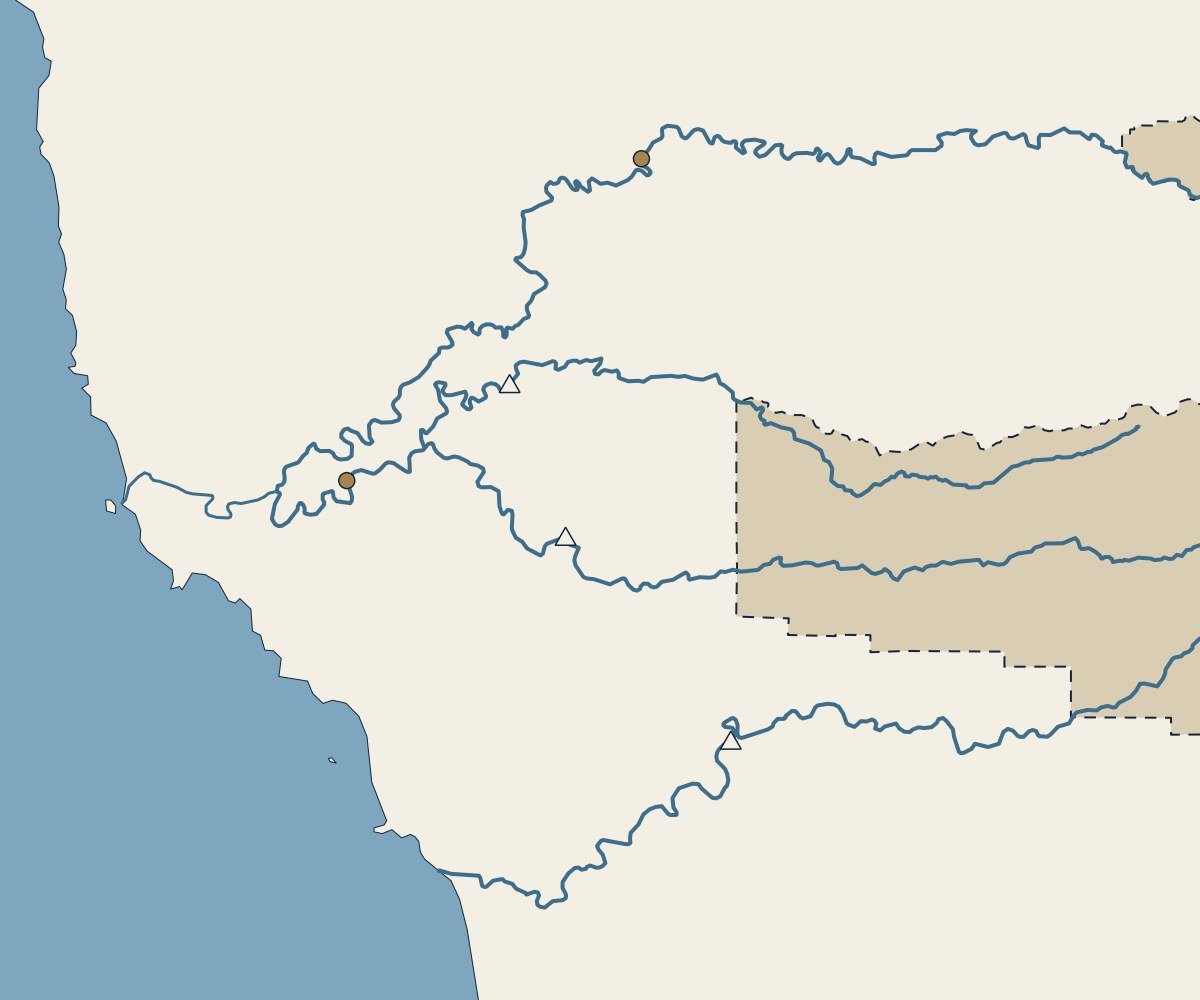
- 1. Wilson ramp (Bogachiel)
- 2. USGS gauge 12042800 (Bogachiel)
- 3. USGS gauge 12043000 (Calawah)
- 4. Salmon Hatchery ramp (Sol Duc)Sol Duc has no gauge
- 5. USGS gauge 12041200 (Hoh)
Dashed line: Olympic National Park boundary; park rules apply upstream.
Confirm each site's access type on WDFW's site page before towing a boat.
Rivers and gauges: U.S. Geological Survey (USGS) · Access sites: Washington Department of Fish and Wildlife (WDFW) · Park boundary: National Park Service (NPS)
Simplified drawing. River data from USGS; access sites from WDFW. Not the legal boundary; WDFW rules govern. Not endorsed by WDFW.
Bogachiel
Start access planning with WDFW's Wilson site, which has a concrete boat ramp. Plan your takeout too.
Read USGS 12042800, Bogachiel River near Forks. A fast rise tends to stop fish moving, and very muddy water nearly stops them. At a peak, check whether the river is still rising or beginning to settle. A dropping, clearing river is the better time for plugs. Keep notes, and you'll learn what the trend means on your stretch. A gauge reading isn't a sign it's safe to launch.
Anglers pull plugs for steelhead here. The timing under Seasons and Conditions is a pattern, not an opening date. Check WDFW's regulations for rules on fishing from a boat on your section.
Rules change by river and in season. Check the current WDFW sport fishing regulations and emergency rules before every trip.
Sol Duc
Start with WDFW's Salmon Hatchery access, which has a concrete boat ramp. Plan the rest of your route and your takeout before you launch.
The Sol Duc has no active USGS gauge. Don't use a nearby river's gauge as if it measured this one. Use river forecasts and what you see at the bank to judge whether the water is rising, peaking or dropping. A fast, muddy rise tends to stop fish moving, and the drop after it can start them again. A peak alone doesn't mean the water has settled.
Anglers pull plugs for steelhead here too. Look at the color and current before you pick a plug size. Check WDFW's regulations for rules on fishing from a boat on the section you plan to fish.
Rules change by river and in season. Check the current WDFW sport fishing regulations and emergency rules before every trip.
Hoh
Use WDFW's water access sites to plan a launch. WDFW's list doesn't name a Hoh boat ramp, so confirm a launch, takeout and route for your boat on WDFW's site before the trip.
Read USGS 12041200, Hoh River at US 101. On a rise, color gets worse and fish tend to stop moving. At the peak, check the latest trend; the rise may not be over. A drop with clearing color is the better time for plugs.
Besides steelhead, anglers back-troll larger plugs for fall salmon on the Hoh from a raft or drift boat. Upstream of the Olympic National Park boundary, the park sets its own fishing rules. Check both WDFW and the park.
Rules on fishing from a boat or floating device can differ by stretch on coastal rivers. Check WDFW's regulations for your section before you launch.
Rules change by river and in season. Check the current WDFW sport fishing regulations and emergency rules before every trip.
Calawah
Begin with WDFW's water access sites. WDFW's list doesn't name a Calawah boat ramp, so confirm a launch, takeout and route for your boat on WDFW's site before the trip.
Read USGS 12043000, Calawah River near Forks. Compare the recent rise, peak and drop with the river's color. Fast rises and very muddy water tend to stop fish moving. They move again as the river drops. Look for green-to-clear water and enough current to work the plug.
Anglers pull plugs here too. Check WDFW's regulations for rules on fishing from a boat on your stretch before you launch.
Rules change by river and in season. Check the current WDFW sport fishing regulations and emergency rules before every trip.
Seasons and Conditions
Best Times, Not Regulations. WDFW's creel surveys interview anglers about their fishing. In its north coast creel tables, anglers keep hatchery steelhead mostly in December and January. They release wild steelhead mostly from February through April. These are patterns, not season dates.
A few western Washington rivers have summer steelhead runs. For salmon, anglers back-troll the Hoh in fall.
Check USGS water data and NOAA's Northwest River Forecast Center before leaving and during the trip. Rain can raise rivers quickly. Keep watching the water even after the morning check.
Reading the Water: Flow, Color and Temperature
Flow: Fish movement slows in turbid water, meaning water clouded by suspended material. Fast rises can interrupt migration; movement can resume on the drop. Very muddy water can nearly stop migration. A hydrograph, a chart of river measurements over time, shows that pattern.
Flow-Gauge Reading Chart
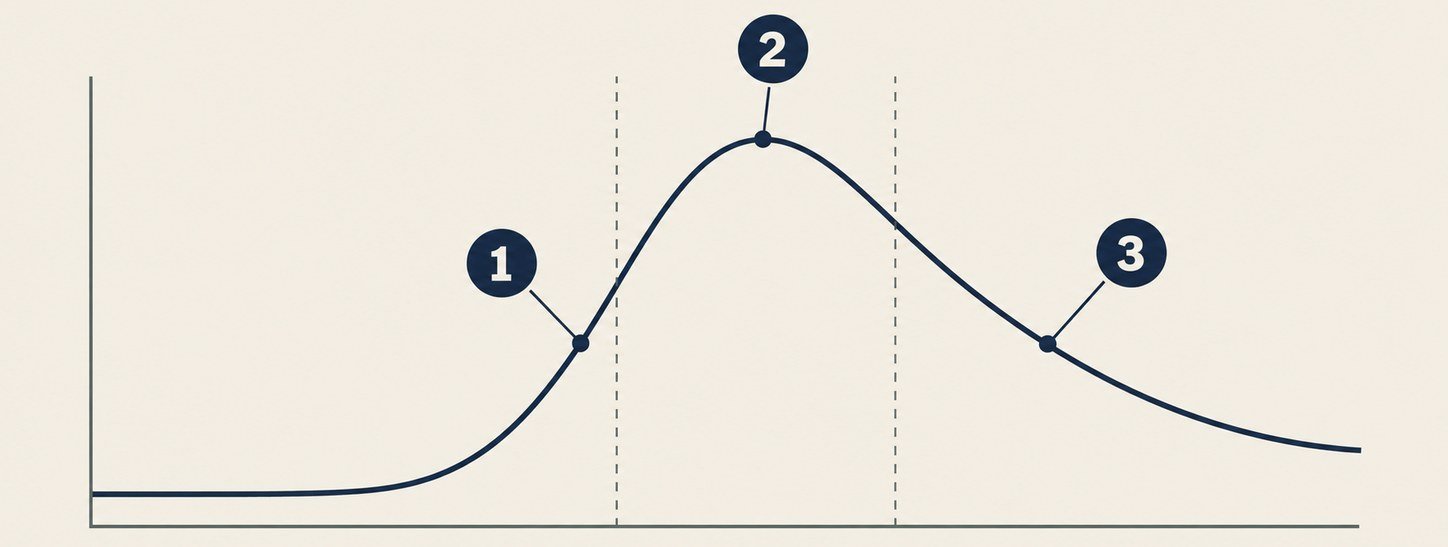
- 1. Rising: a fast rise tends to stop movement
- 2. Peak
- 3. Dropping: movement can pick up as flows drop
Snake and Columbia study patterns describe migration, not a bite forecast.
Color: Plugs work best from emerald green through clear water. Green often accompanies a dropping river. Choose smaller plugs in low, clear water and larger ones in high or colored water. Color helps you choose a plug. It doesn't promise a strike.
Speed and depth: The maker's general steelhead-water example is 4–8 ft deep at about walking speed. An Oregon technique column describes 3–6 ft of broken-surface water. Both are examples, not Washington numbers. The real question is whether the current keeps the plug working where fish may hold.
Temperature: Whatever the temperature, give the plugs time. Back down slowly and pause over the best holding spots.
Light: UV finishes are paints that reflect ultraviolet light. The maker says steelhead respond to them, especially in low light. In clear water, the maker suggests natural crawfish, shrimp or dark patterns. In colored water, it suggests fluorescent red or chartreuse. It says mother-of-pearl with a black lip works in any water.
Plug Size and Color Card

- 1. Small plug: low clear water
- 2. Standard: most days
- 3. Larger: high or colored water
- 4. Clear water: natural or dark
- 5. Colored water: fluorescent
Rods, Reels, Line and Leader
Choose a rod that shows the plug's movement without folding under its pull. A soft tip shows the wobble. A firm lower section, the butt, sets the hook and controls the fish. To load is to bend under steady pressure.
A baitcaster is a baitcasting reel with a revolving spool. Its level-wind guide moves across that spool to lay line evenly. A line counter shows how much line has gone out. These reels help anglers match the spread, the row of lures behind the boat. Let-out is the measured length of line running behind the boat.
Monofilament, or mono, is a single strand of line. Braid is woven from fibers. The leader is the line between the swivel and the plug's snap, or the bait hook on a diver rig. Fluorocarbon is leader material that is harder for fish to see.
| Gear | Starting Setup | Why It Helps |
|---|---|---|
| Rod | About 7 1/2–8 1/2 ft with a soft tip and a firm butt. | The tip shows the wiggle; the butt sets the hook. |
| Reel | Level-wind baitcaster; a line counter is helpful. | Makes equal let-out easier while the rower stays on the oars. |
| Plug Main Line | 8–15 lb mono, with matching line across the spread. | Line diameter affects how deeply plugs dive. |
| Plug Leader | About 3 ft, the same test as your main line or lighter. | The leader breaks first, so you keep the rest of the rig. |
| Diver Main Line and Leader | 15–20 lb main line; 40–60 in of 12–15 lb leader. | The leader stays lighter than the main line. |
| Plugs | Standard steelhead sizes, with smaller options for low, clear water. | Keeps size changes tied to water conditions. |
| Snap | The round-eyed snap that comes with the plug, a wire clip with a rounded loop. | Leaves the plug room to move freely. |
Some anglers prefer fiberglass for its softer tip. For diver and bait, the maker recommends a medium-action rod over a very responsive action, giving fish time to hold the bait. Check your rod's own ratings before matching it to tackle.
Thinner line lets a plug dive deeper; thicker line holds it higher. One rod on 15 lb and another on 12 lb can be enough difference to cost strikes. Match line and measure distance before blaming lure color.
With braid, the plug maker's rig is braid, then one barrel swivel, a small rotating connector that reduces line twist, then about 3 ft of mono leader. Some anglers tie a mono top shot onto the braid instead, a length of mono that adds stretch and lets a snag break off. The top shot then works as your main line, so the rig still has one swivel. Keep the leader the same test as the main line or lighter. A solid hang-up on braid can pull the boat out of position or into a hazard.
Without a counter, measure how much line your reel releases as its guide crosses the spool. Then count those level-wind passes. Measure your own reel; don't borrow another reel's number. Color marks or a stop knot at a measured distance are alternatives.
Starter Kit vs Upgrade Path
Starter Kit
- Rod and reel: Begin with the generic soft-tip rod and level-wind setup above. The useful feature is controlled, repeatable let-out.
- Plugs: A Yakima Bait Mag Lip 3.5, or the 3.0 for low, clear water. Or a Luhr-Jensen Hot Shot: the #30 most days and the #50 for low, clear water. Start with two or three of one model in two colors before adding more shapes.
- Line and leader: Izorline XXX Super Co-Polymer Hi-Vis Yellow is a hi-vis main line made in 8–20 lb. Most anglers use 8–15 lb for plugs. Seaguar STS Trout & Steelhead is a fluorocarbon leader made in 4–17 lb. Pick a test no heavier than your main line.
- Buy local: A tackle shop near the river you plan to fish can tell you which colors are working.
Upgrade Path
- Improve measurement: A line counter makes resetting a cleaned plug to its previous distance easier.
- Add a different presentation: A Luhr-Jensen Jet Diver carries bait down and floats up when pressure eases. Learn its rig (under Diver and Bait) before you add it to the spread.
- Prepare spare leaders: Carry matching leaders and snaps so you can swap out damaged tackle without rushed knots. Keep each leader at or below its main-line strength.
Before buying more tackle, settle the boat plan and life jackets. Washington State Parks' life-jacket guidance is linked under Safety. If you don't run a boat, book a guided day or fish a bank method.
Terminal Tackle and Rigging, Step by Step
Check WDFW's hook, bait and scent rules for your stretch before you build a rig. The plug rig and the diver rig are different; their knots and main-line tests differ.
Plug Rig and Diver-and-Bait Rig
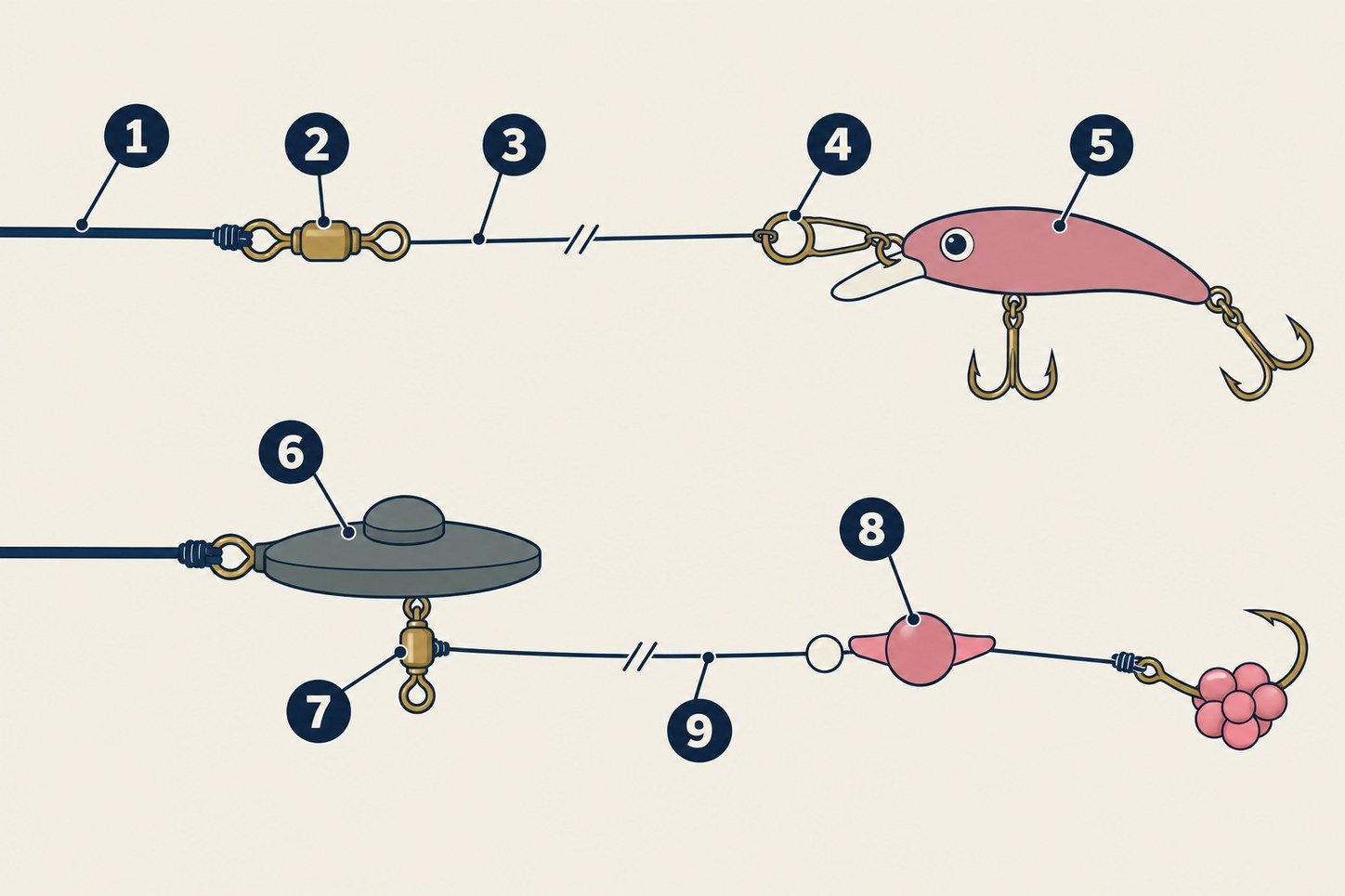
- 1. Main line
- 2. Small barrel swivel
- 3. About 3 ft leader at or below the main line
- 4. Round-eyed snap
- 5. Plug
- 6. Diver
- 7. Swivel
- 8. Bead and winged drift bobber
- 9. 40–60 in leader of 12–15 lb under 15–20 lb main line
How It Works, Step by Step
- Join main line to swivel. Tie the mono main line to a small barrel swivel with an improved clinch knot, the knot the plug maker uses. Drift Fishing shows it step by step. With a top shot, tie the top shot to the swivel the same way. With braid and no top shot, tie the braid to the swivel with the knot the braid maker recommends. Either way, the rig has one swivel.
- Add the leader. Use about 3 ft, the same test as your main line or lighter. Other methods use other leader lengths, so follow the rig for the method you're fishing. Check the leader for rough spots before you tie.
- Attach the snap. Tie the leader to the round-eyed snap that came with the plug, again with an improved clinch knot. Clip it to the plug's attachment eye. Tying directly to the eye or changing the snap can spoil the action.
- Inspect hooks. A treble is a hook with three points. Hot Shots come with strong trebles. Check WDFW's hook rules for your stretch before you fish them. Replace bent or twisted hooks and keep points sharp.
- Check the whole rig. Pull-test the connections, clear the hooks from the line and test the plug's movement before sending it downstream.
Flatlining means fishing the plug without a separate weight or diver. Current makes it dive. It's the usual setup for steelhead.
Choosing the Plug
The Hot Shot #30 is the maker's all-around river size. It dives to about 10 ft. The smaller #50 dives up to 8 ft and suits low, clear water. The maker's page lists the #30, #50 and #70.
The Mag Lip 3.0 and 3.5 are popular steelhead sizes. The 3.0 is 3 in long and weighs .21 oz. The 3.5 is 3 1/2 in long and weighs .33 oz. The maker says the 3.5 can dive to 14 ft. The maker also says it handles current up to 4 mph. Let-out changes how deep it runs. Check its action in the water you plan to fish.
Sources differ here. One says to run the same model and size on every rod so they fish the same depth. Another says to try different shapes and colors and let the fish choose. If you mix, know that they run at different depths. Keep every plug the same distance back either way.
Diver and Bait
A drift bobber is a buoyant lure that helps hold the hook above the rocks. A winged drift bobber has wings that make it spin, and it keeps the bait off the bottom. A snell is a knot that ties the leader along the hook shank. An egg loop is a snell that leaves a loop to hold bait against the hook shank. Drift Fishing shows the egg loop step by step.
To rig a smaller Jet Diver directly:
- Match the line. Use 15–20 lb main line with a 40–60 in leader of 12–15 lb.
- Connect the diver. Attach the main line to the diver's snap.
- Prepare the bait leader. Slide a small bead and a size 3 winged drift bobber onto a pre-snelled leader, one with the hook already snelled on. Tie the leader to the swivel below the diver's air chamber.
- Choose the hook and bait. A Gamakatsu Octopus hook works as the bait hook. Bait it with cluster eggs, shrimp or a bait strip. Check WDFW's bait rules first.
- Choose diving depth. Jet Divers are rated by depth. The number is the running depth in feet, from the 010 (10 ft) to the 050 (50 ft). The maker's example uses a 020 for water 10–12 ft deep. Choose a diver rated comfortably deeper than the target.
A sliding dropper is a short diver connection that moves along the main line. A soft bite reaches the rod tip without the diver in the way. To rig it, slide a size 7 or 5 barrel swivel onto the main line. Add four 6 mm beads, then tie a barrel swivel at the end. Tie the bait leader to that fixed swivel. Connect an 8–12 in dropper to the sliding swivel and snap the diver onto it. Use the same 15–20 lb main line and 40–60 in leader of 12–15 lb.
Tuning a Plug
Tuning adjusts the pull point, where the line attaches, so the plug tracks straight. Test before fishing. With about 6 ft of line out, pull the plug briskly beside the boat. It should dive and wiggle without rolling or pulling aside.
The bill is the plug's diving lip. An eyelet is the small loop the snap clips to. With the bill facing you, bend a fixed eyelet slightly opposite the direction the plug runs. Use small pliers and tiny changes. A screw eye has a threaded stem and is turned instead of bent. Hot Shots have screw eyes. With the bill facing you, turn it clockwise if the plug runs left and counterclockwise if it runs right. For a Kwikfish, a salmon plug, follow the maker's own tuning note.
For a Mag Lip, first test in the current behind the boat with the rod tip pointing downstream. Its skip-beat action, an occasional dart in the wobble, does not by itself mean it needs tuning.
Tuning a Plug
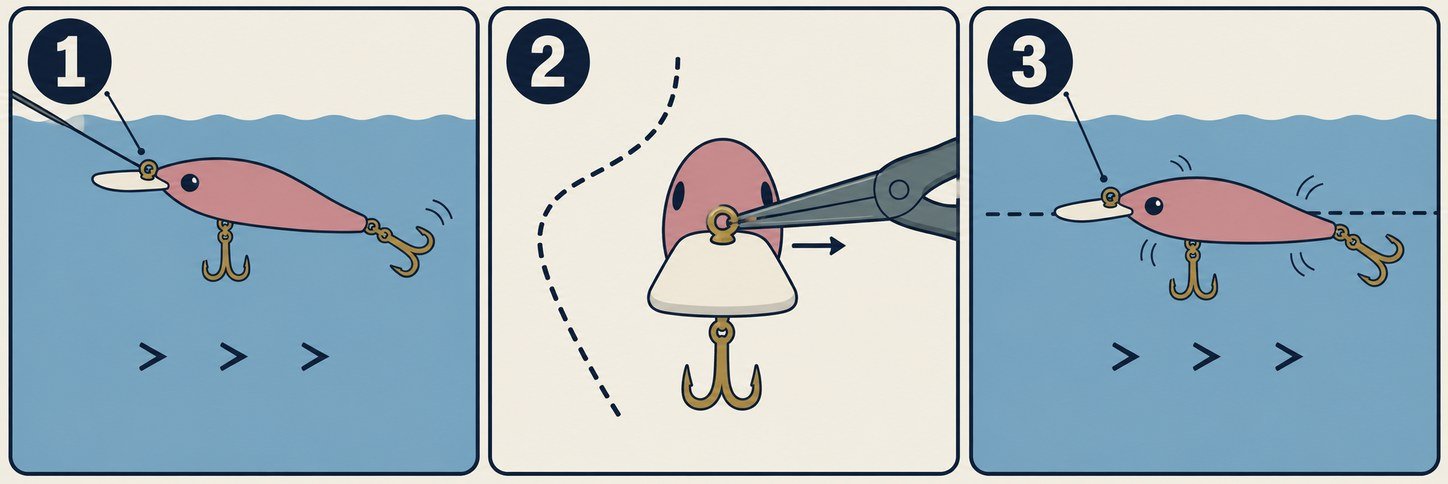
 Pull with about 6 ft of line beside the boat
 Runs left: with the bill facing you, bend the eyelet a little the other way, or turn a screw eye clockwise
 Straight dive and wiggle
- 1. Pull with about 6 ft of line beside the boat
- 2. Runs left: with the bill facing you, bend the eyelet a little the other way, or turn a screw eye clockwise
- 3. Straight dive and wiggle
Brushing Up: Test the plug again after you change hooks or add a wrap. Check the action before you adjust it again.
By Species
Winter Steelhead
Start with a standard steelhead plug and go smaller in low, clear water. Work slowly toward holding water, and spend the most time on tailouts and their deep side by a steep bank. Pause instead of sweeping past the best spot.
Use the plug leader already described: about 3 ft, the same test as your main line or lighter. Read the regional winter timing above alongside current conditions and WDFW rules.
Summer Steelhead
A few western Washington rivers have summer fish. Keep the basic rig and adjust to the water you find. Smaller plugs are the low-clear-water option.
Chinook
For Chinook (kings), anglers use larger plugs, often wrapped with a sardine fillet. Luhr-Jensen Kwikfish in K14–K16 is one salmon choice. The Mag Lip 4.5 is another. It's a larger size than the Mag Lip in the Gear box.
For the Mag Lip 4.5, cut a sardine fillet about 1 3/4 in long and 5/8 in wide. Place it skin-side down and secure it with light mono or elastic thread. Finish with three to four half hitches, small locking loops around the wrap. Keep the hooks clear. The 3.5 takes only a tiny wrap.
Some anglers replace trebles with siwash hooks, single-point lure hooks. Check WDFW's hook and bait rules, then test the finished plug again. Wait for a wrapped plug's rod to stay down steadily or pulse three to four times before responding.
Coho and Chum
Plugs and divers are also used for salmon. This page doesn't cover coho or chum plug rigs, so start with the rigging and boat work above. Check WDFW for the species and stretch before you plan the trip.
Technique, Step by Step
Overhead View of a Plug Spread
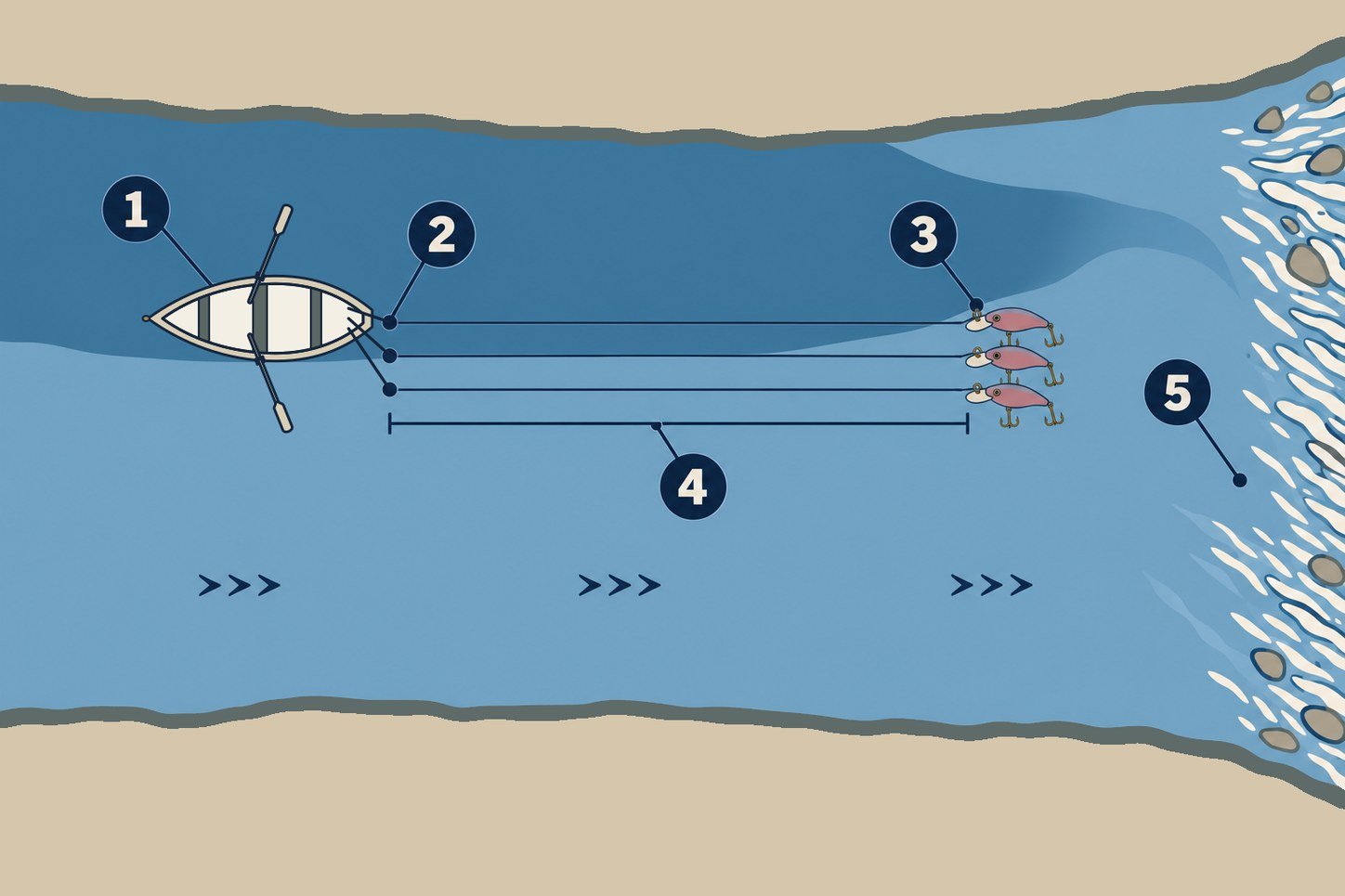
- 1. Drift boat held above a tailout
- 2. Rods at the same start point
- 3. Three plugs side by side at the same distance (the wall)
- 4. Let-out 40–50 ft: most of the time
- 5. Tailout
How It Works, Step by Step
- Hold at the top of the run. The rower holds the boat steady at the upper end while the anglers prepare to release line. Check the water below before you turn to the rods.
- Let the plugs out together. Use 40–50 ft in most conditions. About 30 ft suits shallow water or short runs. Use 50–70 ft for a deeper dive or more distance in clear water. Measure with the line counter or your measured level-wind passes.
- Build the wall. The wall is the row of plugs running side by side at the same distance. Rod holders must also start the same distance from the stern, the back of the boat. If they don't, plugs on the same let-out still run at different distances.
- Set the rods and drag. Set rods in holders about 30 degrees above the water. A rod bent too far hides the wiggle and lets fish spit the plug. Hand-held rods rest low on the gunwale, the boat's upper side edge. Set the drag, which releases line under pressure, before a fish strikes.
- Slip downstream slowly. The rower eases the boat back while keeping it slower than the current. You can't back down too slowly, but you can go too fast. Watch the rod tips, not the clock.
- Hold in the kitchen. The kitchen is the spot where fish are caught most often. Pause the boat there for a minute or more, then continue backing down.
- Sweep the holding water. The rower moves sideways to carry the spread across the run. Work the deeper tailout side first, then sweep toward the other side if needed.
- Check any changed tip. A steady throb shows a working plug above the bottom. If the beat changes, the plug may be digging into the bottom. Reel it up about 10 ft at a time until the throb returns. Then match the other plugs to that distance. Debris can also change the beat. Reel in a fouled plug, clean it and let it back out to the same distance.
Back-Trolling Sequence
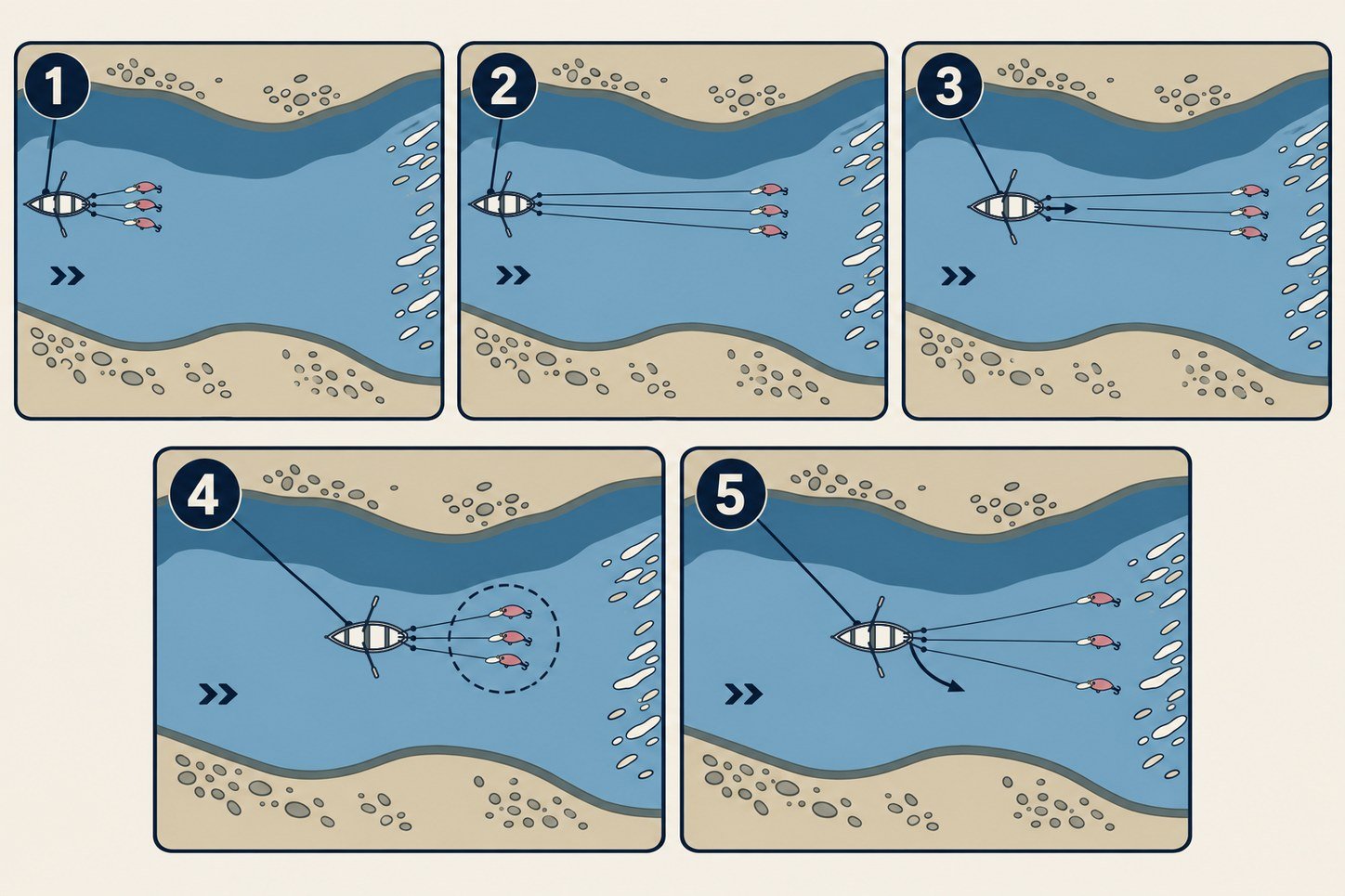
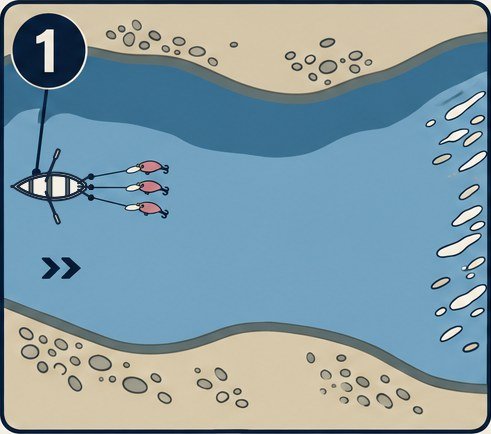
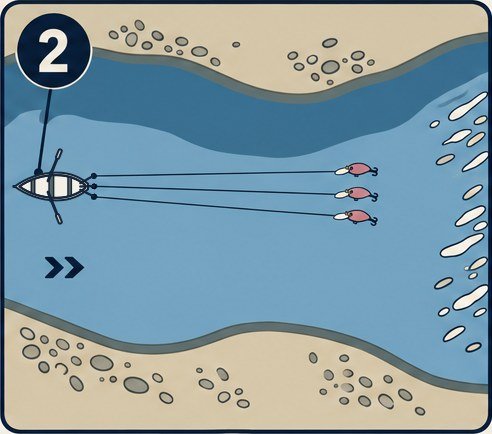
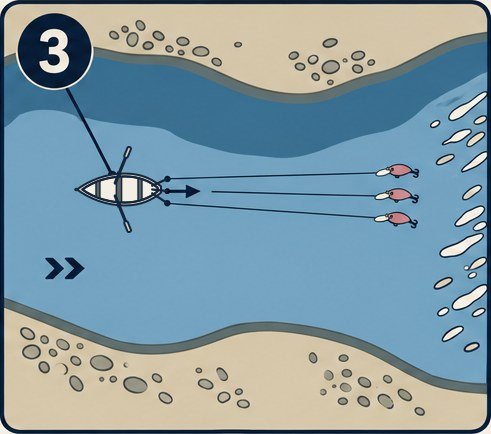
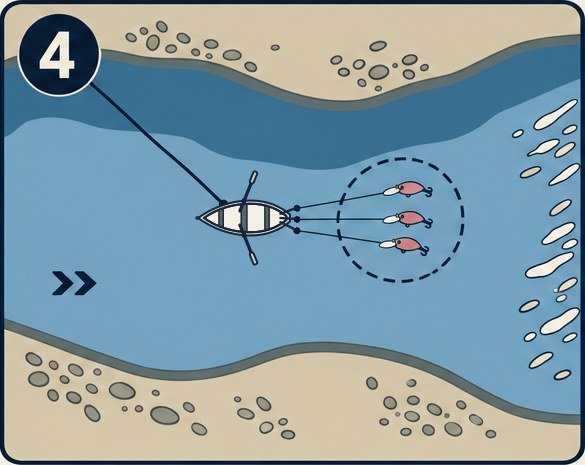
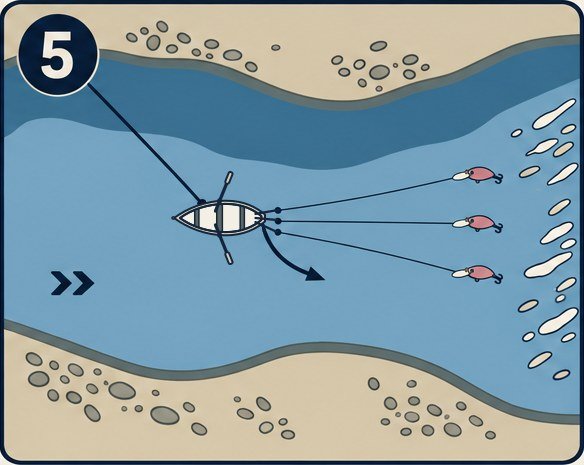
- 1. Hold at the top of the run
- 2. Let out to the same distance
- 3. Slip down slower than the current
- 4. Hold in the kitchen
- 5. Sweep to the other side of the tailout
Reading the Rod Tip
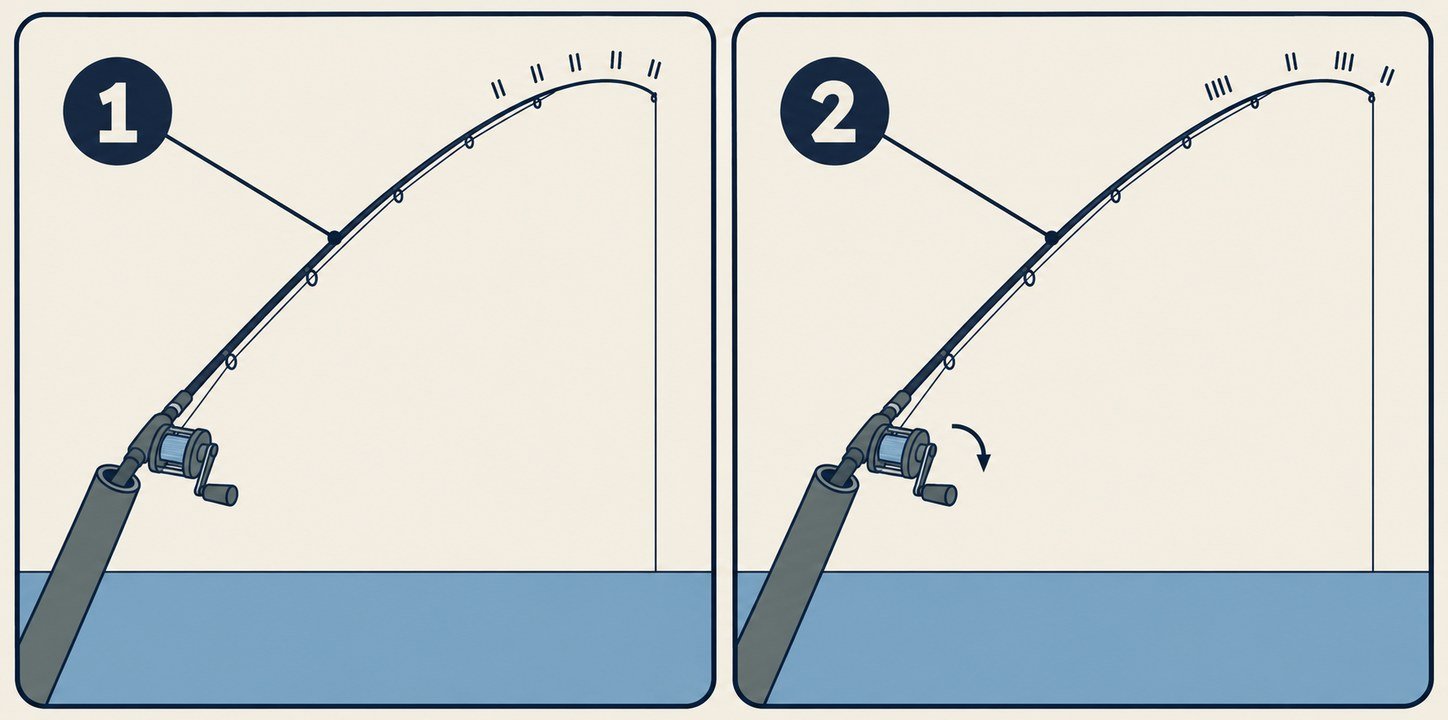
 Steady throb: working
 Changed beat: digging, reel up about 10 ft
- 1. Steady throb: working
- 2. Changed beat: digging, reel up about 10 ft
Reading the Water
Tailouts hold most winter steelhead caught on plugs, the maker says. They're often on the deep side by a steep bank. Work down toward them from the top of the run. Keep enough room to retrieve tackle or move away from the rapid below.
Other holding places include water below boulders, root wads and underwater drop-offs, plus current edges and seams. A root wad is the root mass of a fallen tree. Cover that holds fish can also be a boat hazard.
In low, clear water, fish the middle or top of pools, deep slots and broken fast water. You still start at the top of the run.
Where Plugs Find Fish
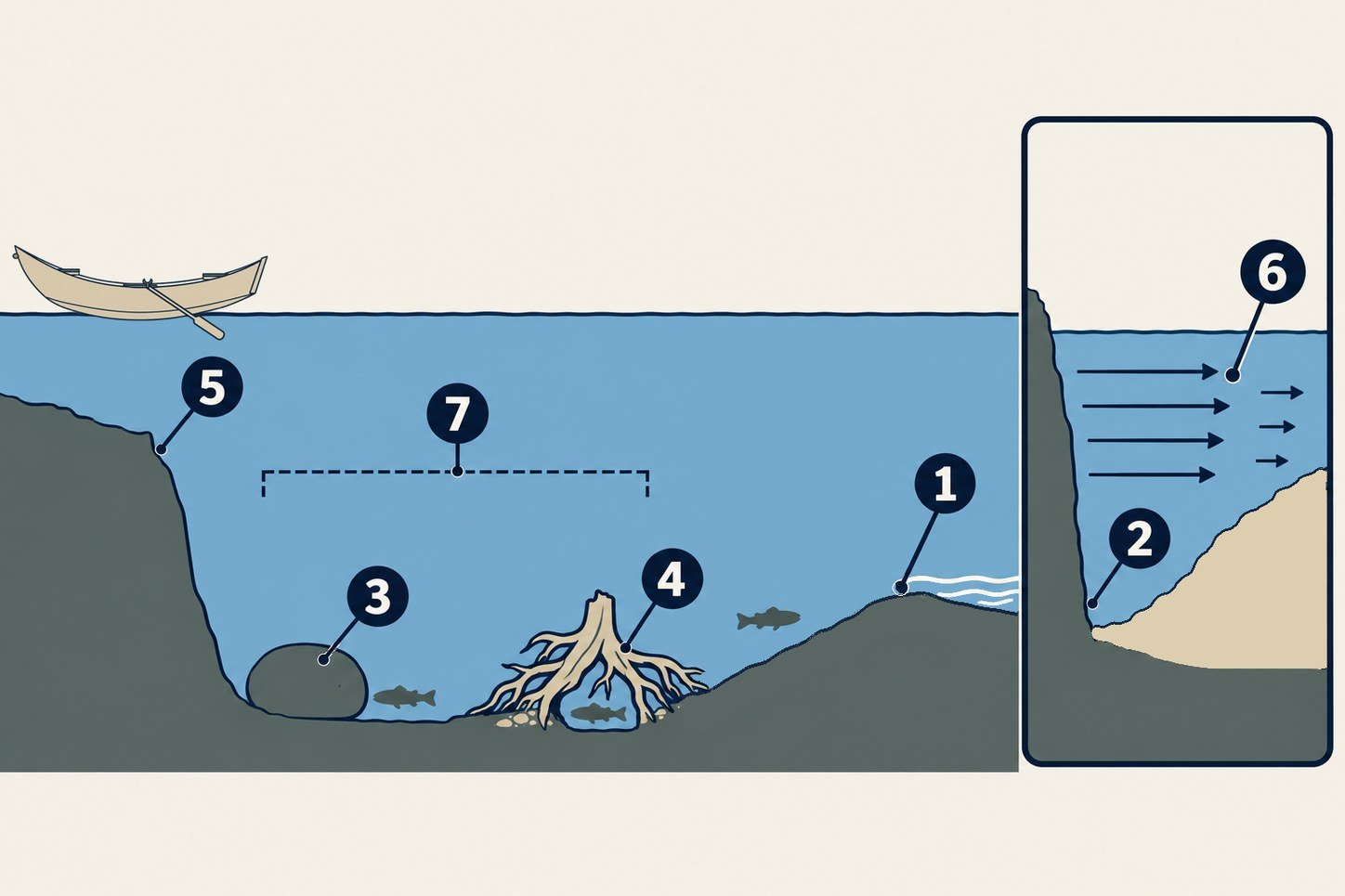
- 1. Tailout lower third
- 2. Deep side by a steep bank
- 3. Boulder
- 4. Root wad
- 5. Drop-off
- 6. Seam
- 7. Low-water: middle or top of the hole
Worked Examples
These are plans, not catch reports. Pick only water the rower can handle, and check access, conditions and the current rules first.
A Winter Morning on the Bogachiel
Check WDFW's rules on fishing from a boat for your section of the Bogachiel. Plan access at Wilson and compare the 12042800 gauge trend with the river's color.
Hold at the top of the run. The rower keeps the drift boat steady while the anglers prepare the spread. If the water is dropping toward emerald green, work toward the tailout's deeper bank side.
For this example, set three plugs 45 ft back using measured level-wind passes. Align the rod-holder start points and keep the plugs even. Use about 3 ft of leader, the same test as the main line or lighter.
Slip down slowly, then hold for a minute in the kitchen. If a rod in its holder buries, keep your hands off at first. Once the hooks are set, lift the rod out and reel. Don't yank back. Follow WDFW's handling rules for any release.
Rules change by river and in season. Check the current WDFW sport fishing regulations and emergency rules before every trip.
A Low, Clear Day
Check WDFW's rules on fishing from a boat for your stretch.
Hold at the top of the run. Set the boat before letting out the plugs. Choose a smaller Hot Shot #50 or Mag Lip 3.0 and measure 50–70 ft of let-out. Keep about 3 ft of leader at the same test as the main line or lighter.
Fish the middle and top of the pool. Deep slots and broken water can hold fish in low water too. Back through slowly and watch for a steady throb on each rod. The rower still watches the water around the boat, not the long lines.
If a rod in its holder buries, let it load before you lift and reel. If nothing hits, finish the pass and check the plugs. Then go back to the top and try a different style or color.
Rules change by river and in season. Check the current WDFW sport fishing regulations and emergency rules before every trip.
A High, Colored Day With a Diver and Bait
Check WDFW's bait, hook and boat rules for your stretch. High water is no reason to launch beyond what the rower can handle.
Hold at the top of the run. Settle the boat before sending the diver downstream. For water 10–12 ft deep, use a Jet Diver 020. Pair 15–20 lb main line with a 40–60 in leader of 12–15 lb.
Build the direct diver rig with its bead, winged drift bobber and bait hook. Bait it with cluster eggs, shrimp or a bait strip.
Keep the boat slower than the river so the diver continues working. On the first bite, hold the boat steady and wait. Respond when the rod tip stays down, not at the first tap. If the boat gets hard to control, reel in and deal with the boat first.
Rules change by river and in season. Check the current WDFW sport fishing regulations and emergency rules before every trip.
Fall Salmon on the Hoh From a Raft
Check WDFW's bait and boat rules for the Hoh. Upstream of the Olympic National Park boundary, check the park's rules too.
Hold at the top of the run. The rower steadies the raft before the plug goes downstream. Fish a larger plug: a Mag Lip 4.5 with a sardine wrap. It's a larger size than the Gear box Mag Lip. Check that the wrapped plug tracks straight behind the boat before you fish it.
Back down slower than the current and pause over holding water. If the rod goes down, wait until it stays down or pulses three to four times before you take it. Reel in the other rods and keep the rower free to handle the raft.
Plan the launch and takeout with WDFW's water access sites before the trip.
Rules change by river and in season. Check the current WDFW sport fishing regulations and emergency rules before every trip.
The Strike, Hook Set, Fight and Landing
A plug strike can turn the steady pulse into a deep, sustained bend. Sources differ on the hook set, so decide how you'll respond before it happens.
- Rod in a holder: Keep your hands off at first. Watch for a few seconds that the hooks are set. Then lift the rod out and reel a few cranks. Yanking back pulls hooks out.
- Rod in your hands: With the rod held low, set as it bottoms out under the fish's pull. Put your thumb on the spool for the set, then let the drag work. The maker says holding the rod may hook more fish per strike.
- Diver and bait: Stop the boat's downstream slip, hold steady and wait until the tip stays down.
- Wrapped salmon plug: Wait until the rod stays down or pulses three to four times.
Other anglers should retrieve their plugs and clear the working space. The rower holds the boat or pulls toward softer water. Keep the net ready without crowding the oars.
Maintain steady pressure and let the drag release line when needed. If a fish goes under the boat, lower the rod tip into the water to keep the line clear of the hull. Avoid giving slack while changing position.
Lead the fish head-first into a soft net. Keep hands away from loose hooks; a thrashing fish can drive a plug hook into nearby skin. Use pliers and keep control of both fish and lure.
Handling and Release
Prepare the release tools before a fish reaches the boat. Use a soft, knotless rubber net and keep a fish intended for release in the water. Long pliers or a dehooker can help free the hook without lifting the fish.
Read WDFW's current handling rules, including whether released steelhead may be removed from the water. A photo doesn't change those rules.
Wet your hands, support the fish and keep fingers away from its gills. Cut the leader if a deeply buried hook cannot be removed cleanly. Single hooks usually come out faster than trebles, but any hook needs careful handling.
Hold the fish upright facing gentle current until it swims away under its own power. Check WDFW's rules before you keep any fish.
Common Mistakes and Fixes
| Mistake | What You Notice | Fix |
|---|---|---|
| Plug out of tune | It pulls aside or rolls | Test and make tiny adjustments; use the correct eyelet or screw-eye method. |
| Uneven let-out | Plugs trail at different distances | Measure line and align rod-holder start points. |
| Backing down too fast | Plug action fades | Slow the boat enough to restore water pressure over the plugs. |
| Never pausing | Holding spots pass quickly | Hold in the kitchen before continuing. |
| Setting too early | The rod unloads as you grab it | Follow the holder, hand-held, diver or wrapped-plug response above. |
| Wrong snap or direct tie | Action becomes weak or uneven | Use the round-eyed snap that came with the plug. |
| Dull or bent hooks | Hook points are damaged | Sharpen or replace and check after fish or hard snags. |
| Fouled plug ignored | A tip's rhythm changes | Retrieve and inspect; clean and reset to the measured distance. |
| Plug digging too hard | The steady throb changes | Check for debris. Reel up about 10 ft at a time until the throb returns, then even out the spread. |
Tips That Make the Difference
- Change with a purpose. The same model and size on every rod keeps depths even. Mixing colors or shapes works too, but they run at different depths.
- Use scent thoughtfully. Shrimp or egg scents are steelhead choices. Sticky scent gel on the bill is another option; check WDFW scent rules first.
- Retest added tackle. The maker suggests a 3 in pink or orange soft worm on one point of the tail treble. Check the rules and test the plug's movement after adding it.
- Try a fresh pass. After a run without a strike, a different style or color is an option. Return to the top before backing down again.
- Keep spares ready. Prepare leaders with snaps and mark their strength. Keep them at or below the main-line test.
- Give newcomers a clear job. Watching the rod tip is a job a beginner can do without learning to cast.
After fishing, wash scent from the plugs with warm water and degreasing soap. Cut off the last 10–15 ft of mono, which gets scraped on logs and rocks.
When It's Slow
Check the working rig first. Is the plug tuned? Are the hooks clear? Is the leader damaged? Does the rod still show the usual pulse?
Then check distance and boat speed. A longer let-out fishes deeper and can help in clear water, but keep every plug the same distance back. Slow down and spend more time in holding spots before changing everything.
Try a smaller, more natural plug in clear water or a larger, brighter choice in colored water. A diver and bait offers a different presentation after checking WDFW's bait rules. If the water no longer suits plugs, move on or try Side Drifting or Float Fishing.
Safety
The rower needs attention and room to work. Agree on a clear call for retrieving tackle, staying seated or preparing to move.
- Life jackets: Wear a life jacket that fits. Washington State Parks says to carry a properly fitted U.S. Coast Guard-approved life jacket for each person. Check its life-jacket guidance for the children's and throwable rules.
- Boater education: Check Washington State Parks' boater education rules, especially if you run a motor.
- Tailouts: Working close to a tailout in a drift boat is risky. The rower needs a plan: pull back into soft water when a fish hooks up, get the plugs out or row down the rapid if the fish goes that way. Look at the rapid before you fish above it.
- Braid hang-ups: A firm snag can pull the boat out of position or toward a hazard. Put boat control ahead of recovering a lure.
- Wood: Sweepers are trees or branches hanging into the water. Strainers let water through but trap boats and people. Know what lies downstream, including logs piled against bridge piers.
- Cold water: Many Washington waters stay under 60°F most of the year. Cold water shock is a risk even when the air feels warm. Read Washington State Parks' cold-water guidance. Wear waterproof layers and carry dry clothing.
- Rising rivers: Recheck gauge trends and forecasts during rain. Be ready to change the route or end the trip as conditions worsen.
- Inside the boat: Stay seated when the rower is holding hard or moving through rough water. Secure loose plugs and keep hooks away from hands, clothing and the oars.
Boat Safety Strip
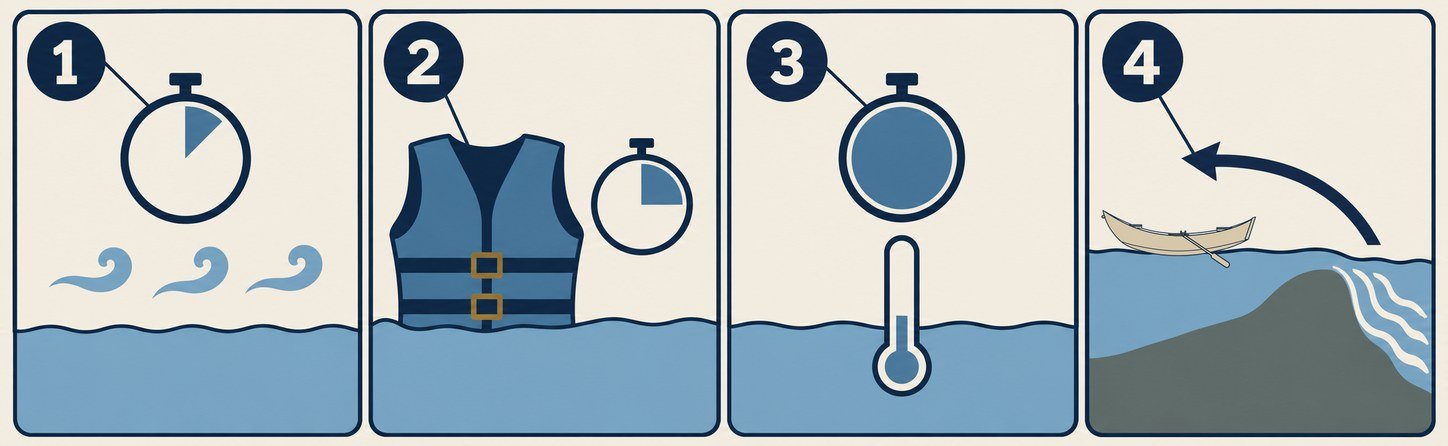
 About 1 minute to control breathing
 About 10 minutes of useful movement
 About an hour before hypothermia takes consciousness
 Tailout danger: pull to soft water or commit to the rapid
- 1. About 1 minute to control breathing
- 2. About 10 minutes of useful movement
- 3. About an hour before hypothermia takes consciousness
- 4. Tailout danger: pull to soft water or commit to the rapid
Source: Washington State Parks and Recreation Commission
Don't anchor in the holes; it takes water from other anglers. Give other boats and bank anglers room.
WDFW Rules to Check
Check the exact river section, date and species before choosing the rig or launching. Include:
- Whether the stretch is open for the intended fishing.
- Retention requirements and identification of wild and hatchery fish.
- Rod, line and hook counts.
- Hook type, trebles, barbs and hook size.
- Bait, bait wraps and scent.
- Selective-gear, weight and anti-snagging rules. Selective gear is WDFW's term for gear limits on some waters, so read its definition in the rules.
- Fishing from a boat or floating device.
- Motor rules for your section.
- Handling and release requirements.
- Licenses, catch record cards and night-fishing rules.
On coastal rivers, rules on fishing from a boat or floating device can differ by stretch. Check WDFW's regulations before you launch. A rig diagram or worked example doesn't answer these questions.
Rules change by river and in season. Check the current WDFW sport fishing regulations and emergency rules before every trip.
A Guided Day and What to Ask
A booked plug trip gives you a way to learn the rod work while your guide runs the boat. The core task is watching the tip and responding when it loads. Ask about the boat, where to meet and what's included. Trips differ.
Before you leave the launch, ask what a working plug looks like on the rod and how to handle a strike. Agree on who clears other rods and who nets the fish. Keep the rower's workspace clear throughout the day.
Questions worth asking before booking:
- How much of the day will involve plugs, side drifting or floats?
- What boat will we use and how many anglers will be aboard?
- Will I hold the rod or use a holder?
- What tackle, clothing and safety equipment should I bring?
- What happens if rain or flows make the planned route unsuitable?
- Which fish are we after, and what may we keep under the current rules?
- Which hook, bait, scent, boat and motor rules affect the planned stretch?
- What should everyone do when a rod goes down?
Ask your guide for their WDFW guide license number before you book.
Learn More
- WDFW Sport Fishing Regulations and Emergency Rules — check the exact trip and river section.
- Washington State Parks: Wear a Life Jacket — fit and requirements to review.
- Washington State Parks: Cold Water Safety — immersion hazards and preparation.
- Washington State Parks: Boater Education & Safety — education rules to check.
- USGS Water Data for Washington and NOAA Northwest River Forecast Center — compare observations with the forecast trend.
- Drift Fishing — improved clinch and egg-loop instructions.
- Yakima Bait: Back-Trolling Plugs for Winter Steelhead and Luhr-Jensen Tech Reports — the makers' how-tos on plugs and divers.
Glossary
- Back-Trolling
- Holding back so the boat moves downstream slower than the current.
- Hot-Shotting
- An older name for pulling plugs, taken from the Hot Shot plug.
- Plug
- Floating hard lure with a diving lip that works in current.
- Diver
- Buoyant device that carries bait down under current pressure.
- Flatlining
- Fishing a plug without added weight or a diver.
- Let-Out
- Measured line released behind the boat.
- Spread or Wall
- Plugs arranged side by side at the same distance.
- Kitchen
- Holding spot where the boat pauses to work the plugs.
- Tuning
- Adjusting the pull point so a plug runs straight.
- Tailout
- The shallowing end of a pool above the next riffle.
- Riffle
- Shallow, moving water with a broken surface.
- Run
- A stretch of fairly steady current.
- Seam
- The boundary between currents moving at different speeds.
- Slot
- A deeper trough in the river.
- Kicker
- Small outboard used to control the drift.
- Jet Sled
- A powered river boat.
- Takeout
- The ramp where you pull the boat out.
- Gunwale
- The upper edge of the boat's side.
- Level-Wind
- Reel guide that moves across the spool to lay line evenly.
- Line Counter
- Reel feature that measures released line.
- Top Shot
- A length of mono added to braided main line for stretch.
- Leader
- Line between the swivel and the plug's snap or the bait hook.
- Fluorocarbon
- Leader material that is harder for fish to see.
- Barrel Swivel
- Small rotating connector that reduces line twist.
- Round-Eyed Snap
- Wire clip with a rounded loop that comes with the plug.
- Treble
- A hook with three points.
- Siwash
- A single-point lure hook.
- Bill
- The plug's diving lip.
- Screw Eye
- Threaded pull point that is turned, not bent, to tune a plug.
- Skip-Beat
- The Mag Lip's occasional dart; not a sign it's out of tune.
- Drift Bobber
- A buoyant lure that helps hold the hook above the rocks.
- Snell
- Knot that ties the leader along the hook shank.
- Egg Loop
- A snell that leaves a loop to hold bait against the hook shank.
- Drag
- The reel mechanism that releases line under pressure.
- Turbidity
- Water cloudiness caused by suspended material.
- Hydrograph
- A chart of river measurements over time.
- Creel Survey
- WDFW interviews with anglers about their fishing.
- Selective Gear
- WDFW term for gear limits on some waters; read its definition in the rules.
- Sweeper
- Tree or branch hanging into the water.
- Strainer
- Wood that lets water through but traps boats and people.
- Sliding Dropper
- Short diver connection that moves along the main line.
Guides Who Specialize in This
More River Methods
Explore Drift Fishing, Side Drifting, Float Fishing and Plunking for other ways to present a lure or bait in current.
At a Glance
| Field | Summary |
|---|---|
| Main Species | Steelhead and salmon. |
| Water | Rivers; a boat method with limited bank adaptations. |
| River Focus | Bogachiel, Sol Duc, Hoh and Calawah. |
| Best Times | WDFW north coast creel patterns: hatchery steelhead kept mostly December–January; wild steelhead released mostly February–April. Fall salmon on the Hoh. Patterns, not season dates. |
| In Short | A boat method: hold at the top, let plugs out evenly and back down slower than the current. |
| Skill Level | Easy rod work; rowing well takes practice and time. |
| Key Gear | About 7 1/2–8 1/2 ft soft-tip rod, level-wind reel and matching 8–15 lb mono for plugs. Plug leader: about 3 ft, the same test as the main line or lighter. |
| Diver Alternative | 15–20 lb main line with a 40–60 in leader of 12–15 lb. |
| Let-Out | 40–50 ft most of the time; about 30 ft shallow or short; 50–70 ft deeper or clear. |
| Before Launching | Check WDFW's fishing-from-boat rules, access, river trend and the downstream route. |
On This Page
- What It Is and When It Beats Other Methods
- Target Species and Where in Washington
- River by River
- Seasons and Conditions
- Rods, Reels, Line and Leader
- Terminal Tackle and Rigging, Step by Step
- By Species
- Technique, Step by Step
- Worked Examples
- The Strike, Hook Set, Fight and Landing
- Handling and Release
- Common Mistakes and Fixes
- Tips That Make the Difference
- When It's Slow
- Safety
- WDFW Rules to Check
- A Guided Day and What to Ask
- Learn More
- Glossary
- Guides Who Specialize in This
- More River Methods