

Kokanee Trolling
How to troll for kokanee in Washington lakes: finding the 50-degree layer, rigging a dodger, trolling slow with S-turns and keeping fish on the hook.
How to troll for kokanee in Washington lakes: finding the fish's depth, rigging a dodger, trolling slow with S-turns and keeping fish on the hook.
Kokanee are landlocked sockeye salmon that spend their whole lives in fresh water. They feed on plankton, tiny organisms drifting in the water, and prefer water near 50°F. Their feeding depth changes as the lake warms and cools.
The basic rig is simple. A dodger, a thin blade that sways in the water, leads a small lure. A snubber, a rubber shock absorber, cushions the pull on a kokanee's soft mouth. Behind it, a short leader, the line between the dodger and the lure, carries the hook and bait.
You can start with weights instead of a downrigger. A fish-finder, an electronic display of depth and underwater returns, helps you search. A downrigger, a winch that lowers fishing gear with a heavy weight, helps you reach deeper fish. Long lining and a dropper weight, covered below, reach fish without one.
The work is finding the feeding depth, checking lure movement and repeating a useful pass. Once a fish bites, steady pressure matters more than a hard hook set.
What It Is and When It Beats Other Methods
Kokanee trolling means pulling a small lure slowly through open water. A dodger or a gang troll, a string of trolling blades, runs ahead of the lure. Bright spoons and spinners work too. A spoon is a curved metal lure that wobbles side to side. A spinner has a blade turning around a wire shaft.
A hoochie, a small plastic squid lure, gets much of its movement from the dodger. A wedding ring spinner, a small spinner with beads and a blade, has action of its own. Those differences affect the leader length you choose.
Trolling lets you search while keeping the lure at a chosen depth. The aim is a repeatable presentation: useful depth, working lure and controlled speed.
Why It Works
Kokanee filter-feed on tiny plankton in open water. The Washington Department of Fish and Wildlife (WDFW) kokanee page describes trolling blades or dodgers ahead of bright spoons or spinners in silver, red or orange.
The dodger and lure do different jobs. The dodger moves ahead of the lure. A short leader transfers that movement to a hoochie. A longer leader lets a spinner work more freely. Test the assembled rig beside the boat so you can see the difference.
Temperature gives you a starting point for the search. Kokanee prefer water near 50°F, but that doesn't put them at a fixed depth. As the water warms, they move deeper.
This is mainly an open-water boat method. The Oregon Department of Fish and Wildlife (ODFW) kokanee article describes fishing from boats, kayaks and float tubes, with few kokanee caught from the bank.
WDFW's kokanee page also lists still fishing and jigging as ways to catch them. Those methods get their own pages here. For this method, focus on learning how your trolling rig behaves before adding more tackle.
Brushing Up: Keep a useful pass repeatable. Record the gear, line out and direction of travel. A bite is easier to learn from when you know how you presented the lure.
Target Species and Where in Washington
Kokanee are the target. Look for a blue back, silver sides, larger eyes and a deeply forked tail. There are no distinct dark spots on the back or tail. Fish turn bright red before spawning.
See Kokanee for more species context.
The lakes covered below are Lake Roosevelt, Banks Lake, Rufus Woods Lake, Lake Chelan, Lake Samish, Lake Whatcom, Lake Stevens, American Lake, Lake Merwin and Yale Reservoir. See Kokanee Lakes in Washington for notes on each.
Where It Works in Washington
WDFW lists kokanee in many Washington lakes. Some populations are stocked. Lake Roosevelt's kokanee are wild. That background doesn't tell you where fish will be during your visit. Find their depth before choosing how to reach them.
Plan around a boat you can control at slow speed. Think about room for rods, safe movement and a clear place to use the net. Simple tackle helps when space is limited.
Trout share some of these lakes, so check what you catch. What you may keep is a WDFW rule. Check it before every trip.
Kokanee Lakes in Washington
WDFW's lowland lakes pages list species and access by lake. Rules are set by lake, so check each lake's page and the current rules before planning your tackle and trip.
Kokanee Lakes in Washington

- 1. Lake Roosevelt
- 2. Banks Lake
- 3. Rufus Woods Lake
- 4. Lake Chelan
- 5. Lake Samish
- 6. Lake Whatcom
- 7. Lake Stevens
- 8. American Lake
- 9. Lake Merwin
- 10. Yale Reservoir
Lake list from Washington Department of Fish and Wildlife (WDFW) lake pages.
Lake locations: Washington Department of Fish and Wildlife (WDFW). Lake shapes: U.S. Geological Survey (USGS). Simplified; not to scale. Not endorsed by WDFW.
Lake Roosevelt, Banks Lake and Rufus Woods Lake
On Lake Roosevelt, water-level changes can make launching hard. This is a reservoir, a lake held back by a dam. Its kokanee are wild. Check the level before driving, then make sure your launch is usable.
Banks Lake runs almost 27 miles between Coulee City and Electric City. Its WDFW page includes kokanee among the available fish. Rufus Woods Lake runs 51 miles above Chief Joseph Dam. Its WDFW page lists kokanee and carries its own access and license notes.
WDFW's fishing planner gives a Lake Roosevelt leader length of 12 to 20 in. That's for Lake Roosevelt. The general leader rules are in Terminal Tackle.
Use the NWS Spokane forecast office for all three, including wind. Decide before you leave whether the day suits your boat.
Check WDFW's Lake Roosevelt page for access and its own rules.
Rules change by lake and in season. Check the current WDFW sport fishing regulations and emergency rules before every trip.
Lake Chelan
On Lake Chelan, the lake stretches more than 50 miles from Chelan to Stehekin. It's Washington's largest natural lake. Pick a route and a turnaround point that suit your boat and the forecast.
WDFW's Lake Chelan page says kokanee fishing is usually best from mid-April through June. That's the best time, not a season.
Use the NWS Spokane forecast office, including its wind forecast. Decide where you can travel comfortably before deciding how much water to search.
Check WDFW's Lake Chelan page for access and its own rules.
Rules change by lake and in season. Check the current WDFW sport fishing regulations and emergency rules before every trip.
Lake Samish and Lake Whatcom
On Lake Samish, WDFW lists stocked kokanee and access with a boat launch on the east side. The lake is about 6.5 miles southeast of Bellingham.
Lake Whatcom lies just east of Bellingham. Its WDFW page lists resident kokanee and WDFW access. Parts of the lake have their own rules, so check that page before you go.
Use the NWS Seattle forecast office for both lakes. Review wind as well as rain and air temperature. Comfortable air doesn't remove the cold-water risk.
Check WDFW's Lake Samish page for access and its own rules.
Rules change by lake and in season. Check the current WDFW sport fishing regulations and emergency rules before every trip.
Lake Stevens and American Lake
On Lake Stevens, WDFW lists stocked kokanee and access with a boat ramp. The lake is about five miles east of Everett.
WDFW lists stocked rainbow trout and kokanee in American Lake, along with a WDFW boat ramp. Check each fish; not every bite is a kokanee.
Use the NWS Seattle forecast office for both lakes, including wind. Before leaving shore, arrange the net and loose tackle so you can move around the boat without stepping over gear.
Check WDFW's Lake Stevens page for access and its own rules.
Rules change by lake and in season. Check the current WDFW sport fishing regulations and emergency rules before every trip.
Lake Merwin and Yale Reservoir
On Lake Merwin, kokanee are the main target. Water levels change with runoff and can make boat access hard. Shore access is very limited.
Yale Reservoir also has changing levels. Ramps can be out of the water, and its WDFW page describes shore fishing for kokanee as very poor. Check levels before driving rather than assuming that a ramp will reach the water.
WDFW's Yale Reservoir page says shallow fishing is best in spring and fall and deep fishing is best in summer. Match your depth tool to where you find the fish.
Use the NWS Portland forecast office for both lakes.
Check WDFW's Lake Merwin page for access and its own rules.
Rules change by lake and in season. Check the current WDFW sport fishing regulations and emergency rules before every trip.
Seasons and Conditions
Best Times, Not Regulations
WDFW's kokanee page describes spring fishing before fish move deeper to avoid warm surface water. Deeper offshore water near the thermocline, the layer where warm surface water gives way to colder deep water, can hold fish through summer. Some waters have a slight fall increase as adults move toward spawning streams.
WDFW's fishing planner gives January through April as the peak kokanee period on Lake Roosevelt. WDFW's Lake Chelan page gives mid-April through June as its usual best period. These are best times, not seasons. Check the rules for when a lake is open.
Temperature, Depth and Weather
Kokanee prefer water near 50°F. In summer, look for them deeper, near the thermocline.
ODFW's kokanee article says kokanee can be anywhere from close to the surface to hundreds of feet down in deeper lakes. Find the depth on the day you fish.
WDFW's kokanee page says late-spring plankton blooms can bring kokanee closer to the surface and make them more aggressive.
Where Kokanee Hold Through the Year

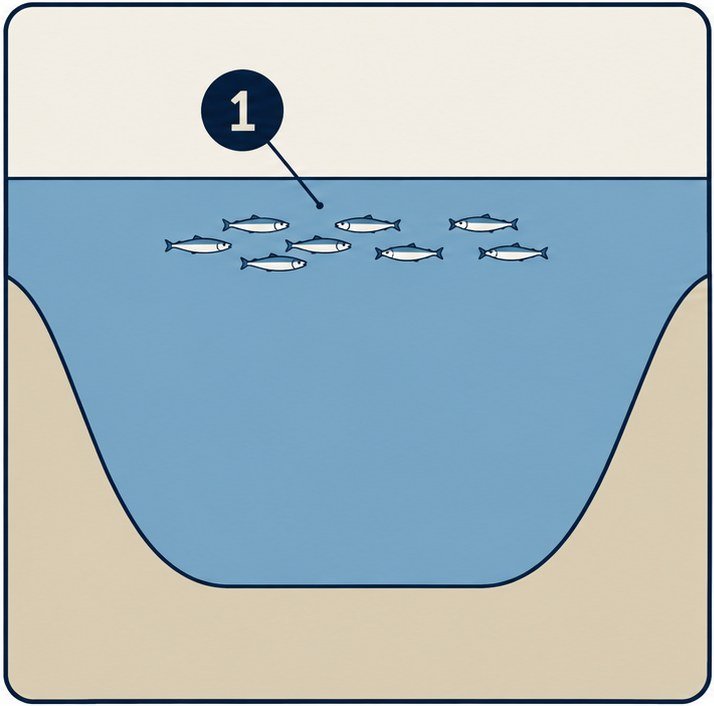

- 1. spring: fish closer to the surface
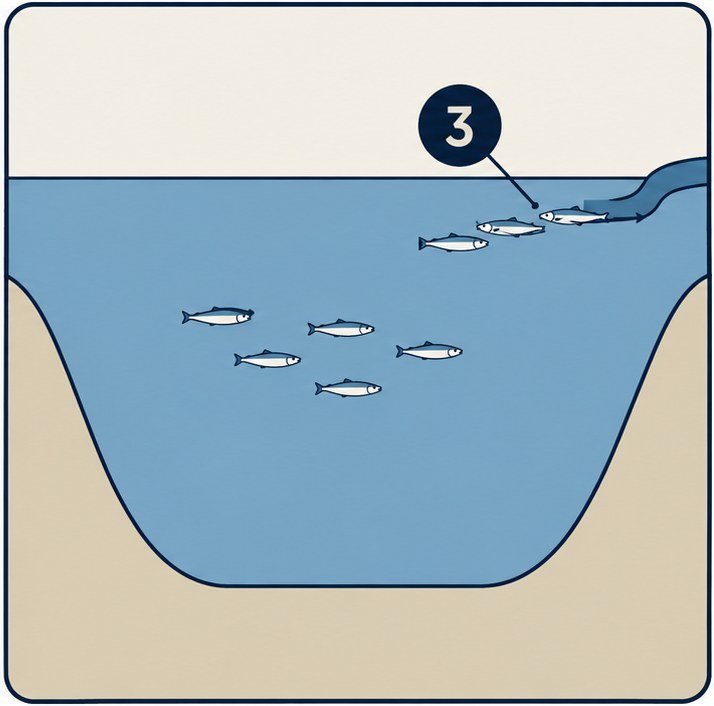
- 2. summer: warm layer on top, fish below the thermocline
- 3. fall: some fish move toward spawning streams near shore
- 4. about 50°F water, the layer kokanee prefer
Check the forecast, including wind. Wind also affects boat control. If you can't hold a steady course, reel in and head back.
Check reservoir levels before you drive. Lake Roosevelt, Lake Merwin and Yale Reservoir can have level changes that make launching hard or leave ramps out of the water.
Brushing Up: Separate surface temperature from fish depth in your notes. The surface reading helps explain conditions, but it doesn't measure the water at your lure.
Rods, Reels, Line and Leader
Start with tackle that cushions the fish and lets you repeat a presentation. A soft rod matters because kokanee have very soft mouths. WDFW's kokanee page recommends a snubber or very soft rods.
Mono means monofilament, a single strand of fishing line. A good starting setup is 10 lb mono main line and a 10 lb mono leader. Keep the leader no heavier than the main line.
A level-wind is a reel guide that moves across the spool to lay line evenly. A line counter is a reel feature that displays line out. Mack's Lure describes that combination as useful for downriggers and long lines.
| Gear | Starting Setup | Why |
|---|---|---|
| Rod | Soft rod, 7 to 8 ft. | A downrigger rod bends deeply. A rod for a dropper weight, a separate weight ahead of the dodger, needs more backbone. |
| Reel | Level-wind reel with a line counter. | Helps repeat the amount of line released. |
| Main Line | Clear 10 lb mono. | Mack's Lure gives 10 lb as a preferred starting strength. |
| Leader | 10 lb mono on 10 lb main line. | Keep it no heavier than the main line. |
| Snubber | Inline rubber shock absorber. | Goes between the dodger and lure. |
| Dodger | Mack's Lure Double D Dodger or Sling Blade Original. | Double D sizes are 4.4, 5.8 and 7.6 in. Sling Blade sizes are 4, 6 and 9 in. |
| Lure | Small hoochie or wedding ring spinner. | Choose leader length to suit its action. |
| Bait | White shoepeg corn, a firm white corn used as bait. | Keep bait clear of the lure's moving parts. |
| Depth Tool | Long line or a trolling weight to start. | A downrigger is an upgrade for reaching and repeating deeper settings. |
| Landing and Storage | Long-handled net and cooler with ice. | Have both ready before fishing. |
Match the rod to the load it will pull. ODFW's kokanee article distinguishes a very flexible downrigger rod from a dropper rod with more backbone. A soft tip is useful, but it doesn't make every rod suitable for every trolling weight.
The reel's drag is the mechanism that releases line under pressure. Check that it releases smoothly. You want controlled pressure when a fish pulls, without clamping everything tight.
Starter Kit vs Upgrade Path
Starter Kit
- A soft 7 to 8 ft rod and a level-wind reel with a line counter.
- Clear 10 lb mono main line and 10 lb mono leader.
- Mack's Lure Double D Dodger or Sling Blade Original.
- Mack's Lure Trolling Snubber between the dodger and the lure.
- Mack's Lure Wedding Ring Classic Original or Pee Wee Hoochie as the lure.
- Pautzke Fire Corn Natural as a prepared corn option.
- Trolling weights of 1 to 3 oz for the dropper approach.
- A long-handled net, cooler with ice and properly fitted life jacket.
Long lining and a dropper weight work without a downrigger. ODFW's kokanee article calls a fish-finder and downriggers very helpful, so add them when you're ready.
Upgrade Path
- Add a fish-finder to help locate the feeding depth.
- Consider a Scotty 1050 Depthmaster for manual downrigger control. The maker describes it as an introductory model.
- Consider side planer boards, floats that carry a line out to the side, to spread lines away from the boat.
Learn the basic rig before you add equipment. Buy an upgrade when it solves a problem you can name.
Three Ways to Get Down
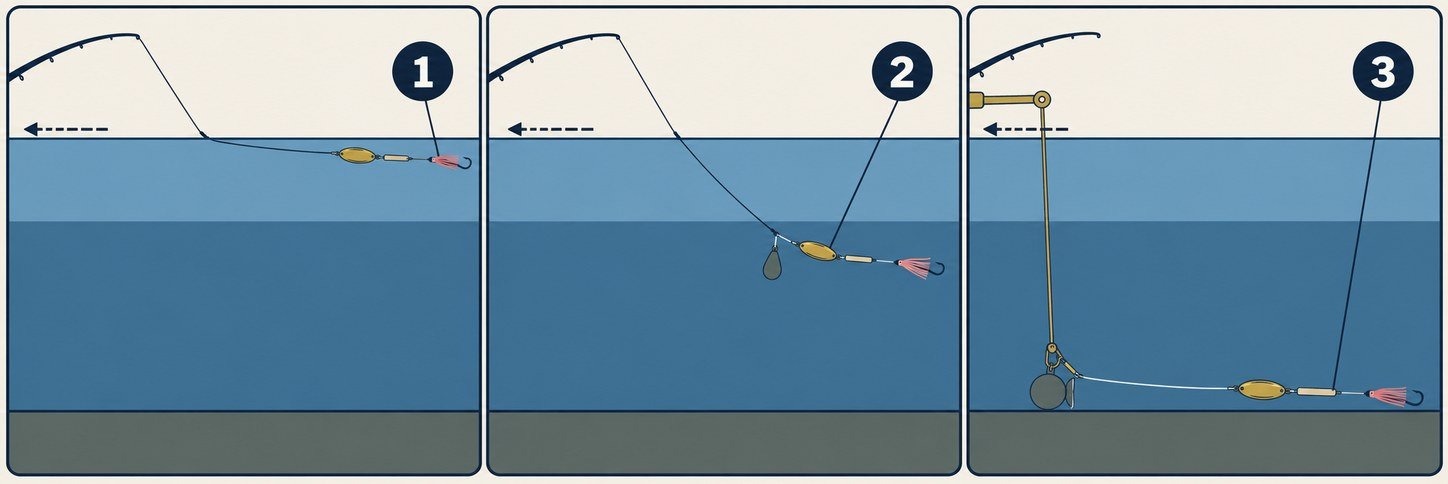
- long line, no weight, about 10 to 12 ft

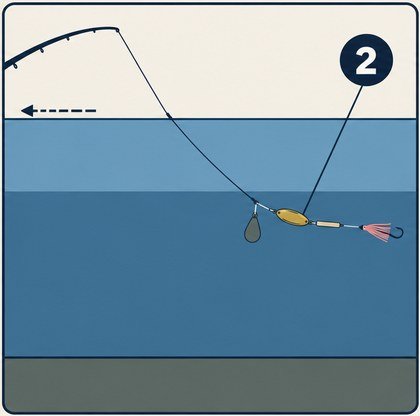
- dropper weight of 1 to 3 oz, as deep as about 40 ft
- downrigger with a heavy ball for deeper fish

- 1. long line, no weight, about 10 to 12 ft
- 2. dropper weight of 1 to 3 oz, as deep as about 40 ft
- 3. downrigger with a heavy ball for deeper fish
Depths: Oregon Department of Fish and Wildlife (ODFW) kokanee article.
Terminal Tackle and Rigging, Step by Step
Lay the parts out in fishing order before connecting them:
Main line → dodger → snubber → leader → lure tipped with corn.
Mack's Lure says its Trolling Snubber goes between the dodger and the lure.
The Kokanee Rig

- 1. 10 lb main line
- 2. dodger
- 3. snubber
- 4. leader, no heavier than the main line
- 5. hoochie or wedding ring spinner
- 6. white corn on the hook
Build the Rig
- Connect the dodger. Start with the dodger ahead of the rest of the rig. The Mack's Lure Double D Dodger has five attachment points and can also serve as a side planer. The Sling Blade Original has a slim shape, cupped at one end and tapered at the other. Pick one and watch it beside the boat.
- Add the snubber behind it. Mack's Lure Trolling Snubber is an inline shock absorber. Its listed length is 3.5 to 4.5 in. Keep it where the maker puts it, between the dodger and the lure.
- Choose leader strength. Use 10 lb mono on a 10 lb mono main line. Never go heavier than the main line.
- Choose leader length for the lure. ODFW's kokanee article gives about 2½ times the dodger length, usually 9 to 24 in. Shorter leaders suit lures without their own action, such as hoochies. Longer leaders suit spinners and spoons.
- Connect the lure. Mack's Lure Wedding Ring Classic Original is hand-tied on mono with a single octopus hook. Mack's Lure Pee Wee Hoochie comes in 1.5 and 2 in sizes with a #4 hook. The maker describes trolling it behind a Sling Blade.
- Add bait and test. ODFW's kokanee article describes white shoepeg corn, shrimp or maggots as hook toppings. Keep the hook and moving parts clear. Pull-test the connections and watch the complete rig before sending it away.
Leader Length and the Dodger

- 1. rule of thumb: leader about 2½ times the dodger, usually 9 to 24 in
- 2. hoochie: shorter leader
- 3. wedding ring spinner: longer leader
Source: Oregon Department of Fish and Wildlife (ODFW) kokanee article.
Leader length is a starting choice, not a universal formula. WDFW's fishing planner uses 12 to 20 in for Lake Roosevelt. Start with ODFW's rule of thumb, then watch the lure before you change length.
Corn, Color and Scent
Idaho Fish and Game's kokanee tips suggest keeping something pink available. ODFW's kokanee article names pink, orange and chartreuse as useful colors. WDFW's kokanee page describes silver, red or orange spoons and spinners. None is a promise for every lake or trip.
ODFW's kokanee article describes tuna oil, garlic or anise scent and pink or orange dye. Keep scent containers closed and away from surfaces you need to grip.
Pautzke Fire Corn Natural is a prepared corn bait cured with krill scent. Check the lake's bait rules before you use any bait.
For Lake Roosevelt, WDFW's fishing planner describes a kernel or two of white shoepeg corn, followed by scent.
Getting to Depth
Long lining means trolling a long length of line without a separate sinking weight. ODFW's kokanee article describes a heavier dodger with 100 to 150 ft of line. It reaches about 10 to 12 ft in that example.
A dropper weight is a separate weight ahead of the dodger. ODFW's kokanee article describes 1 to 3 oz as a common choice. The approach can reach about 40 ft, depending on weight, line length and speed. Lead core line is fishing line with a weighted core that helps it sink. It's another option in that article.
A downrigger ball is the heavy weight lowered on a downrigger cable. ODFW's kokanee article describes downrigger weights of 6 to 10 lb. It favors a downrigger when the alternative calls for more than 6 oz of trolling weight. Follow the equipment maker's load guidance for your own setup.
Side planer boards solve a different problem. WDFW's fishing planner describes carrying lines 100 to 150 ft away from the boat on Lake Roosevelt. That's distance to the side, not fishing depth. The Mack's Lure Double D Dodger can also double as a side planer.
Don't mix up that side distance with the 100 to 150 ft of line ODFW's long-lining example lets out behind the boat.
Behind the Boat and to the Side

- 1. long line: 100 to 150 ft of line out behind the boat (ODFW's kokanee article)
- 2. planer board: line carried 100 to 150 ft out to the side (WDFW's fishing planner, Lake Roosevelt)
- 3. same numbers, different directions
Technique, Step by Step
How It Works, Step by Step
- Pick a starting depth. Use water temperature and a fish-finder if you have one.
- Set the gear at that depth. Use the depth tool that suits the fish you find.
- Troll slowly. ODFW's kokanee article gives 0.8 to 1.6 mph. Watch the lure too, not only the speed reading.
- Watch the dodger beside the boat. Look for controlled movement. If the tackle tangles or the lure stops working, retrieve and correct it before continuing.
- Make gentle S-turns. An S-turn is a curved, side-to-side trolling course. ODFW's kokanee article says S-turns can often bring a bite.
- Inspect the rig. Check bait, hook points, leader and lure movement after a suspected bite or tangle. A clean rig tells you more about what to change.
- Watch the rod. Learn its normal movement while trolling. Watch for a deeper bend or a sudden bounce. Keep the handle easy to reach and the landing area clear.
S-Turns While Trolling

- 1. trolling path curving left and right
- 2. two trailing lines following the curve
S-turns can often bring a bite
Source: Oregon Department of Fish and Wildlife (ODFW) kokanee article.
Trolling Speed
ODFW's kokanee article says to troll slower than you would for salmon.
WDFW's fishing planner gives 1.3 to 1.5 mph for Lake Roosevelt, with no faster than 1.7 mph in that advice.
A product's operating range is different again. Mack's Lure lists the Sling Blade Original as trolling up to 2.4 mph. That's the blade's top speed, not a kokanee trolling speed.
Reading the Lake
Start with temperature and open water. Kokanee feed on plankton and prefer water near 50°F. As the surface warms, look deeper rather than assuming fish stayed at the last useful setting.
ODFW's kokanee article calls a fish-finder very helpful. Find the marks, then set your gear at that depth and make the next pass easy to repeat.
Reading the Fish Finder

- 1. thermocline band
- 2. school of fish marks at one depth
- 3. gear set at that depth
Brushing Up: Read marks as clues. Compare repeat passes, gear depth and the fish you actually land.
Worked Examples
These are plans, not catch reports. Each starts the same way: check the rules and conditions, find the depth, then choose how to reach it.
Spring on Lake Stevens
Rules change by lake and in season. Check the current WDFW sport fishing regulations and emergency rules before every trip.
Check the forecast and the lake level, then find the fish's depth before you set.
Lake Stevens has stocked kokanee and WDFW access with a boat ramp. This plan assumes fish are still close to the surface.
WDFW's kokanee page says late-spring plankton blooms can bring kokanee closer to the surface. Long lining or a light dropper weight can reach them without a downrigger.
Choose a dodger and hoochie. Start with a shorter leader, as ODFW's rule of thumb suggests for a hoochie. Tip the hook with white shoepeg corn after checking the lake's bait rules.
Make gentle S-turns and inspect the rig before changing color or leader length.
Summer on Lake Chelan
Rules change by lake and in season. Check the current WDFW sport fishing regulations and emergency rules before every trip.
Check the forecast and the lake level, then find the fish's depth before you set.
This example starts with a warm surface layer and fish deeper, near the thermocline. WDFW's kokanee page describes fish holding in deeper offshore water through summer.
Use a downrigger to put the lure at the depth you find.
Keep the next pass repeatable before changing the lure.
Keep lines apart so they don't tangle.
If you can't find fish, keep searching before you add tackle. A downrigger sets depth. It doesn't find fish.
Winter Into Spring on Lake Roosevelt
Rules change by lake and in season. Check the current WDFW sport fishing regulations and emergency rules before every trip.
Check the forecast and the lake level, then find the fish's depth before you set.
WDFW's fishing planner gives January through April as Lake Roosevelt's peak kokanee period. That's a best time, not a season. Water-level changes can make launching hard, so check access conditions before the drive.
The planner describes fishing 10 to 15 ft down, often no deeper than 25 ft. Find the fish before copying those settings.
For a side-planer approach, the planner describes lines 100 to 150 ft away from the boat. Keep that side distance separate from line out behind the boat.
Use the planner's 12 to 20 in leader example. Its speed advice is 1.3 to 1.5 mph, with no faster than 1.7 mph. Those are presentation notes, not lake rules.
The planner's bait example uses a kernel or two of white shoepeg corn and scent. Check current bait rules before rigging.
Yale Reservoir Without a Downrigger
Rules change by lake and in season. Check the current WDFW sport fishing regulations and emergency rules before every trip.
Check the forecast and the lake level, then find the fish's depth before you set.
WDFW's Yale Reservoir page says shallow fishing is best in spring and fall and deep fishing is best in summer. Changing levels can leave ramps out of the water.
For shallow fish, consider long lining. ODFW's kokanee article describes 100 to 150 ft of unweighted line behind a heavier dodger, reaching about 10 to 12 ft.
A 1 to 3 oz dropper weight offers another approach. ODFW's example can reach about 40 ft, depending on weight, line length and speed. Make gentle S-turns rather than holding a straight course at an unchanged speed.
If fish are deeper than about 40 ft, that's downrigger water. Without one, that's a good place to stop. Don't add more weight than your tackle handles.
The Bite, Hook Set, Fight and Landing
A bite can change the rod's normal pulse or pull it into a deeper bend. Pick up smoothly and begin reeling without giving the fish slack.
Avoid a hard sweep. Kokanee have very soft mouths. ODFW's kokanee article favors a slow, steady retrieve with light gear. Let the rod bend and keep the pressure even.
Losing some hooked fish is normal. ODFW's kokanee article calls lost fish part of the kokanee game. Don't respond to a lost fish by tightening everything harder.
Keep the net within reach before the bite. ODFW's kokanee article calls a long-handled net very helpful. Bring the fish within a controlled reach and move the net under it.
Avoid lifting a fish into the boat by the line. Keep your movement calm and your balance secure. If another person handles the net, agree on who will move where before the fish arrives.
Handling and Release
Check the lake's current rules for what you may keep. That includes trout and other fish you encounter while trolling.
For fish you keep, ODFW's kokanee article advises bleeding them and getting them on ice as quickly as possible. Kokanee have delicate flesh. Prepare the cooler before fishing so a landed fish doesn't start a search for ice.
For release instructions and species-specific handling rules, check WDFW's sport fishing regulations. Rules differ by lake, so don't carry one lake's rules to another.
Common Mistakes and Fixes
| Mistake | What You Notice | Fix |
|---|---|---|
| Speed chosen without checking the rig | Lure movement looks wrong or the leader tangles | Retrieve, clear the rig and inspect its action beside the boat. |
| Depth copied from an earlier trip | Gear stays at an unchanged setting despite different conditions | Find the feeding depth again. |
| Hard hook set | Contact is lost after a sharp sweep | Lift smoothly and reel steadily. |
| Rod too stiff for the presentation | Little cushioning during the fight | Use a soft rod and the snubber arrangement described above. |
| Net out of reach | You scramble as the fish reaches the boat | Prepare a long-handled net before setting tackle. |
| Hoochie leader too long for useful action | Little movement reaches the lure | Use a shorter leader for a hoochie and test. |
| Leader stronger than main line | A break-off takes the dodger and the rest of the rig | Use a 10 lb leader on a 10 lb main line. |
| Line behind the boat confused with side-planer distance | Measurements describe different directions | Separate distance behind the boat from distance to its side. |
| Too many changes together | You can't tell what helped | Change depth, speed or lure separately. |
Tips That Make the Difference
- Find depth before shopping for a solution. A basic weighted rig can start the process.
- Check movement close to the boat. Look at the complete rig with bait attached. Clear tangles before judging a color.
- Carry a pink option. ODFW's kokanee article names pink among its preferred colors. Other colors catch fish too.
- Keep scent separate from depth control. ODFW's kokanee article describes several scents, but scent doesn't tell you where the fish are.
- Keep the net ready. ODFW's kokanee article calls a long-handled net very helpful.
- Prepare the ice first. ODFW's kokanee article advises chilling kept fish quickly.
Brushing Up: Label spare leaders by lure type and length. That makes a deliberate change easier than rebuilding from memory while the boat is moving.
When It's Slow
Start with the rig. Is the bait still attached? Is the leader wrapped around the lure? Does the dodger move freely? Retrieving to answer those questions is more useful than towing a tangled setup longer.
Then check depth. Move the gear up or down and make the next pass repeatable. Use a fish-finder if you have one.
Change speed on its own, using the ranges in Technique. Try a gentle turn and watch how the presentation changes.
Next, try color or leader length. Match leader changes to the lure's action. A hoochie takes a shorter leader than a wedding ring spinner.
Move to another part of the lake when the present search is no longer useful. Save enough notes to know what you have tested. Before you switch methods, see the method pages below.
Safety
Trolling keeps you on open water, often on big lakes and reservoirs. Set up the boat before the first line goes out.
- Life jackets: Wear a life jacket that fits. Washington State Parks says to carry a properly fitted U.S. Coast Guard-approved life jacket for each person. Check its life-jacket guidance for the children's and throwable rules.
- Boater education: Check Washington State Parks' boater education rules, especially if you run a motor.
- Cold water: Many Washington waters stay under 60°F most of the year. Cold water shock is a risk even when the air feels warm. Read Washington State Parks' cold-water guidance.
- Wind and weather: Check the forecast from the NWS Seattle, NWS Spokane or NWS Portland forecast office for your lake, including wind, before you leave. Give big lakes and reservoirs room in your plan. Turn back before boat control gets hard.
- Water levels: Check Lake Roosevelt, Lake Merwin and Yale Reservoir levels before you drive. Changing levels can make launching hard or leave ramps out of the water.
- Other boats: Look around before you turn or let out more line. Leave room for another boat's course and trailing gear.
- Downrigger cables: Keep cables clear of hands and the propeller. Stop and sort out a problem before you go on.
- Loose tackle: Contain hooks and weights. Keep the walking area and net space clear.
- Cold and rain: Dress in layers and carry a waterproof outer layer. Plan for sitting still as well as moving around.
- Boat movement: Tell others before you change speed or course. Someone handling tackle may not be watching the water ahead.
WDFW Rules to Check
Check the exact lake before choosing your tackle and retention plan. WDFW sets freshwater rules statewide and by lake, with changes through emergency rules.
- Is the lake open when you plan to fish?
- What applies to kokanee daily limits and any size rules?
- What trout rules apply, including whether trout may be kept?
- What rules apply to other species you might catch?
- Are there special rules for the individual lake?
- What rules cover the number of lines per angler and whether a second rod is allowed?
- What boat restrictions apply, such as speed limits or motor restrictions?
Lake Roosevelt's WDFW page points to special trout and kokanee rules.
Use WDFW's sport fishing regulations and the Fish Washington app to check your plan.
Rules change by lake and in season. Check the current WDFW sport fishing regulations and emergency rules before every trip.
Learn More
- Washington Department of Fish and Wildlife (WDFW): Kokanee — fish identification, food, temperature and method basics.
- WDFW Lowland Lakes — species and access information by lake.
- WDFW Fishing Planner, Part One — Lake Roosevelt kokanee planning and presentation advice.
- ODFW: Kokanee Fishing in Oregon — general tackle, depth tools and fish-care instruction.
- Fish Washington App — another way to review fishing rules.
- WDFW Sport Fishing Regulations and Emergency Rules — check before every trip.
- NWS Seattle, NWS Spokane and NWS Portland Forecast Offices — weather and wind by lake.
- Washington State Parks Life Jackets and Cold-Water Safety — before a day on the water.
Glossary
- Dodger
- Thin blade that sways in the water ahead of a lure.
- Downrigger
- Winch that lowers fishing gear with a heavy weight.
- Downrigger Ball
- Heavy weight lowered on a downrigger cable.
- Drag
- The reel mechanism that releases line under pressure.
- Dropper Weight
- Separate weight ahead of the dodger that helps tackle sink.
- Fish-Finder
- Electronic display of depth and underwater returns.
- Gang Troll
- String of trolling blades pulled ahead of a lure.
- Hoochie
- Small plastic squid lure.
- Kokanee
- Landlocked sockeye salmon.
- Lead Core Line
- Fishing line with a weighted core that helps it sink.
- Leader
- Line between the dodger and the lure.
- Level-Wind
- Reel guide that moves across the spool to lay line evenly.
- Line Counter
- Reel feature that displays line out.
- Long Lining
- Trolling a long length of line without a separate sinking weight.
- Mono
- Monofilament, a single strand of fishing line.
- Planer Board
- Float that carries a fishing line out to the side of a boat.
- Plankton
- Tiny organisms drifting in the water.
- Reservoir
- Lake held back by a dam.
- S-Turn
- Curved, side-to-side trolling course.
- Shoepeg Corn
- Firm white corn used as bait.
- Snubber
- Rubber shock absorber that cushions pulls on the rig.
- Spinner
- Lure with a blade turning around a wire shaft.
- Spoon
- Curved metal lure that wobbles side to side.
- Thermocline
- Layer where warm surface water gives way to colder deep water.
- Wedding Ring Spinner
- Small spinner with beads and a blade.
Guides Who Specialize in This
Guided kokanee trips run from a boat; the rigs on this page work from your own boat and need no guide.
Ask your guide for their WDFW guide license number before you book.
More Lakes and Other Methods
Explore Still Water for lake-fishing context, Trolling for the broader method, Jigging for vertical presentations and Spoons and Spinners for those lure types.
At a Glance
| Field | Summary |
|---|---|
| Main Species | Kokanee. |
| Water | Washington lakes and reservoirs. |
| In Short | Troll slowly with a dodger, snubber, short leader and small corn-tipped lure at the fish's depth. |
| Skill Level | Finding depth and repeating a presentation take practice. |
| Key Gear | Soft 7 to 8 ft rod; level-wind reel with line counter; 10 lb mono main line; 10 lb mono leader, no heavier than the main line; snubber; dodger; hoochie or wedding ring spinner; white shoepeg corn; suitable depth tool; long-handled net and ice. |
| Starting Depth Tools | Long line or trolling weights; a downrigger reaches deeper fish. |
| Conditions | Follow temperature, feeding depth, wind and reservoir levels. |
On This Page
- What It Is and When It Beats Other Methods
- Target Species and Where in Washington
- Kokanee Lakes in Washington
- Seasons and Conditions
- Rods, Reels, Line and Leader
- Terminal Tackle and Rigging, Step by Step
- Technique, Step by Step
- Worked Examples
- The Bite, Hook Set, Fight and Landing
- Handling and Release
- Common Mistakes and Fixes
- Tips That Make the Difference
- When It's Slow
- Safety
- WDFW Rules to Check
- Learn More
- Glossary
- Guides Who Specialize in This
- More Lakes and Other Methods